Featured guide
Oracle Audit Letter First 48 Hours
Your first reply to an Oracle audit letter sets the tone for the whole audit. A step-by-step protocol for what to send, what to hold and who speaks.
Read the guide
Plain-language articles on licensing rules, audit tactics and AI contract terms, written from the buyer's side of the table. No vendor sponsors this page, so nothing here is softened for one.
Your first reply to an Oracle audit letter sets the tone for the whole audit. A step-by-step protocol for what to send, what to hold and who speaks.
Read the guideAn Oracle audit is now a business negotiation across IT, procurement, finance and legal. How Oracle's approach shifted and where it is looking in 2026.
Ten Oracle licensing traps that quietly turn customer confusion into publisher revenue, and the first move against each one.
Certification turns unlimited deployment rights into a fixed, perpetual grant. The five-step checklist that decides what you keep when your Oracle ULA ends.
A ULA is sold as freedom to deploy. The provisions buried in the paperwork, and how ready you are when they come due, decide whether it was worth it.
How a well-run bank failed its Oracle ULA certification and renewed for US$4.5 million to cover licences it did not need, and how it was later fixed.
Oracle now prices Java on headcount, not usage. How to measure your real Java exposure under the employee metric, and shrink it, before Oracle emails you.
Customers overpay Oracle because of three beliefs that hand it the advantage. Why internal-only negotiation costs money and what an independent adviser changes.
Do Oracle ULA licenses expire? Must you renew? Does certifying more raise support costs? The 10 ULA beliefs that cost customers money, and 5 moves to make.
Do Oracle standby servers need licences? Oracle's rules for Data Guard, failover clusters, the 10-day rule, mirroring, backup tests and cloud recovery.
Oracle Database costs $47,500 per processor at list, plus 22% support a year. Options, packs, Named User Plus, Standard Edition 2 and cloud costs, worked out.
What Oracle license compliance means, the gaps that cost most (options, VMware, standby, cloud, Java), how to measure your position and how to stay compliant.
How Oracle licensing works: licences and 22% support, processor and Named User Plus metrics, editions and options, VMware, cloud, disaster recovery and ULAs.
AI token prices fell about 8x in a year. Why cheaper AI is a reason to spend more on new work, and how to buy it model-agnostic, without vendor lock-in.
Enterprise AI stopped being a subscription and became a meter. Why AI bills exploded in 2026, from Uber to Meta, and how to govern AI as a variable cost.
How Oracle counts licences on Microsoft Azure: two vCPUs per processor licence, Standard Edition 2 limits, ULA certification, Database@Azure and the traps.
How to use the Oracle Processor Core Factor Table: the 2026 factors for Xeon, EPYC, Ampere, POWER and SPARC, worked examples, and where it does not apply.
How Oracle WebLogic Server is licensed in 2026: Standard, Enterprise and Suite prices, socket vs core counting, Named User Plus minimums and audit traps.
Oracle's Partitioning Policy says it is 'for educational purposes only'. Why it does not bind you on VMware, and a three-step defence for VMware audit claims.
Oracle's Java metric changes and audit risks, and how Euladox discovery and SAM-as-a-Service find every Java installation and keep you compliant.
How to reduce software licensing costs: build your effective licence position, remove unused licences, fix the metric, negotiate on your data, use alternatives.
Flexera, Snow, ServiceNow, USU (Aspera), Ivanti, ManageEngine, Lansweeper and more: what each SAM tool is best for, what to watch for, and how to choose one.
How an Oracle license audit runs: notice, declaration, scripts, analysis, findings and the commercial proposal, what triggers one and how to handle each step.
DeepSeek showed what doing more with less looks like. What it teaches about Oracle and enterprise software costs, and how far those costs can come down.
How Oracle Java licensing changed, from free updates to per-employee pricing, and how our Java License Assessment finds your exposure and cuts it, often to 0.
OpenJDK or Oracle JDK? The licensing and support differences IT leaders need to understand before moving to cut Oracle Java costs.
The basic rules Oracle uses to license on-premises software: where products are installed and running, physical and virtual platforms, and application users.
The Oracle CSI (Customer Support Identifier) explained: what it is, why you hold several, and why CSI numbers matter in license audits and support renewals.
Five Oracle trends shaping spend in 2026: ULA renewals, cloud credits, Exadata as a service, Java per employee and audits, and how to optimise Oracle licences.
A new CIO at one of our clients compares Rythium's Oracle Java license review with the advisors the company used before.
Oracle BYOL lets you use on-premises licences in the cloud. The rules for AWS, Azure and Google Cloud, the OCI mapping, and the 100-day migration window.
How Oracle licensing works in Authorized Cloud Environments: vCPU rules, no core factor, Standard Edition socket limits, and ULA licences in the cloud.
Run your own Oracle license audit before Oracle does: collect contracts, find every installation, check options, packs and Java, count by Oracle's rules, fix.
How Oracle license audits work and how to prepare: types of audit, who runs them, the stages, triggers, Oracle's remedies, ULA and Java risks, and our defence.
Most Oracle customers either pay what is demanded or settle for the first discount. Where Oracle's leverage comes from, and how to reduce Oracle license costs.
How Oracle Database is licensed on AWS, Azure, Google Cloud and OCI in 2026: the vCPU rule, Standard Edition 2 limits, ULAs and the traps in cloud moves.
The five Oracle Database licensing gaps we find most: options and packs, VMware, Standard Edition 2 limits, standby servers and the cloud, and how to fix each.
What an Oracle license review covers, when to run one, the gaps and savings it usually finds, and why it should be independent of Oracle's own licence reviews.
The ten Oracle licensing and cost problems Rythium saw across 39 customers in India, the Middle East and Africa, from ULA pushback to rising support fees.
Updates to Oracle Java SE 17 are no longer free after September 2024. What changes for organisations running Java 17, and how to respond.
How Oracle ULA certification works, the choice between certifying and renewing, why forced ULA renewals happen, and what to do months before the term ends.
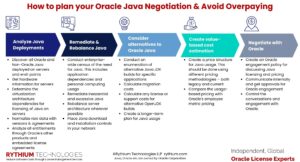
Five steps to optimise Oracle licence costs: visibility, remediating unlicensed features, rebalancing architecture, negotiating and continuous monitoring.
A checklist of 35 Oracle Database licence compliance issues, from miscounting processors and option usage to DR, cloud, cloning and mergers.
Oracle ESL, ASFU and Full Use licenses compared, with restricted use, proprietary hosting and included licenses: what each allows and who is liable.
Oracle Technology Global Price List of 15 Sep 2026: its sections and columns, key list prices for Database, options and WebLogic, and how to calculate licences.
Licensing Oracle on AWS, Azure and Google Cloud: the vCPU equivalence, why the core factor table does not apply, NUP minimums and Standard Edition rules.
JDeveloper is free to use, but its licence has limits: the editions, what the OTN developer terms allow, and the WebLogic single-prototype restriction.
What Oracle Enterprise Manager includes at no cost with your Oracle licences, and which management packs and plug-ins must be bought separately.
The most common Oracle licence compliance issues, from options and packs to NUP counting, VMware, restricted-use contracts and M&A, with best practices.
An Oracle licence assessment that mirrors an audit: discovery scripts and scans, contract analysis, Effective License Position, and optimisation advice.
How an Indian bank facing a sharp Oracle Java cost increase cut its Java licensing costs by 85% through deployment optimisation and negotiation.
Java licensing changes come with confusing terms. A plain guide to the general, contractual and licence terminology enterprises need to understand.
The open-source alternatives to Oracle Java SE built on OpenJDK, compared from a licensing point of view, without recommending any vendor.
Beyond the licence fee, Java SE licensing carries hidden costs from oversights and licensing gaps. How to find them before they hit your budget.
What triggers an Oracle audit, how the process runs, and how to prepare documentation, review usage and negotiate a settlement with an independent adviser.
The Oracle products that let you use Java without an extra purchase, under Approved Product Use in the OTN License Agreement for Oracle Java SE.
What the Oracle Exadata Database Machine is: an engineered system for fast OLTP and data warehousing on very large databases, and the bottleneck it removes.
Recent Java licensing changes have raised costs sharply. How Rythium's Java License Assessment Service measures and limits your exposure.
Oracle's Java pricing turned a free product into a real cost. A worked example for a 10,000-employee firm, and how customers move to zero-cost Java.
Why Oracle audits, how the process runs, and settling well.
Oracle pricing and contract terms keep changing. How Rythium advises customers on the commercial and contractual terms to negotiate with Oracle.
Oracle moved Java from user and processor licensing to an employee metric in January 2023. What that means for cost, and the alternatives open to you.
How Oracle's Unlimited License Agreement works, why it is one of the most popular Oracle licensing options, and how it can turn from benefit into liability.
What Oracle support really costs, what third-party support for Oracle covers and costs, who should consider it, and when it is legal. With a worked example.
Ten questions to ask any Oracle licensing consultant: are they a reseller or partner, do they know the contracts, and can they cut the claim?
Rythium's referral partner programme for Oracle licence management services: how partners earn and how their customers benefit.
Rythium's Java License Assessment Service and Analyzer give a deep view of your Java usage, so you avoid compliance penalties in an Oracle Java audit.
The complete Oracle ULA guide in one place: what a ULA is, its key features, myths, glossary, benefits and risks, pricing, certification and renewal.
Rythium Technologies announces the Java License Analyzer, a tool that brings visibility and analytics to Oracle Java licensing changes and Java costs.
Oracle Java licence changes have made Java costly. What to weigh when choosing between Oracle Java and non-Oracle JRE and JDK options.
Oracle says the Java licence change made things simpler; for most customers it made Java far more expensive. A critical look at what Java should cost.
The key terms used in Oracle ULA contracts, in alphabetical order, from Accelerated Certification Date onwards. Knowing them prevents ULA problems.
Oracle is especially aggressive with audits around ULA certification and renewal. The issues customers met in 2024 and how to prepare for them.
How Oracle ULA merger and acquisition clauses work, the licensing due diligence they demand, and what to settle with Oracle before a deal closes.
The events that should trigger an internal Oracle licence audit: new data centres, hardware refresh, DR, cloud moves, M&A, virtualisation and ULA milestones.
Oracle has started closing Java deals on the new employee metric in the USA, Europe and India. What the deals look like and what to do now.
A 12-step process for the end of an Oracle ULA term: plan, count deployments, weigh certification against renewal and choose the option that costs least.
Oracle's Java licence changes make Java very expensive. How to plan your budget and your engagement with Oracle to avoid overpaying and compliance risk.
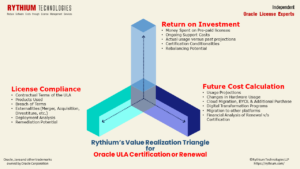
Rythium's ULA Value Realization Triangle, a framework to weigh the risks and benefits of an Oracle ULA and decide between certification and renewal.
Since Oracle's Java licence changes, knowing where Java is installed has become essential. The reasons to analyze Java deployments now.
Check every Java deployment, Oracle and non-Oracle, with Rythium's Java License Analyzer, and calculate the commercial value of your Java usage.
ULA Certification Case Studies. Examples of customers who have successfully certified (exited) or renewed their Oracle ULA
What Oracle 19c on Ampere ARM (core factor 0.25) and Exadata X10M on AMD EPYC (core factor 0.5) mean for your Oracle licence count.
Oracle SE2 replaced Standard Edition and SE One and is limited to two-socket servers. What to check before you migrate.
When a failover server needs no Oracle licence: the ten-day rule, the clustered shared-storage conditions, how partial days count, and older OLSA wording.
Ten yes-or-no questions that show how likely an Oracle licence audit is, from virtualisation and DR to old metrics and recent acquisitions.
Why removing unused software after an internal licence audit lowers compliance risk, security exposure and cost, and the steps to do it safely.
Mars took Oracle to court in San Francisco to limit an Oracle license audit under its 1993 agreement. What the case showed about Oracle's audit practices.
An Oracle PULA is a ULA without the end date. How the two differ, why the PULA carries bigger risks, and what to check before you sign either agreement.
Four beliefs about software audits that cost companies money: only big firms get audited, only Microsoft audits, contracts mean compliance, nothing helps.
Famous EULA clauses, from iTunes banning nuclear weapons to audits at any hour, and five enterprise licence clauses that cost real money when nobody reads them.
We use cookies for analytics and ads, only if you agree. Privacy Policy