
Oracle Multicloud Universal Credits (MUC) let you buy OCI and Oracle AI Database on AWS, Azure and Google Cloud under a single commitment. This guide explains how the MUC contract is built, who can use it, how billing and true-ups work, and where the flexibility stops.
Sheshagiri Anegondi’s view: Oracle’s MUC is a good licensing model, but customers should not use it as a hedge against uncertainty.
In short
- One contract, many bills. A single primary subscription holds the commitment, term and rate card. Usage runs on separate OCI and hyperscaler subscriptions, invoiced by Oracle and by each cloud provider.
- A shared pool at the top, fences underneath. Every cloud draws down the same Oracle commitment, but the commitments on each hyperscaler marketplace are use-them-or-lose-them and can’t be moved.
- Unused credits are billed every year. Oracle invoices unused credits at the end of each annual period, not just at the end of the term.
- Walking away is expensive. Without renewal, Oracle AI Database@ consumption on AWS, Azure and Google Cloud moves to list price.
- New money only. Existing Universal Credits commitments and existing private offers cannot be converted. USD only, direct purchase only.
What Oracle announced
For most enterprises, running Oracle Database across more than one cloud has meant more than one Oracle deal: one arrangement on Oracle Cloud Infrastructure (OCI), a separate private offer on Azure, another on AWS, each with its own commitment, discount and renewal date. Oracle Multicloud Universal Credits are designed to fold those into one.
Oracle announced MUC at Oracle AI World in Las Vegas on 14 October 2025, describing it as “the industry’s first flexible, cross-cloud consumption model.” It became generally available on 9 March 2026. Oracle’s documentation defines it as a licensing option that lets you procure Oracle AI Database and OCI services “in the cloud of your choice.”
A single MUC commitment can be used across four environments:
- Oracle Cloud Infrastructure (OCI): eligible OCI services under the Universal Credits model
- Oracle AI Database@AWS
- Oracle AI Database@Azure
- Oracle AI Database@Google Cloud
| MUC at a glance | |
|---|---|
| 1 | Contract, term and rate card across all clouds |
| 4 | Environments: OCI plus three hyperscalers |
| USD | The only currency accepted today |
| Yearly | Unused credits invoiced each annual period |
Oracle’s case for it
Oracle’s documentation sets out three benefits:
- One contract, any cloud. A single licensing option that reduces the overhead of multiple contracts and commitments.
- Unified pricing and rate card. One negotiated rate card across the entire database estate, whichever cloud it runs in.
- True cloud choice. Credits can be applied in any available OCI, AWS, Azure or Google Cloud region to meet compliance, performance or proximity needs.
Those benefits name the real problem. The technology for running Oracle Database inside other clouds already existed; what slowed adoption was buying it in four places, on four sets of terms. MUC addresses the paperwork. Whether it also lowers cost depends on how well the commitment is sized, which is where the detail matters.
“Oracle Multicloud Universal Credits (MUC) tries to provide a solution to the problem of making multiple procurements when deploying Oracle database on more than one public cloud. But one contract is not the same as one pool of money, and that difference decides whether MUC actually saves you anything.”
Sheshagiri Anegondi, Managing Partner, Rythium Technologies, former Oracle Vice-President
How the MUC contract is structured
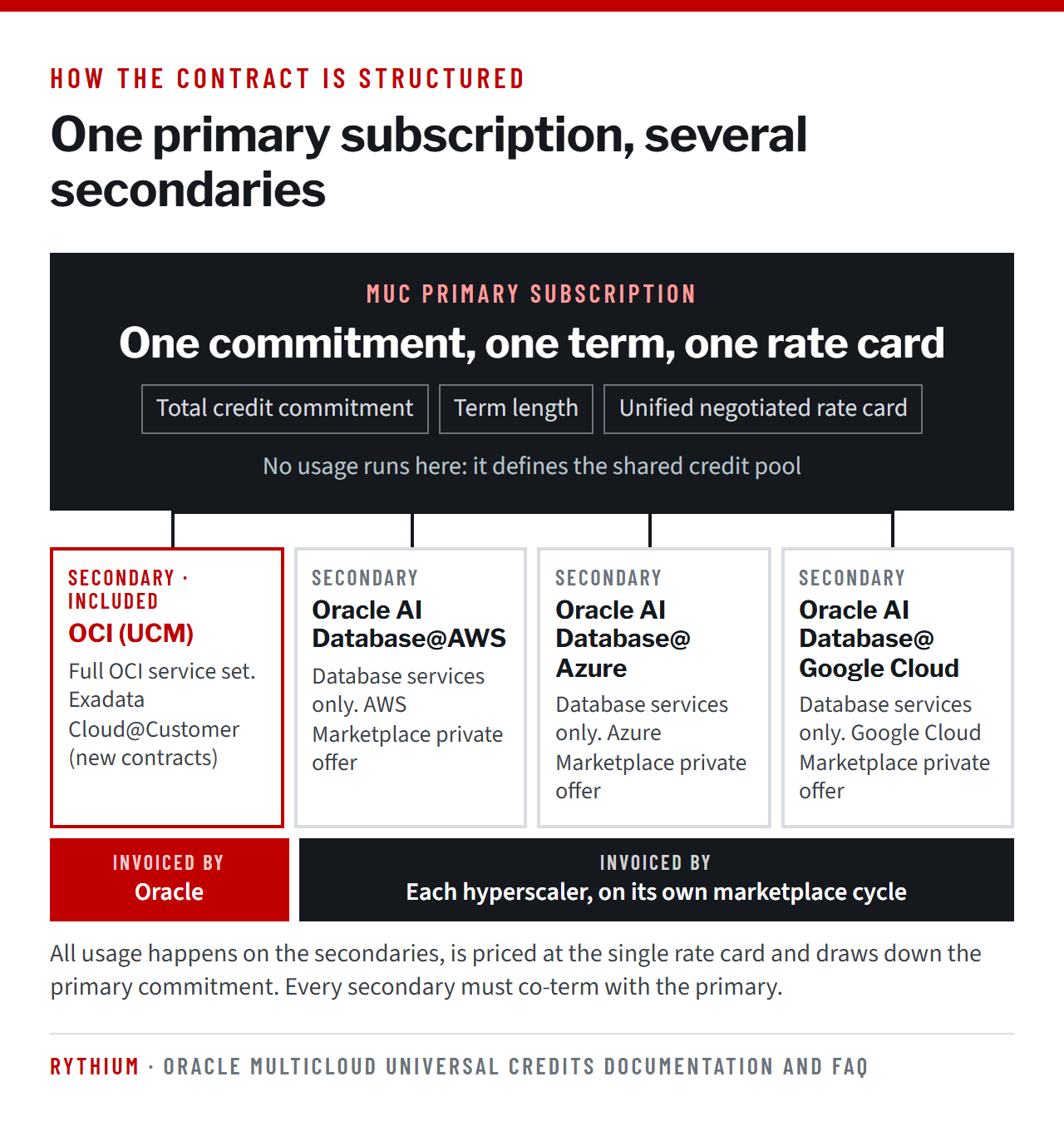
Oracle’s documentation describes a primary subscription linked to several secondary subscriptions.
- MUC primary subscription. Holds the total credit commitment, the term length and the rate card. No usage runs on it directly. In Oracle’s words, it “defines the shared credit pool that all subordinate subscriptions draw from.”
- Secondary subscriptions. One per cloud: an OCI subscription (Universal Credits, included by default) and an Oracle AI Database@ private offer on each hyperscaler marketplace. All actual usage happens here, priced at the unified rate card and drawn down from the primary commitment.
- Co-terming. Every secondary subscription must co-term with the MUC primary subscription. Rate card pricing and term length cascade from the primary to all secondaries.
Three details that are easy to miss
- Database services only on the hyperscalers. Oracle AI Database@AWS, @Azure and @Google Cloud provide Oracle AI Database services only. Other OCI infrastructure services come through the OCI subscription included in the contract.
- Exadata Cloud@Customer counts, in a new contract. Exadata Cloud@Customer usage on a Universal Credits subscription is eligible when it is included in a new MUC contract.
- One rate card regardless of where usage occurs. Oracle states that all secondary usage is calculated against the single rate card “regardless of which cloud provider generated the usage.”
Who can use Oracle Multicloud Universal Credits today
The eligibility rules are narrower than the headline suggests. Oracle’s FAQ says MUC is for customers planning workloads on at least two of AWS, Azure and Google Cloud. Its technical documentation is slightly broader, describing new multicloud customers as those using OCI “with one or more hyperscaler partners”. Confirm which test applies to you with Oracle before you plan around it.
| Situation | Status | What Oracle says |
|---|---|---|
| New commitment, new or existing Oracle customer | Eligible | MUC applies to new commitments; an OCI subscription is included by default |
| Existing OCI Universal Credits customer adding multicloud usage | Eligible | Via a new MUC commitment covering partner-cloud usage |
| Converting an existing Universal Credits (UCM) commitment | Not supported | Conversion or migration to MUC isn’t supported; Oracle plans to support transitions later |
| Converting an existing hyperscaler private offer (expansion, replenishment, renewal) | Not supported | Not supported today |
| Exadata Cloud@Customer | Eligible | When included in a new MUC contract |
| Purchase through a reseller or partner | Not available | Direct Oracle customers only; indirect sales planned for a future release |
| Oracle Alloy, Government Cloud, noncommercial data centers | Not available | “Not at this time” |
| Currency | USD only | Other currencies to be added later |
For Indian and Middle Eastern enterprises in particular, the US-dollar-only rule and the absence of reseller support are practical constraints: many buy Oracle cloud through partners and budget in local currency.
Existing OCI customers: what can and can’t move
Oracle’s documentation adds a useful nuance for tenancies already on OCI:
| Existing OCI arrangement | Can it be linked to MUC? |
|---|---|
| UCM tenancy running on pay-as-you-go or accumulating overage charges | Yes. It can be remapped to an OCI secondary subscription under the MUC primary, so future usage draws down the shared MUC commitment |
| UCM tenancy with its own committed contract | No, ineligible for remapping |
| The MUC primary subscription itself, once activated | No. It coexists with other OCI subscriptions in the tenancy but can’t be remapped |
A tenancy also needs an active OCI subscription, in addition to the MUC primary subscription, before it can accept an invitation to join an organization in OCI Organization Management. The Associate Sub IDs on each secondary subscription provide the link Oracle uses for reporting, compliance and cost roll-ups.
How you buy it, and what happens next
According to Oracle’s documentation, the purchase runs in four steps:
- Contract and commitment. Your Oracle sales representative negotiates a single commitment amount, term length and rate card. Quotes and ordering documents are generated automatically for the cloud providers you select.
- Order booking. You receive welcome activation emails for the MUC subscription and for each secondary subscription.
- Relationship creation. The links between the primary and secondary subscriptions are created and stored automatically.
- Adding providers later. A separate ordering document is required for each new provider subscription, and it must co-term with the primary.
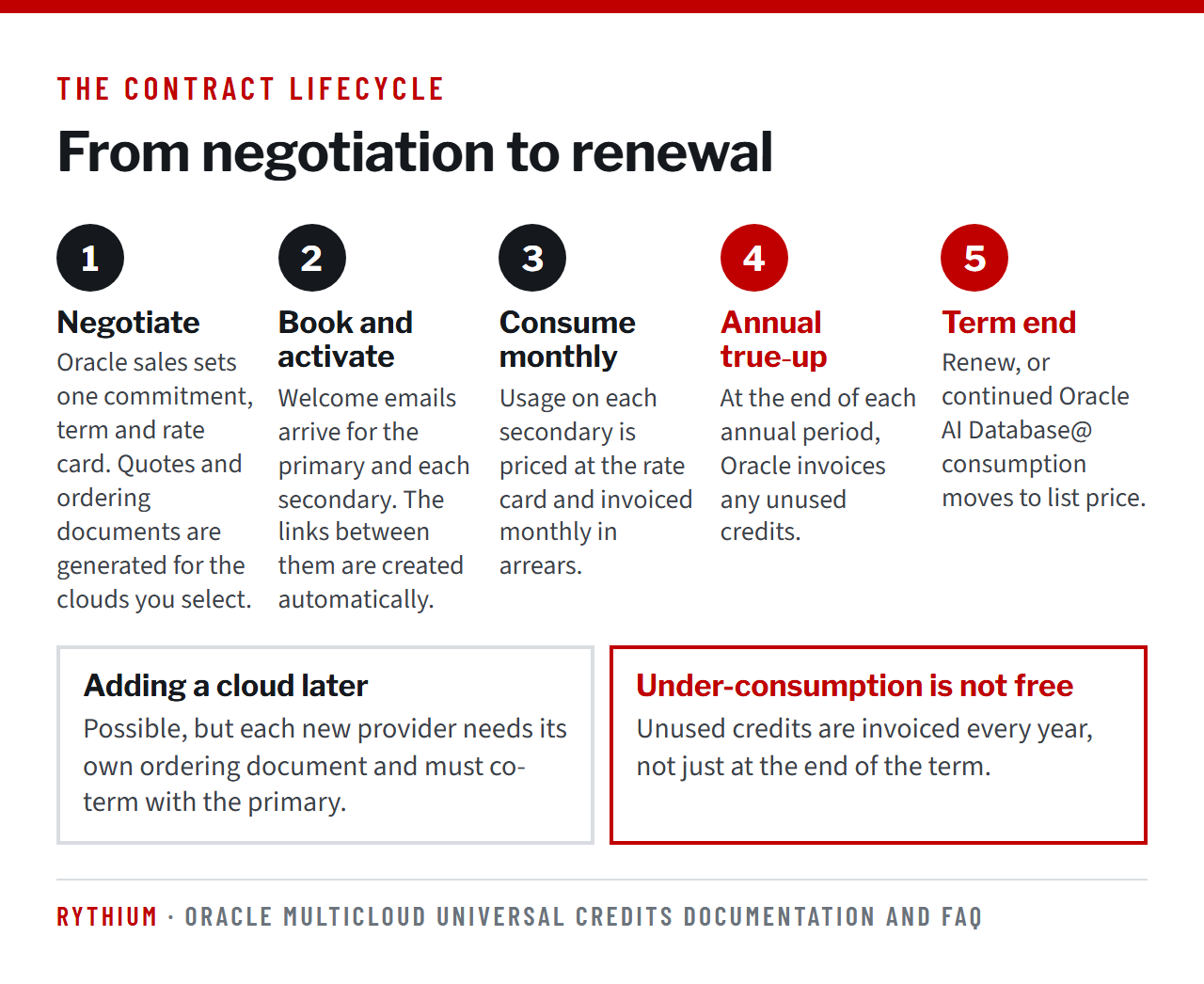
Because every secondary must co-term with the primary, a cloud added in year two runs only for the remaining term. Plan the allocation with the full term in view, and assume that any cloud added later will be negotiated on the timetable of the existing contract, not a fresh one.
How MUC billing works
Each hyperscaler continues to invoice for consumption on its own cloud, natively and on its own marketplace cycle; Oracle bills the OCI subscription. All secondary usage is calculated using the MUC rate card and invoiced monthly in arrears.
On each hyperscaler you choose between two kinds of private offer, working with that provider’s account team. The choice decides whether the spend also counts towards the separate committed-spend agreement you may already have with the cloud provider:
| Cloud | Upfront-commitment private offer | Usage-based private offer |
|---|---|---|
| AWS | Charges, including overages, count against your AWS commitment; additional incentives may apply | Billed monthly in arrears; does not count against your AWS commitment; may not qualify for incentives |
| Microsoft Azure | Charges, including overages, count against your Azure commitment; additional incentives may apply | Billed monthly in arrears; does not count against your Azure commitment; may not qualify for incentives |
| Google Cloud | Charges, including overages, count against your Google Cloud commitment; additional incentives may apply | Billed monthly in arrears; does count against your Google Cloud commitment |
Oracle also asks customers to check with their Oracle sales team whether a workload qualifies for a usage-based private offer, so availability should not be assumed.
Overages
On an upfront-commitment subscription, the hyperscaler bills overages monthly in arrears at your negotiated rate card, and the overage counts against your MUC commitment.
Unused credits
This is the detail that changes the economics. Oracle’s documentation states that “Oracle invoices you for any unused credits at the end of each annual period in accordance with the Ordering Document.” In other words, the commitment behaves like an annual minimum spend: under-consuming in any year produces an invoice that year.
“The most important line in Oracle’s Multicloud Universal Credits documentation is the one about unused credits. Because Oracle invoices them every year, an MUC commitment behaves like an annual minimum spend. Size it to what you will genuinely consume each year, not to your target architecture.”
Sheshagiri Anegondi, Managing Partner, Rythium Technologies, former Oracle Vice-President
Why this matters. Many large customers have committed-spend agreements with Microsoft, AWS or Google. Whether Oracle database consumption burns down that commitment can matter as much as the Oracle discount itself. Choose the private-offer type with both contracts in view, and size the MUC commitment so that each year’s consumption realistically meets it.
Where the MUC flexibility ends
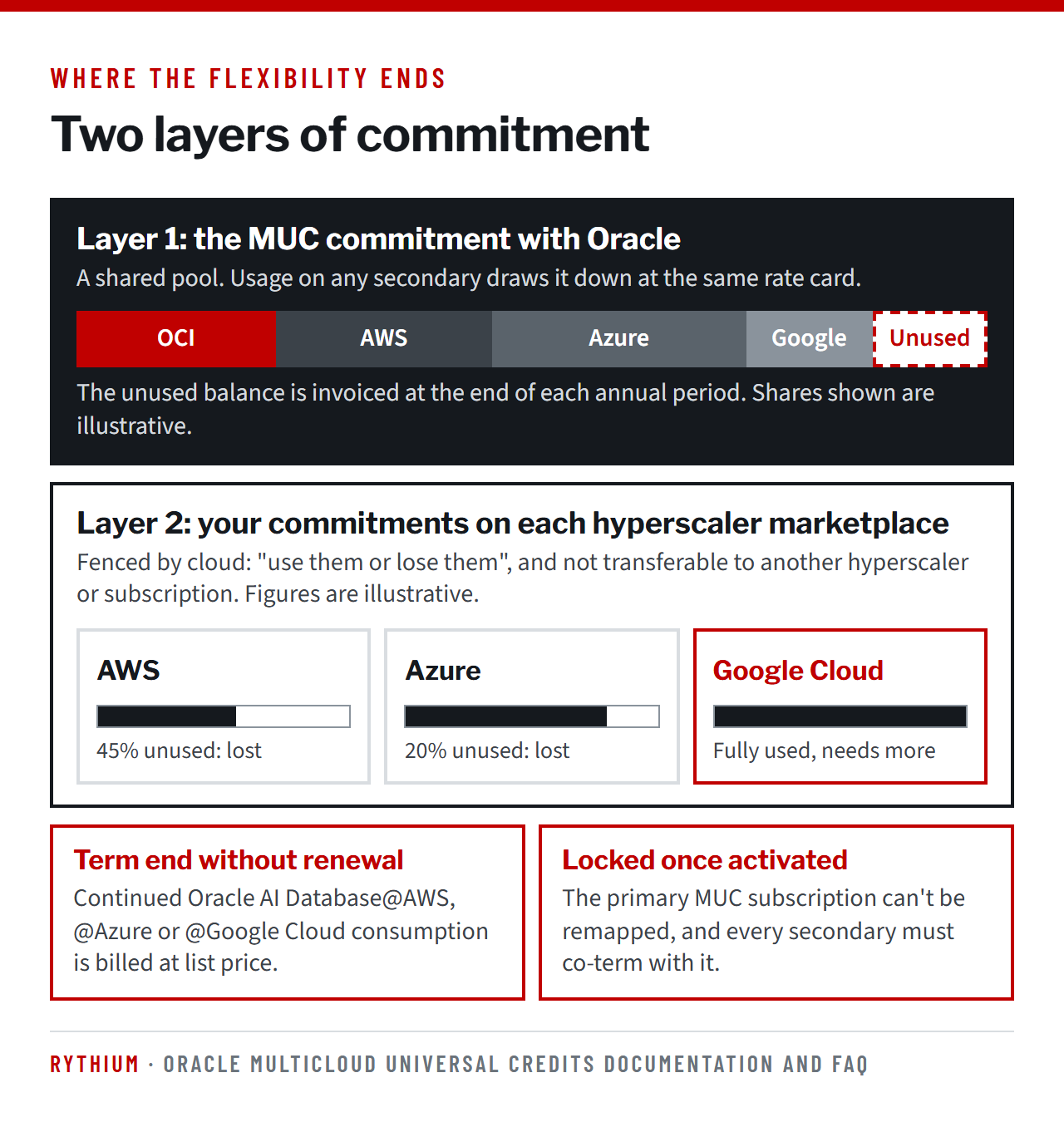
The marketing message is “one contract, any cloud.” Read together, Oracle’s FAQ and documentation describe two layers of commitment that behave quite differently.
Layer 1: the shared MUC pool
Usage on any secondary subscription draws down the same Oracle commitment at the same rate card. This is genuinely flexible: a shift of database workload from Azure to AWS still consumes the one MUC commitment. But any balance left at the end of an annual period is invoiced.
Layer 2: the hyperscaler commitments
Oracle’s FAQ is explicit that hyperscaler-level commitments are “use them or lose them” and cannot be transferred to other hyperscalers or subscriptions. If you place a large upfront commitment on Azure and the workloads end up on AWS, the unused Azure portion does not follow them.
“Most enterprises adopt multicloud as a hedge against uncertainty. Oracle Multicloud Universal Credits reward the opposite: accurate forecasting by cloud and by year. Customers who forecast well will benefit; those who can’t will pay for credits they never use.”
Sheshagiri Anegondi, Managing Partner, Rythium Technologies, former Oracle Vice-President
Other constraints to plan for
- Non-renewal means list price. If you don’t renew at the end of the term, continued Oracle AI Database@AWS, @Azure or @Google Cloud consumption is billed at list price.
- Locked structure. The primary subscription can’t be remapped once activated, and every secondary co-terms with it.
- Data transfer and latency. Oracle itself warns that running workloads across providers can incur additional data transfer fees and latency, costs that sit outside the MUC rate card.
- Visibility. Oracle notes that a unified contract “can obscure per-cloud usage unless you implement tagging, reporting, and chargeback processes.” With four invoices on different cycles, someone has to own the consolidated view.
Put together, the model rewards accurate forecasting and penalises the uncertainty that often drives a multicloud strategy in the first place. It also shapes the renewal: once databases run across several clouds under one Oracle rate card, the alternative to renewing is list price across all of them.
“The list-price clause at the end of the term is where Oracle’s leverage sits. Once your databases run across AWS, Azure, Google Cloud and OCI on one rate card, the alternative to renewing is list price everywhere. Negotiate renewal protection on day one, not in the final quarter.”
Sheshagiri Anegondi, Managing Partner, Rythium Technologies, former Oracle Vice-President
What Oracle’s documents don’t say
Across the announcement, the FAQ and the technical documentation, several points that usually decide the economics of an Oracle cloud deal are not addressed:
| Topic | Why it matters |
|---|---|
| Minimum commitment size | Determines whether MUC is practical for mid-sized estates |
| Term length options | Co-terming means the term sets the timetable for every cloud you add |
| Discount levels and rate-card structure | The “unified, discounted” rate card is only as good as the negotiation behind it |
| BYOL and license-included pricing | Existing on-premises licenses may change the cost of Oracle AI Database@ services significantly |
| Support Rewards and existing support contracts | Can offset on-premises support costs under standard Universal Credits |
| Renewal pricing protection | Without it, the list-price fallback weakens your position at term end |
| Roles, tooling and reporting for burn-down | Oracle recommends tagging and chargeback but does not describe a consolidated view |
These are negotiation items. They should be settled in writing in the Oracle ordering document rather than assumed. How Oracle counts licenses on each cloud when you bring your own is covered in our guide to Oracle licensing on AWS, Azure, Google Cloud and OCI.
“Oracle’s published material on Multicloud Universal Credits is silent on BYOL, Support Rewards and minimum commitment size, the points that usually decide the economics of an Oracle cloud deal. If a term isn’t written into your ordering document, don’t assume it works in your favor.”
Sheshagiri Anegondi, Managing Partner, Rythium Technologies, former Oracle Vice-President
Eight questions to answer before committing to MUC
MUC can simplify procurement and improve your rate card. To make sure it also lowers cost, work through these first:
- Can you consume the commitment every year? Unused credits are invoiced at the end of each annual period. Size the commitment to realistic year-by-year consumption, not the end-state architecture.
- How confident is your split by cloud? Hyperscaler-level commitments can’t be moved. Size each from current consumption and committed migration plans, not from strategy slides.
- Which private-offer type fits each cloud? Upfront versus usage-based decides whether the spend retires your existing AWS, Azure or Google commitment. Model both contracts together.
- Are you eligible, and what happens to what you already have? Existing UCM commitments and private offers can’t convert. Pay-as-you-go UCM tenancies can be remapped; committed ones can’t. Map every current agreement first.
- Where do your licenses fit? Clarify how BYOL, license-included pricing and existing support contracts are treated. The published material does not address it.
- What will the clouds you add later cost? Each new provider needs its own ordering document and must co-term. Agree pricing for future additions now.
- What does the renewal look like? Non-renewal moves consumption to list price. Negotiate renewal caps or price protection while you still have leverage.
- Who owns burn-down tracking across four bills? Oracle invoices OCI; three hyperscalers invoice the rest on different cycles. Decide who owns tagging, reporting and chargeback before the first invoice lands.
Oracle Multicloud Universal Credits: frequently asked questions
What are Oracle Multicloud Universal Credits?
A licensing option with one commitment, one term and one negotiated rate card that can be used across OCI and Oracle AI Database@AWS, @Azure and @Google Cloud. Oracle announced it in October 2025 and made it generally available in March 2026.
Is it one pool of credits or several?
Both. The MUC primary subscription is a shared pool that every cloud draws down at the same rate card. The commitments you place on each hyperscaler marketplace are separate and cannot be transferred between clouds.
What happens to unused credits?
Oracle invoices unused credits at the end of each annual period, in line with the ordering document. Separately, unused hyperscaler-level commitments are lost rather than moved to another cloud.
Can I convert my existing Universal Credits contract?
No. Conversion of existing UCM commitments or private offers is not supported. Pay-as-you-go or overage UCM tenancies can be remapped to an OCI secondary subscription under MUC; tenancies with their own committed contracts cannot.
Who sends the invoice?
Oracle bills the OCI subscription. AWS, Microsoft and Google invoice Oracle AI Database consumption on their clouds through their marketplaces. All usage is priced at the MUC rate card and invoiced monthly in arrears.
Can I add another cloud later?
Yes, but each new provider subscription needs a separate ordering document and must co-term with the existing MUC primary subscription.
What happens if I don’t renew?
Continued Oracle AI Database@AWS, @Azure or @Google Cloud consumption is billed at list price.
Evaluating a multicloud Oracle commitment? Rythium reviews Oracle cloud and multicloud proposals independently, with no vendor fees, ever. We help you size the commitment year by year, split allocations by cloud, align Oracle and hyperscaler commitments, and negotiate renewal protection before you sign. Talk to an independent advisor or write to info@rythium.com.
This article summarises Oracle’s public materials for general information. Program terms are set by Oracle and each cloud provider and may change; confirm details in your Oracle ordering document.
Sources: Oracle Introduces Multicloud Universal Credits, Oracle press release, October 2025; Oracle Multicloud Universal Credits FAQ; Multicloud Universal Credits (MUC), Oracle Cloud Infrastructure documentation; Oracle Multicloud Universal Credits generally available, OCI blog, March 2026.
Sheshagiri Anegondi
Managing Partner of Rythium Technologies. Seventeen years at Oracle, from 1998 to 2015, in leadership roles including Vice President Sales, after Compaq and Digital Equipment Corporation.
Author of “Licensing Oracle: The Reference Manual for Managing Oracle License Compliance & Procuring Oracle Software, Hardware, Cloud & Services” (2021, ISBN 10: 1639046887).
See more of our analysis in Google: add Rythium as a preferred source