
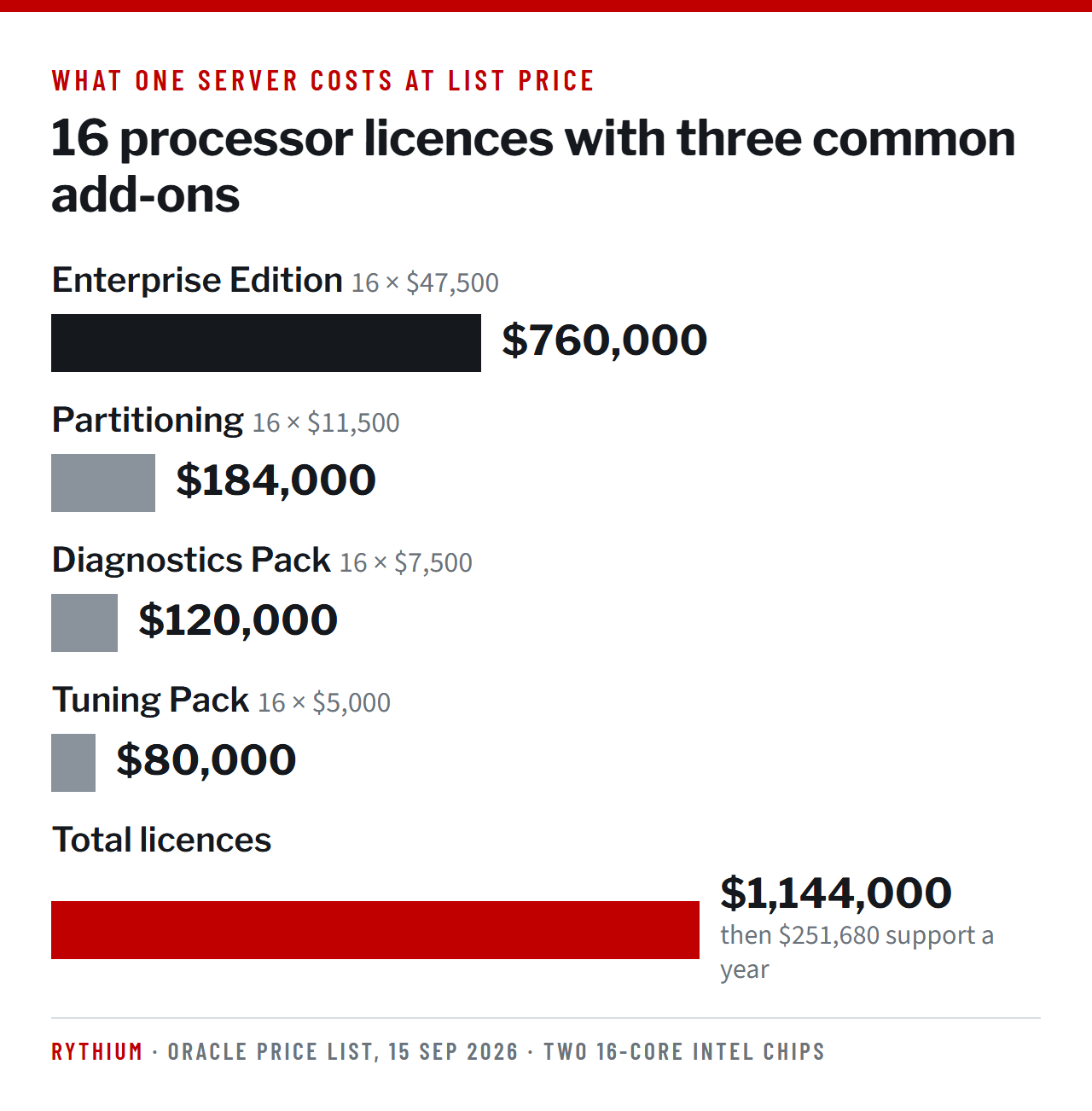
The short answer: an Oracle Database Enterprise Edition license costs $47,500 per processor at list, and support adds $10,450 a year. A typical two-socket Intel server needs 16 processor licences, so the database alone lists at $760,000, plus $167,200 a year in support. Add three common options and the server reaches $1,144,000. These are list prices, before discounts, from Oracle’s price list of 15 September 2026.
The price per licence is the smallest part of the answer, because what you pay depends far more on how many licences Oracle’s rules say you need. This guide shows the prices, then works through what real servers cost, and where the money goes over the years.
In short
- Enterprise Edition: $47,500 per processor or $950 per named user. Standard Edition 2: $17,500 per processor or $350 per named user.
- Support: 22% of what you paid, every year. After five years, support has cost more than the licence.
- A two-socket server with 32 Intel cores needs 16 processor licences: $760,000 for Enterprise Edition at list.
- Options add up: Partitioning, Diagnostics and Tuning on that server add $384,000.
- The cloud can double it: AWS, Azure and Google Cloud count vCPUs, so the same cores need twice the licences.
Oracle database license cost: the price list, September 2026
The Oracle database license cost at list is $47,500 per processor for Enterprise Edition and $17,500 for Standard Edition 2, or $950 and $350 per Named User Plus (NUP). Support adds 22% a year, so the Oracle Enterprise license cost of $47,500 per processor comes with $10,450 a year in support. The table is from Oracle’s Technology Global Price List of 15 September 2026, in US dollars, with support per year.
| Product | Per processor | Support a year | Per NUP | Support a year |
|---|---|---|---|---|
| Database Enterprise Edition | $47,500 | $10,450 | $950 | $209 |
| Database Standard Edition 2 | $17,500 | $3,850 | $350 | $77 |
| Real Application Clusters | $23,000 | $5,060 | $460 | $101.20 |
| Database In-Memory | $23,000 | $5,060 | $460 | $101.20 |
| Multitenant | $17,500 | $3,850 | $350 | $77 |
| Advanced Security | $15,000 | $3,300 | $300 | $66 |
| Partitioning | $11,500 | $2,530 | $230 | $50.60 |
| Active Data Guard | $11,500 | $2,530 | $230 | $50.60 |
| Advanced Compression | $11,500 | $2,530 | $230 | $50.60 |
| Diagnostics Pack | $7,500 | $1,650 | $150 | $33 |
| Tuning Pack | $5,000 | $1,100 | $100 | $22 |
| WebLogic Server Standard Edition | $10,000 | $2,200 | $200 | $44 |
| WebLogic Server Enterprise Edition | $25,000 | $5,500 | $500 | $110 |
| WebLogic Suite | $45,000 | $9,900 | $900 | $198 |
Our guide to the Oracle price list explains the rest of the document.
Why the count matters more than the price
An Oracle “processor” is a number you calculate rather than a chip you buy: you take the physical cores where the software is installed or running, multiply by a core factor (0.5 for Intel and AMD), and round up. Every option you use is licensed on the same number, so the bill is the price of everything in use, multiplied by a count that depends on your hardware, your virtualisation and your cloud. Our Oracle database license calculator does that count on the servers you actually run, with Oracle’s core factors and the options and packs in use.
That is also why “how much does Oracle cost per core?” has a simple answer on Intel and AMD: Enterprise Edition works out at $23,750 per core at list, because two cores make one processor licence.
What one server costs
Take a common server: two Intel Xeon chips with 16 cores each. That is 32 cores, and 32 × 0.5 = 16 processor licences.
Now the same server three other ways.
On Named User Plus
If only a few dozen people use the system, Named User Plus looks cheaper, but the minimum is 25 users per processor for Enterprise Edition. On 16 processors that is 400 users, or $380,000, even if 40 people use it. Users who reach the database through an application are counted at the front end, and above 800 users, processor licences become the cheaper choice for this server.
On Standard Edition 2
Standard Edition 2 counts each occupied socket, not cores, and it may only run on servers with up to two sockets. This server needs 2 licences: $35,000, plus $7,700 a year in support. The limits are real: each database can use at most 16 CPU threads, and no Enterprise Edition options or management packs are allowed. Where a workload fits, the saving is large.
In a public cloud
On AWS, Azure and Google Cloud, two vCPUs count as one processor licence and the core factor does not apply. Since a vCPU is usually half of a physical core, the same hardware needs twice as many licences there.
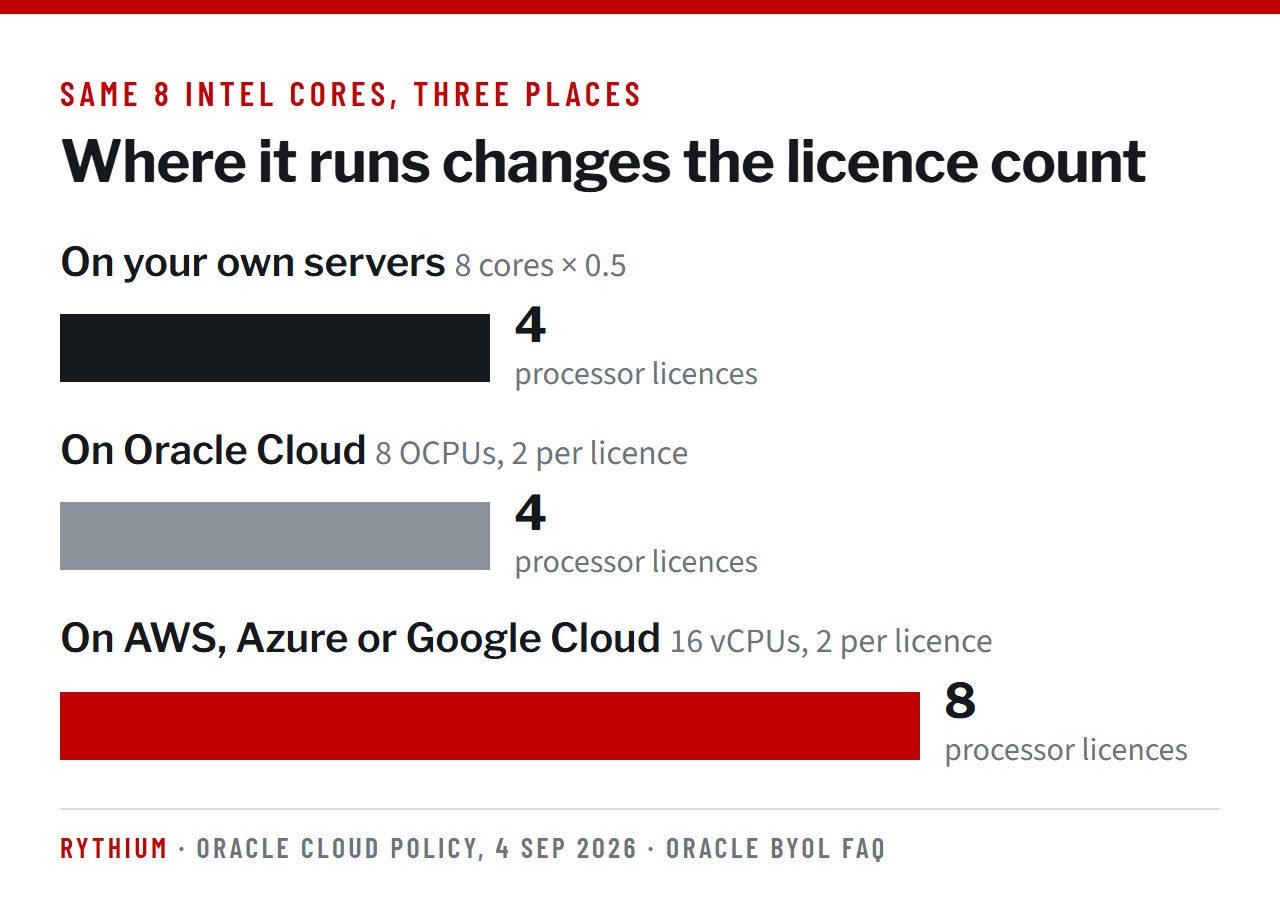
For Enterprise Edition, 8 cores cost $190,000 on your own servers or on Oracle Cloud, where one licence covers two OCPUs. The same cores on AWS cost $380,000. Our guide to licensing Oracle in the cloud covers each provider.
The cost over time
Support is where most of the money goes, at 22% of what you paid, every year, for as long as you want updates and help.
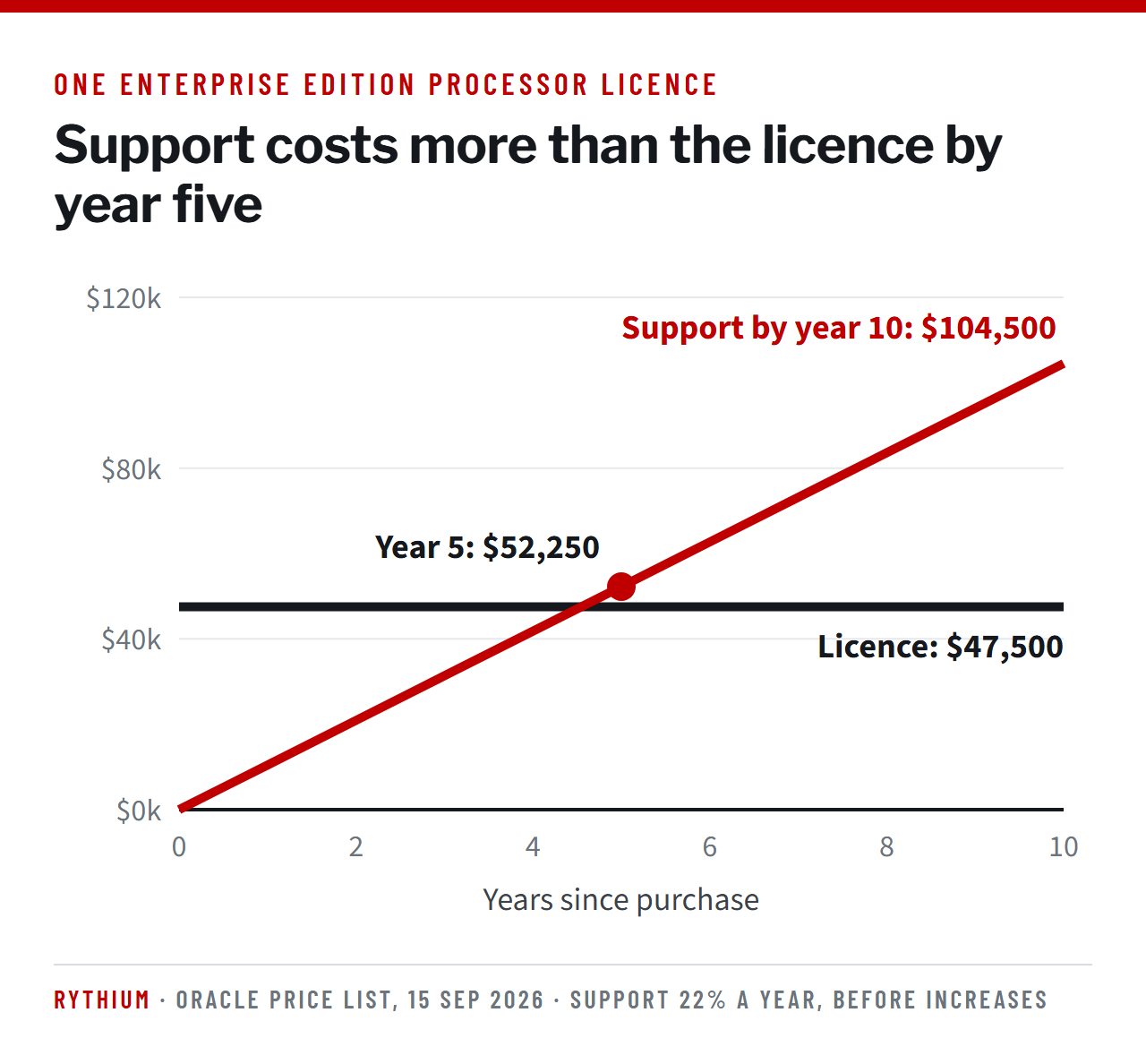
Three rules make support hard to reduce. A product and its options must be supported together. Ending support on part of an order makes Oracle reprice the rest, which can wipe out the saving. And if support lapses, coming back costs a reinstatement fee of 150% of the last annual fee for the time you were away.
The hidden costs of staying on Oracle
- Options switched on by default. The Diagnostics Pack is on in Enterprise Edition, so one routine report can create a $7,500-per-processor gap.
- Standby servers. A Data Guard standby is licensed like production, so it can double the database bill.
- VMware. Oracle’s policy counts every host an Oracle virtual machine could move to.
- Cloud moves. Twice the licences on AWS, Azure and Google Cloud for the same cores.
- Java. Oracle’s Java subscription is priced per employee, for the whole company. On its price list of 8 October 2026, a company with 3,000 employees pays $378,000 a year. Our Java license review shows what you actually owe.
- Audits. A gap found by Oracle usually comes with back support for the time it was in use.
What we see in real Oracle bills
Two of our engagements show where the money goes once the list price is set.
- An Oracle ULA at a bank. Oracle quoted a three-year renewal of the bank’s Unlimited License Agreement at $7.1M. When we counted its deployments against Oracle’s rules, growth in the covered products had flattened, so the bank certified out of the agreement instead. The certified exit and right-sized support came to $2.85M, and 214 licences nobody used were taken off support.
- An Oracle Fusion Cloud renewal. A global engineering group’s ordering document stood at £24.07M for 24 months. It was subscribed for 35,000 employees but held 31,240 worker records, and it paid for 200 Project Contract Billing users when no more than 61 ever logged in. We found a path to £17.42M, 27.6% lower. The Fusion case study has the full numbers.
In both, most of the saving came from matching what was bought to what was used, before any talk of discounts. More results are on our case studies page.
How to pay less
- Switch off options and packs you have not licensed, and remove the ones nobody uses.
- Pick the metric that fits: named users for small internal systems, processors for busy ones.
- Move suitable databases to Standard Edition 2.
- Run fewer, larger licensed servers, and keep Oracle virtual machines in dedicated clusters.
- Compare clouds on licence counts as well as compute prices.
- Buy when Oracle most wants to sell. Oracle’s financial year ends on 31 May, and its quarters end in August, November, February and May.
- For stable systems that no longer need upgrades, look at third-party support.
Our article on Oracle license cost optimization covers each lever in more depth.
Questions people ask about Oracle costs
How much does an Oracle Database Enterprise Edition license cost?
At list price, Enterprise Edition is $47,500 per processor or $950 per named user, and Standard Edition 2 is $17,500 per processor or $350 per named user. Support adds 22% a year. Most large buyers negotiate a discount.
How much does Oracle cost per core?
On Intel and AMD servers, two cores make one processor licence, so Enterprise Edition works out at $23,750 per core at list, plus $5,225 a year in support.
How much does Oracle Partitioning cost?
$11,500 per processor or $230 per named user at list, plus $2,530 or $50.60 a year in support. On the two-socket server above, that is $184,000. Partitioning is an Enterprise Edition option, so it cannot be added to Standard Edition 2.
How much does Oracle Enterprise Manager cost?
Its base features come at no extra charge with the Oracle licences and support you already have. The management packs are licensed separately, on every database they are used for: the Diagnostics Pack is $7,500 per processor and the Tuning Pack $5,000. Our guide to Oracle Enterprise Manager licensing lists what is free and what is not.
How much is Oracle support per year?
22% of the price you paid for the licence: $10,450 per Enterprise Edition processor at list.
Is Oracle cheaper on Oracle Cloud than on AWS?
For licences you bring yourself, usually yes. On Oracle Cloud one processor licence covers two OCPUs, which are two full cores. On AWS, Azure and Google Cloud it covers two vCPUs, which are usually one core.
What are the hidden costs of staying on Oracle?
Annual support at 22%, options switched on by default, standby servers, VMware clusters, cloud moves that double the count, Java priced per employee, and back support when an audit finds a gap.
How can we reduce database licensing costs?
Remove unused options, match the metric to the number of users, move suitable systems to Standard Edition 2, consolidate servers, contain virtual machines, and negotiate on your own numbers well before a renewal.
Before you buy, renew or migrate, book an hour with our Advisor on Call to check what you actually need. On Oracle, our customers cut their exposure or the quoted prices by 30% to 100%.
Sources: Oracle Technology Global Price List, 15 September 2026; Oracle Processor Core Factor Table; Licensing Oracle Software in the Cloud Computing Environment (in effect 4 September 2026); Oracle BYOL FAQ; Oracle Software Technical Support Policies.

Sheshagiri Anegondi
Managing Partner of Rythium Technologies. Seventeen years at Oracle, from 1998 to 2015, in leadership roles including Vice President Sales, after Compaq and Digital Equipment Corporation.
Author of “Licensing Oracle: The Reference Manual for Managing Oracle License Compliance & Procuring Oracle Software, Hardware, Cloud & Services” (2021, ISBN 10: 1639046887).
See more of our analysis in Google: add Rythium as a preferred source