
The short answer: the most common Oracle ULA problems come from using products that are not in the contract, not reporting changes such as mergers, and not knowing exactly what is deployed. Oracle audits aggressively, and more so when a ULA is near its end. If you plan to certify (exit) or renew, these are the issues to check first.
Oracle is known for rigorous license audits, and it is even more active with Unlimited License Agreements. The issues below are the ones organizations should be aware of. For the process itself, see Oracle ULA certification.
Use of products that are not in the ULA
A ULA always specifies the products you may use. Using products outside its scope can cause non-compliance in an audit, unless you hold separate entitlements for them. Understand the limits of the ULA and use the covered products accordingly.
Failure to report changes
Mergers, acquisitions and infrastructure changes that are not reported to Oracle can lead to discrepancies in an audit. Keep Oracle informed of changes that affect license requirements linked to the ULA terms. The merger clauses are covered in Oracle ULA M&A clauses.
Failure to reconcile with ULA terms
A ULA may set specific conditions for reporting and reconciliation. Not following them can cause compliance issues in an audit. Know the procedures in your agreement and follow them.
Changes in deployment practices
Virtualization or cloud migration can change your compliance position. Not every change needs to be reported to Oracle, but every change should be accounted for so that you are audit ready.
Inaccurate license position assessment
Assess your license position regularly. Errors in these assessments lead to non-compliance findings in an audit.
Incomplete license inventory
This follows from the point above. Keep an accurate, current inventory of your Oracle licenses. Gaps in it lead to compliance issues.
Usage tracking complexity
A ULA covers a wide range of Oracle products, and tracking the deployment of each is complex. Products behave differently when installed and used, and you need to understand those differences while you track deployment.
Misunderstanding the exit requirements
Exiting a ULA follows a specific process set out in the agreement. If you do not follow it, you may face problems in an audit. Plan for the exit requirements early. Our ULA exit service helps with this.
Understanding the value of the Oracle ULA
It helps to understand what a ULA is worth to you. The diagram below shows how we look at it.
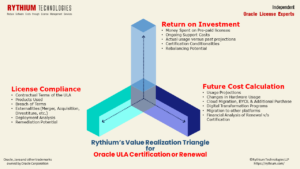
If you are facing an audit, see Oracle license audit defense.
Questions we are asked about Oracle ULA audits
Does Oracle audit a ULA?
Yes. A ULA does not remove the risk of an audit, and the end of the term is the point where Oracle checks the most.
What is the biggest ULA audit risk?
Using products outside the ULA product list, because those are licensed in the normal way.

Sheshagiri Anegondi
Managing Partner of Rythium Technologies. Seventeen years at Oracle, from 1998 to 2015, in leadership roles including Vice President Sales, after Compaq and Digital Equipment Corporation.
Author of “Licensing Oracle: The Reference Manual for Managing Oracle License Compliance & Procuring Oracle Software, Hardware, Cloud & Services” (2021, ISBN 10: 1639046887).
See more of our analysis in Google: add Rythium as a preferred source