
The short answer: To limit your Java exposure, first find every Java install in your estate, whether Oracle, non-Oracle or OpenJDK. Then match each one to its version, its license terms and any agreement or third-party entitlement you hold. Last, fix the gaps: remove what you do not need, move what you can to a free runtime and negotiate the rest. We describe the steps below, and our Java licensing changes page gives the timeline behind them.
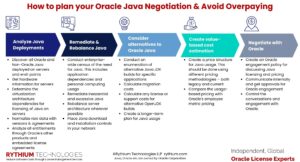
Step 1: find your Java footprint
Start with a discovery of your Java deployments. List all instances, including Oracle Java, non-Oracle Java and OpenJDK, with host name, path, publisher and version. This gives you a clear picture of current use. Our Java License Analyzer is built for this.
Step 2: match installs to license terms
Next, compare what you found with your existing Oracle Java agreements and third-party entitlements. Version matters here:
- JDK 25 is free under Oracle’s No-Fee Terms and Conditions until September 2028.
- JDK 21 updates after September 2026 and JDK 17 updates after September 2024 are not free for production use.
- Many applications bundle Java. Oracle products that include Java may use it for that product only.
Accurate classification shows which installs create a cost and which do not.
Step 3: size the exposure
Oracle prices its Java SE Universal Subscription by employee, and counts contractors and outsourced staff. A company with 3,000 employees pays US$378,000 a year on the list of 8 October 2026. See our Java license cost and price list article for the full tables.
Step 4: reduce it
We give recommendations for fixing gaps and rebalancing your Java footprint. They include:
- removing Java that nobody uses,
- moving systems to an OpenJDK build or a supported non-Oracle Java,
- asking third-party development teams to cover Java used in their software, and
- advice on how to structure a deal if you do need Oracle.
Step 5: negotiate with facts
If you talk to Oracle, we help you write replies, plan the negotiation, review commercial offers and take part in the talks. Facts from steps 1 to 4 are your strongest position.
What you gain
- Lower compliance risk: you know your Java obligations.
- Lower cost: you find savings and use licenses well.
- Better control: you hold one inventory with clear recommendations.
This work is our Java license review.
Questions we are asked about Java exposure
How do we find where Oracle Java runs?
Scan servers, desktops and cloud environments, then classify each install by publisher and version. A tool does this faster than a spreadsheet.
Does one install make us liable for every employee?
Oracle says so for its employee subscription. Whether you need a subscription at all depends on versions and use, so check this before you accept Oracle’s figure.

Sheshagiri Anegondi
Managing Partner of Rythium Technologies. Seventeen years at Oracle, from 1998 to 2015, in leadership roles including Vice President Sales, after Compaq and Digital Equipment Corporation.
Author of “Licensing Oracle: The Reference Manual for Managing Oracle License Compliance & Procuring Oracle Software, Hardware, Cloud & Services” (Notion Press, 2021) (ISBN 10: 1639046887).
See more of our analysis in Google: add Rythium as a preferred source