
In short
- Shift. AI moved from a flat subscription to a metered, usage-based input. The bill is now larger and far harder to forecast.
- Signal. Uber burned a year of AI budget in four months; Meta cited an “exponential increase” in cost; Walmart began rationing tokens per employee.
- Cause. Premium-model-by-default, agents running unattended for hours, and consumption celebrated as productivity.
- Metric. Measure output, not tokens. Salesforce swapped token counts for “agentic work units.” Volume is not value.
- Move. Right-size the model to the task, attribute spend to teams and outcomes, and govern AI like the variable cost it has become.
In the first half of 2026, a remarkable thing happened to the enterprise AI budget: it stopped behaving like software and started behaving like a utility bill. Companies that had spent two years being told to use as much AI as possible discovered, almost at once, that someone was metering the tap. As reported across USA Today, The New York Times and Bloomberg, Uber burned through its entire annual AI budget in roughly four months. Meta told staff it would rein in usage after an “exponential increase” in cost. Walmart began rationing tokens per employee. The era the press had christened tokenmaxxing was over almost before most boards had a line item for it.
The instinct in most organisations is to read this as a spending problem and reach for the obvious lever — a cap. That is a mistake. What changed is not how much AI costs; it is what kind of cost it has become. AI has migrated from a fixed subscription to a variable, consumption-metered input — and almost no one changed how they budget, attribute or govern it to match.
The winners of the next eighteen months will not be the firms that spend the least on AI. They will be the ones that govern it like the variable cost it now is.
From Rythium’s AI procurement practice
Let’s now look at what changed, and how it needs to be managed.
From subscription to meter: how the bill changed shape
The economics of enterprise AI inverted quietly. Vendors have shifted from flat monthly subscriptions toward usage-based pricing, where you pay per token — the fragments of text a model reads and writes. USA Today reported the counter-intuitive result: even as the price per token falls, the cost of completing a task is rising, because tasks now involve more steps, more data and longer inputs. The bill is therefore both larger and harder to forecast. One vendor executive quoted by USA Today described customers seeing budget overruns of twenty to thirty percent almost immediately after the pricing model changed.
A subscription is a number you can put in a spreadsheet in January. A meter is a number you discover in arrears.
From Rythium’s AI procurement practice
This is not a small line item, either. Gartner estimates that AI coding costs will surpass the average developer’s salary by 2028, and found that three-quarters of executives expect their technology budgets to rise this year — nearly half of them by double digits.
A cost that behaves like a meter, grows like a headcount, and is governed like a SaaS subscription is a cost heading for trouble.
From Rythium’s AI procurement practice
The tokenmaxxing trap: how consumption got mistaken for productivity
The deeper problem was a measurement error dressed up as a strategy. When leaders could not easily gauge how skilfully their people used AI, many reached for the one number they could see: consumption. The New York Times described engineers at large technology firms competing on leaderboards that tracked token use — the more you burned, the more productive you were assumed to be. Rob May, whose “Tokenminning Manifesto” gave the correction its name, told the Times the approach ended up rewarding volume over efficiency. It is a familiar failure: any metric that is cheap to measure and only loosely correlated with value will eventually be gamed, and consumption is the cheapest metric of all.
Two habits compounded it. Teams defaulted to the most powerful, most expensive frontier model for every task, whether it warranted one or not. And AI shifted from conversational chatbots to autonomous agents that run for hours unattended — which, as the Times noted, can consume tens of thousands of dollars of tokens per engineer per month. Unsupervised consumption plus premium-by-default is a formula for precisely the bill these companies received.
Where the money actually leaks — the four leaks
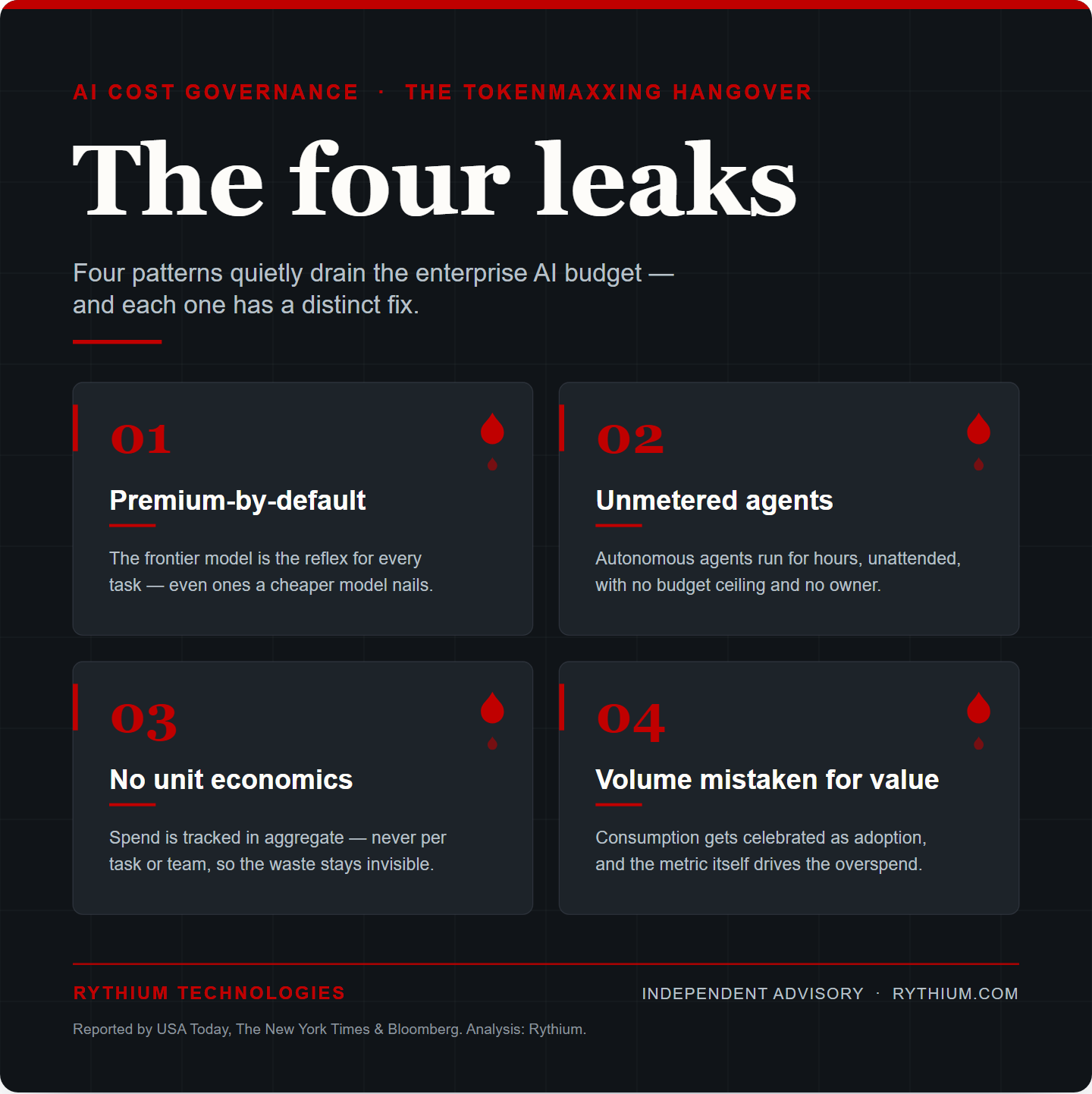
Strip away the headlines and the overspend concentrates in four patterns. They are worth naming because each has a distinct fix.
- Premium-by-default. The frontier model becomes the reflex for every request, including the many a far cheaper model would finish just as well.
- Unmetered agents. Autonomous workflows run long and unattended; cost accrues in the background with no ceiling and no owner.
- No unit economics. Spend is tracked in aggregate, never per task, per feature or per team — so no one can separate the use that creates value from the use that merely burns tokens.
- Volume mistaken for value. Consumption is celebrated as adoption, and the KPI itself manufactures the overspend.
Caps are a symptom, not a strategy
Faced with the bill, the near-universal first response has been the blunt instrument: the cap. Uber placed monthly limits on its AI coding tools. Walmart rationed tokens per employee. Meta took down its leaderboards and began limiting use. Caps stop the bleeding, and sometimes you need to. But a cap is a confession, not a control — it says the organisation cannot yet tell productive spend from wasteful spend, so it throttles both. The more useful framing came from Uber’s chief operating officer, who told a podcast (reported by the Times) that if you cannot draw a straight line from the spend to the features and value it ships, the trade becomes very hard to justify. The task is not to spend less. It is to know what you are spending on.
“AI stopped being a licence you buy and became a utility you meter — and almost no one changed how they budget for it.”
From Rythium’s AI procurement practice
A model portfolio, not a model default
The single highest-return governance move is also the least glamorous: stop using the most expensive model for everything. Cursor’s field CTO captured it for the Wall Street Journal with an analogy worth stealing — most AI tasks are a grocery run, not a track day, and you do not need the supercar to fetch the milk. The savings are not marginal. AT&T’s chief AI officer told the New York Times that opting for less advanced models where they suffice can cut costs by as much as ninety percent; a WEKA executive told USA Today the cheaper models are often “90% as good at 10% of the price.”
The discipline is to route: reserve frontier models for genuinely hard work and send the routine majority to cheaper or open models. USA Today reported that routing marketplaces have taken off for exactly this reason — on one, the share of open-source tokens nearly doubled between January and June. Right-sizing is not a compromise on quality. It is refusing to overpay for capability the task never needed.
Measure output, not tokens
If consumption was the wrong metric, the fix is not a prettier dashboard of consumption. It is a different denominator. The most instructive corporate response came from Salesforce, which — as the Times reported — stopped counting tokens and began counting “agentic work units,” a measure intended to capture output rather than use. Whatever you call it, the principle is the one every mature cost discipline eventually learns: govern the cost per unit of value, not the volume of the input.
Tokens consumed tells you the size of the bill. Cost per shipped feature, per resolved ticket, per closed case tells you whether the bill was worth paying.
An AI FinOps operating model
Bill shock is a governance gap, not a technology problem — and it is the same gap that produces software-licensing exposure: spend runs ahead of the discipline that governs it. A durable operating model has a handful of moving parts; each aimed at one of the four leaks.
Quick answers
Why did our AI bill jump so suddenly?
Three forces at once: pricing shifted from flat subscriptions to usage-based metering, AI “agents” began running multi-step tasks unattended for hours, and teams defaulted to the most expensive model for everything. USA Today and The New York Times reported the same pattern across Uber, Meta and others — budgets set against a subscription mindset met a bill that behaves like a meter.
Are usage caps a good idea?
As emergency triage, yes — a cap stops runaway spend while you get your bearings. As a strategy, no. A cap throttles good and bad spend alike because it cannot tell them apart. The goal is attribution and routing, so you can cut waste without starving the uses that create value.
How much can right-sizing models actually save?
A great deal. AT&T’s chief AI officer told The New York Times that using less advanced models where they suffice can cut costs by up to ninety percent, and a WEKA executive told USA Today the cheaper models are frequently around ninety percent as capable at a tenth of the price. Reserve frontier models for the genuinely hard minority of tasks.
What metric should replace token consumption?
A measure of output, not input. Salesforce, per the Times, moved from counting tokens to counting “agentic work units.” Whatever the label, track cost per shipped feature, per resolved ticket or per closed case — the cost per unit of value, not the volume of tokens.
Is this the same discipline as software asset management?
Fundamentally, yes. AI bill shock and software-licensing exposure are the same failure — consumption running ahead of governance. The controls that manage one (attribution, contract discipline, independent validation, right-sizing) are the controls that manage the other. That overlap is exactly why an independent, buyer-side view helps.
Sources referenced: reporting by USA Today, The New York Times, Bloomberg and The Wall Street Journal on 2026 enterprise AI spending, and Rob May’s “Tokenminning Manifesto.” Analysis and framing are Rythium’s own.
AI spend running ahead of your governance? Book an AI Spend Review.
Read next: Stop Banking the Discount: Why Cheaper AI Should Make You Spend More, Not Less.

Sheshagiri Anegondi
Managing Partner of Rythium Technologies. Seventeen years at Oracle, from 1998 to 2015, in leadership roles including Vice President Sales, after Compaq and Digital Equipment Corporation.
Author of “Licensing Oracle: The Reference Manual for Managing Oracle License Compliance & Procuring Oracle Software, Hardware, Cloud & Services” (Notion Press, 2021) (ISBN 10: 1639046887).