
Independent Oracle Unlimited License Agreement Audit & Certification Advisory
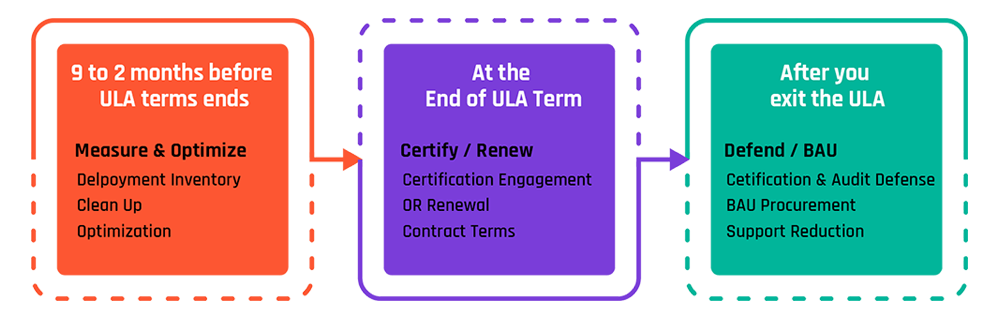
Oracle ULA Certification /Exit is the process to be followed at the end of the ULA contract term to count the number of Oracle licenses deployed, send this count as a declaration to Oracle and obtain a certified grant of perpetual licenses.
Apart from ‘What is Oracle ULA Certification /Exit?, the other most common questions that we are asked are:
You will get answers to all the questions here.
There are many Oracle ULA problems, the biggest being that Oracle has a vested interest in keeping its customers locked into ULA agreements. Oracle does not want any of its customers to certify the ULA.
The reasons for this are quite simple:
Because of these reasons Oracle makes the certification process or exiting from a ULA a very complex, obstacle filled and potentially expensive process.
We have worked on advising more than 125 customers on their ULAs. After conducting a due diligence on their contracts, deployment and future licensing needs— we advised nearly a 100 to certify. We also advised quite a few to renew the ULA. Not a single one of our clients were allowed to be ‘forced’ by Oracle to renew.

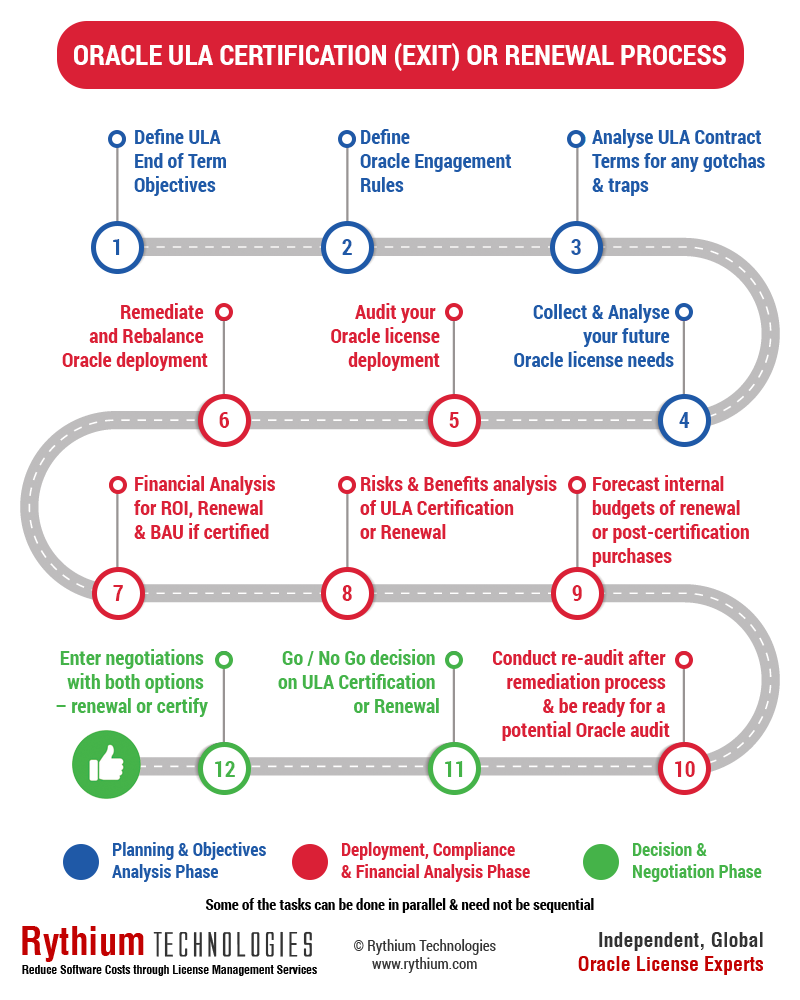
We recommend you to review:
The cost of an expert is miniscule compared to the value of savings
While we have provided the details of how to certify the Oracle ULA, it is important to note that there are risks if the process is not conducted with due care. We have seen Oracle charge extremely hefty ULA renewal fees for those customers who want to certify but make mistakes.
That’s where people like us come in. We are
You might want to read more about our CEO Sheshagiri Anegondi (Sheshu). He is amongst the foremost Oracle License Experts globally. He personally assists customers who want to certify or renew their Oracle ULA.
Apart from ULAs, the biggest concern now for Oracle customers is Java. Click here if you want to know the Oracle Java License changes that have happened in over the past few years.
• An Unlimited License Agreement is a contract that lets you deploy unlimited quantities of specified Oracle products for a fixed term, usually three to five years, for an upfront fee plus annual support.
• At the end of the term, you must either certify the deployments into perpetual licenses or renew the ULA, often at higher cost.
• We advise that the first option should be to certify.
• Renewal makes sense only if you genuinely need substantial new Oracle deployment over the next 3 to 5 years.
Most customers we work with discover that certification gives them more than enough perpetual licenses for their actual needs, at a fraction of the renewal cost.
Most important, the decision to renew or certify, should be data-led, not fear-led.
Twelve to eighteen months before expiry, at the latest. Earlier is better. Certification is not a paperwork exercise. It requires deployment discovery, deployment ramp-up where appropriate, contract review, and a carefully managed engagement with Oracle. Customers who start three months out almost always end up renewing because they ran out of time.
Renewal generates higher revenue for Oracle than certification. Oracle’s sales team is incentivized to renew, expand product scope and lift price. Their playbook is to seed doubt about your deployment count, virtualization compliance, and future growth, making renewal feel safer..
Failure usually means a forced renewal at higher cost, often 60% to 100% above the previous ULA fee, with expanded product scope and new compliance traps. In some cases customers also face audit findings for products outside the ULA. The cost of failing certification routinely runs into millions.
The OSW is the Excel-based declaration Oracle uses to record your certified deployments. The way you fill it out determines your perpetual license count for the next decade. Common mistakes (under-counting environments, mis-mapping virtualization, forgetting DR) directly reduce your future entitlement. We treat the OSW as a strategic document, not a form.
• It depends on the ULA contract. Many older ULAs are silent or restrictive on public cloud, and Oracle will exclude those deployments at certification.
• Some ULAs include cloud rights, but the wording matters. We review the contract carefully before any cloud deployments are committed to the certification spreadsheet.
Sometimes, but it requires careful contract interpretation and timing. Oracle’s standard M&A grace period gives some window for absorption of certain size of acquisitions, but the certification rules are stricter. We have certified ULAs covering acquisitions, divestitures and joint ventures, but the planning has to start well before the corporate event closes.
• Your support stream typically remains fixed at the level set during the ULA.
• Oracle’s matching-support rule generally prevents you from reducing it just because your perpetual license count is now defined.
• That said, post-certification is the right time to evaluate support cost reduction and rebalance the overall Oracle support spend.
Yes. We run the full ULA certification: deployment discovery, contract review, pre-certification planning, OSW preparation, response to Oracle’s clarification questions, and the closing engagement with Oracle LMS. Your team participates where their input is needed, but we own the process and the outcome alongside you.
Related Pages
We use cookies for analytics and ads, only if you agree. Privacy Policy