
The short answer: the Oracle Technology Global Price List is Oracle’s public list of prices for its database, middleware and other technology products. The current edition is dated 15 September 2026 and is a free PDF on oracle.com. Each product has a price per Named User Plus and per Processor, with a year of support beside each, and support is 22% of the licence price. Oracle Database Enterprise Edition, for example, lists at US$47,500 per processor. To turn a price into a bill you also need Oracle’s Core Factor Table, explained below.
Understanding the Oracle Technology Price List and the Core Factor Table lets you work out the cost of licences and support. The official price list is on oracle.com: Oracle Technology Global Price List (PDF).
Structure of the price list
The price list has sections, footnotes and definitions.
- Section I: Oracle Database
- Section II: Oracle Fusion Middleware Products
- Section III: Applications and Systems Management Products
- Section IV: Oracle Application Specific Technology Products
- Footnotes: these give more information on licensing. Many of the rules are not written in the price list itself but in Oracle’s License Definitions and Rules document.
- Definitions: the licence metric definitions. Here again, many details and rules sit separately in the License Definitions and Rules document.
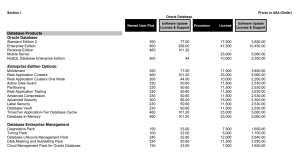
Columns in the Oracle Technology Price List
- Product name
- Price for the Named User Plus metric (NUP)
- Price for one year of support (Software Update License and Support) for the NUP metric
- Price for the Processor metric
- Price for one year of support for the Processor metric
Key prices on the 15 September 2026 price list
| Product | Per Named User Plus (US$) | Per Processor (US$) | Support per Processor a year (US$) |
|---|---|---|---|
| Database Enterprise Edition | 950 | 47,500 | 10,450 |
| Database Standard Edition 2 | 350 | 17,500 | 3,850 |
| Real Application Clusters | 460 | 23,000 | 5,060 |
| Partitioning | 230 | 11,500 | 2,530 |
| Active Data Guard | 230 | 11,500 | 2,530 |
| Advanced Security | 300 | 15,000 | 3,300 |
| Diagnostics Pack | 150 | 7,500 | 1,650 |
| Tuning Pack | 100 | 5,000 | 1,100 |
| WebLogic Server Standard Edition | 200 | 10,000 | 2,200 |
| WebLogic Server Enterprise Edition | 500 | 25,000 | 5,500 |
| WebLogic Suite | 900 | 45,000 | 9,900 |
| GoldenGate | 350 | 17,500 | 3,850 |
Options and packs are priced on top of the database edition they run with. These are list prices; the price you pay depends on the discount you negotiate. For what a full estate costs over time, see what Oracle licensing costs.
Core Factor Table
The Oracle Core Factor Table is the other document you need before you can work out the number of licences.
What is a core factor? The number of Oracle licences depends on the computing power of the server. To tell different processor types and server architectures apart, Oracle defines a core factor for each processor model and lists them in the Core Factor Table.
The core factors of some common servers and platforms:
- Intel processors for servers (except Itanium): 0.5
- AMD processors for servers: 0.5
- IBM POWER6 to POWER9 and IBM Z: 1.0
- Oracle SPARC: between 0.25 and 0.75, depending on the model
For the complete list, see Oracle’s Processor Core Factor Table (PDF), and our guide to the Oracle core factor table for worked examples.
How to calculate the licences you need
Processor licences
Processor licences needed = cores per physical processor x number of physical processors x core factor, with any fraction rounded up.
Named User Plus licences
- Calculate the number of processor licences for the server, as above.
- Calculate the minimum Named User Plus licences: processor licences x the minimum NUP per processor.
- Count the actual number of users.
Buy the higher of the minimum and the actual number of users.
A worked example
A server with two 16-core Intel Xeon processors has 32 cores. 32 x 0.5 = 16 processor licences. For Database Enterprise Edition at list, that is 16 x US$47,500 = US$760,000, plus 16 x US$10,450 = US$167,200 a year in support. Licensed by Named User Plus instead, the minimum is 25 per processor for Enterprise Edition: 16 x 25 = 400 users, or US$380,000 at US$950 each, if 400 or fewer people use it.
Oracle licence cost calculation
The list price calculation is simple:
- Choose the product.
- Choose the licensing metric.
- Read the list price for that product and metric.
- Decide the quantity of licences to buy.
- Calculate the licence list price, and the support list price, which is 22% of the licence list price.
Questions we are asked about the Oracle price list
Where can I download the Oracle technology price list?
Oracle publishes it as a free PDF on oracle.com, linked above. The current edition is dated 15 September 2026.
Is Oracle’s list price what we will pay?
Rarely. It is the starting point. The discount is negotiated, but support is calculated on the price you actually pay, so a higher discount lowers the bill every year.
How much is Oracle support?
22% of the net licence fee, every year. For one Database Enterprise Edition processor at list, that is US$10,450 a year.
Read more about our Managing Partner, Sheshagiri Anegondi, one of the foremost Oracle licensing experts globally. Java is another widely audited Oracle product; see Oracle Java licensing changes and the alternatives.

Sheshagiri Anegondi
Managing Partner of Rythium Technologies. Seventeen years at Oracle, from 1998 to 2015, in leadership roles including Vice President Sales, after Compaq and Digital Equipment Corporation.
Author of “Licensing Oracle: The Reference Manual for Managing Oracle License Compliance & Procuring Oracle Software, Hardware, Cloud & Services” (Notion Press, 2021) (ISBN 10: 1639046887).
See more of our analysis in Google: add Rythium as a preferred source