
The short answer: the ULA Value Realization Triangle is the framework we use in Oracle ULA certification and renewal engagements. It looks at three things: compliance risk, return on investment, and future costs. Together they show whether a ULA is worth certifying, renewing or leaving. For Java bundled in a ULA, certification follows the product list in the contract, which is the first thing we check under compliance risk.
The framework spans the activities needed for a successful ULA certification or renewal, and it supports informed decisions about ULA investment. See Oracle ULA certification for the full process.
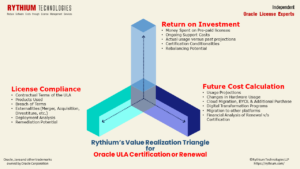
The three parts of the triangle
- Risk mitigation through license compliance management
- Cost-benefit analysis through return-on-investment calculations
- Decision support through future cost calculations
License compliance
The first element is compliance risk: the risk that you cannot meet the requirements of ULA certification. We assess it through our license compliance management task. The parameters are:
- Contractual terms of the ULA
- Breach of terms
- Externalities (merger, acquisition, divestiture and so on)
- Deployment analysis
- Virtualization and cloud usage
- ULA products used
- Non-ULA product deployments
- Remediation potential
Return on investment
The second element is return on investment: the financial benefit the organization has had from the ULA that is running now. The parameters are:
- Cost comparison between past projections and actual usage
- Ongoing support costs
- Certification conditions
- Rebalancing potential
Future cost calculations
The third element is future costs. Estimating them brings correspondingly higher benefits in risk mitigation and return on investment. The parameters are:
- Usage projections
- Changes in hardware usage
- Cloud migration, BYOL and additional purchases
- Digital transformation programs
- Migration to other platforms
- Support costs
- Financial analysis of renewal versus certification
Why we use the framework
ULA certification is complex and needs significant time, money and resources. The triangle is a simple way to see where the most attention is needed to reach a successful certification or renewal. It makes sure you do not miss any component when you weigh the risks and benefits of the agreement.
Related reading: benefits and risks of the Oracle ULA and the Oracle ULA FAQ.

Sheshagiri Anegondi
Managing Partner of Rythium Technologies. Seventeen years at Oracle, from 1998 to 2015, in leadership roles including Vice President Sales, after Compaq and Digital Equipment Corporation.
Author of “Licensing Oracle: The Reference Manual for Managing Oracle License Compliance & Procuring Oracle Software, Hardware, Cloud & Services” (Notion Press, 2021) (ISBN 10: 1639046887).
See more of our analysis in Google: add Rythium as a preferred source