
How a global engineering and consulting group found a path to cut its Oracle Fusion Cloud ordering document by 28%, from £24.1M to £17.4M, before signing its next term.
| Reduction identified | Below the current ordering document | ERP services consolidated | Employee subscriptions with no matching worker |
|---|---|---|---|
| £6.65M | 27.6% | 4 → 1 | 3,760 |
| Client | Global engineering and consulting group, more than 30,000 people across over 30 countries |
|---|---|
| Oracle estate | Oracle Fusion Cloud ERP, HCM and EPM: more than 30 cloud services on one ordering document |
| Commercial position | 24-month term, ordering document value of £24.07M, renewal approaching |
| Engagement | Oracle Cloud procurement advisory: consumption analysis, SKU review, discount benchmarking and pricing options |
| Outcome | A benchmarked bill of materials and four pricing options, the lowest at £17.42M |
The challenge: a contract that had drifted away from the business
The client had moved its finance, projects and HR processes onto Oracle Fusion Cloud several years earlier. Since then the business had changed shape: divestments, a smaller workforce, and project teams that used Fusion very differently from the original implementation plan. The ordering document had not changed with it.
With the renewal approaching, the client’s procurement and IT leadership wanted an independent view of three questions before Oracle’s quote arrived:
- Are we paying for more than we use?
- Has Oracle sold us the right services for the way we work?
- Are our discounts competitive?
Our approach: four steps, from contract to pricing options
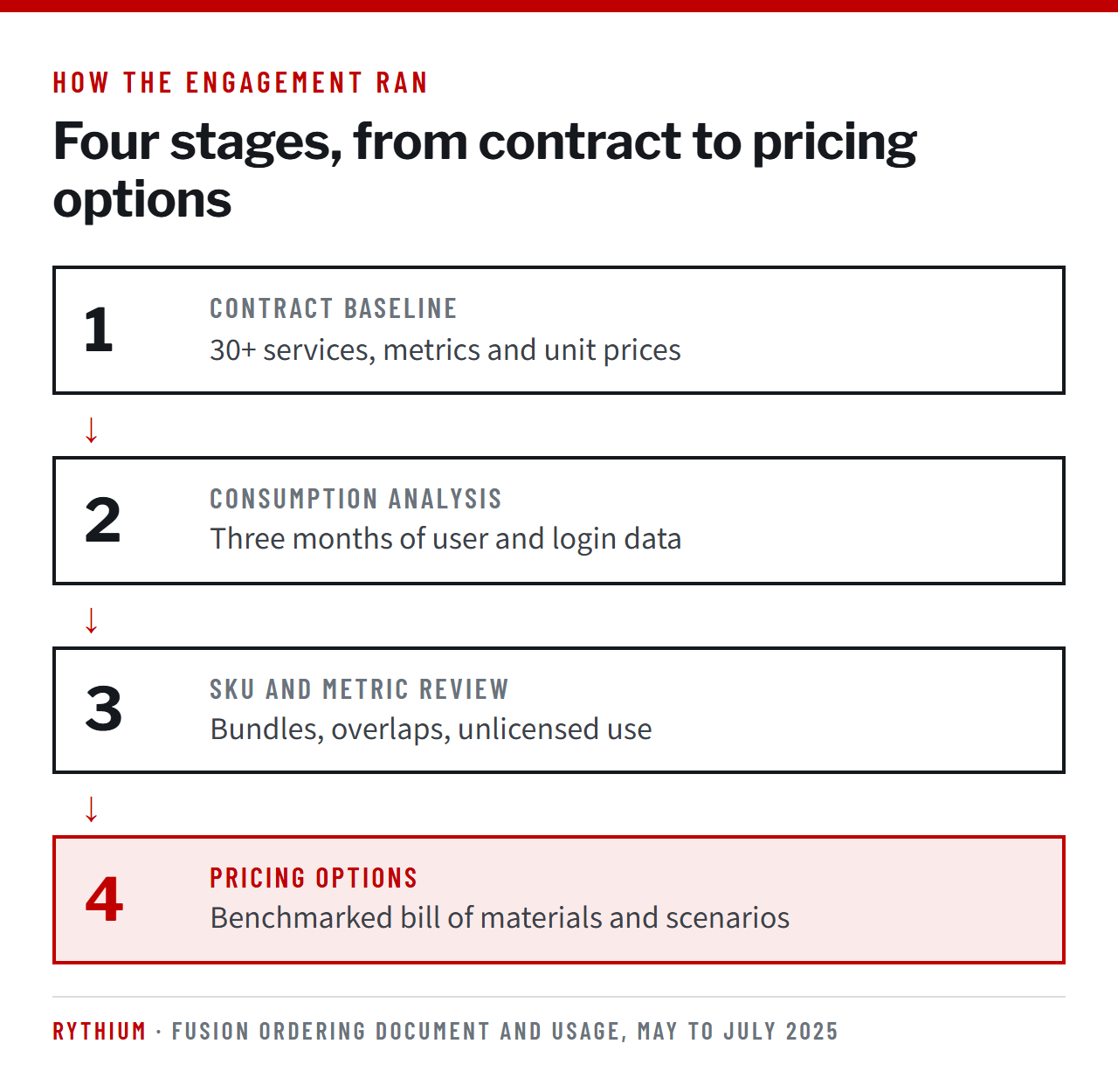
- Contract baseline. We rebuilt the ordering document line by line: more than 30 cloud services, each with its metric (Hosted Named User, Hosted Employee, records, expense reports, test environments), quantity, unit price and effective discount.
- Consumption analysis. Using read-only reports from the client’s Fusion environment, we measured named-user counts month by month from May to July, and matched more than 31,000 worker records against login history.
- SKU and metric review. We checked whether each user population was licensed through the most economical service, looked for overlapping subscriptions, and flagged usage of services the client had never bought.
- Pricing options. We built a new bill of materials sized to real consumption, modelled consolidation into Oracle’s bundled ERP service, and benchmarked every discount against comparable global Fusion deals.
What we found: three findings that drove the numbers
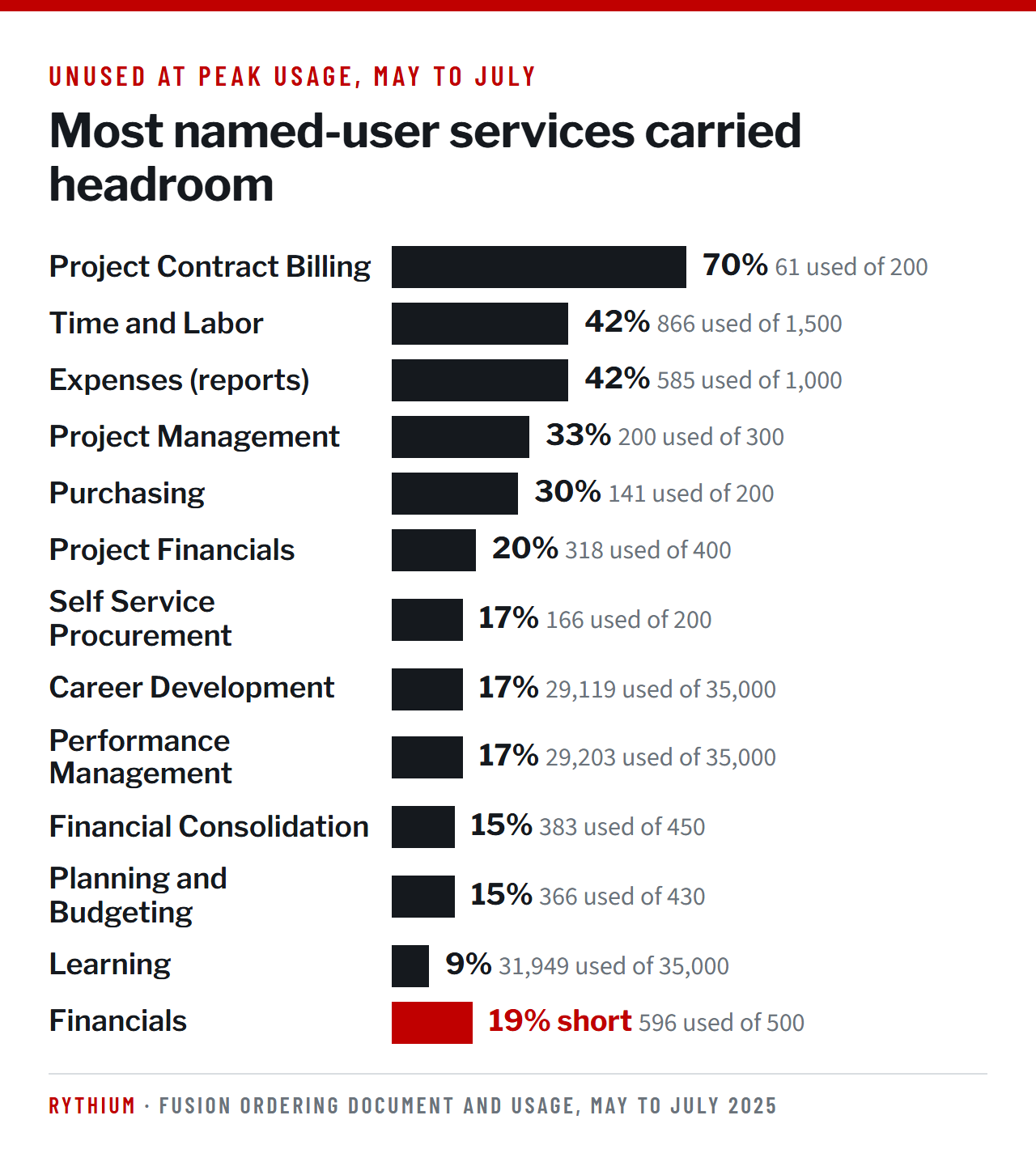
1. The client was paying for more than it used
On almost every named-user service, subscribed quantities were well above peak usage. Project Contract Billing was the extreme case: 200 subscriptions, never more than 61 users. Time and Labor, Expenses, Project Management and Purchasing each carried 30% to 42% headroom that no one was using.
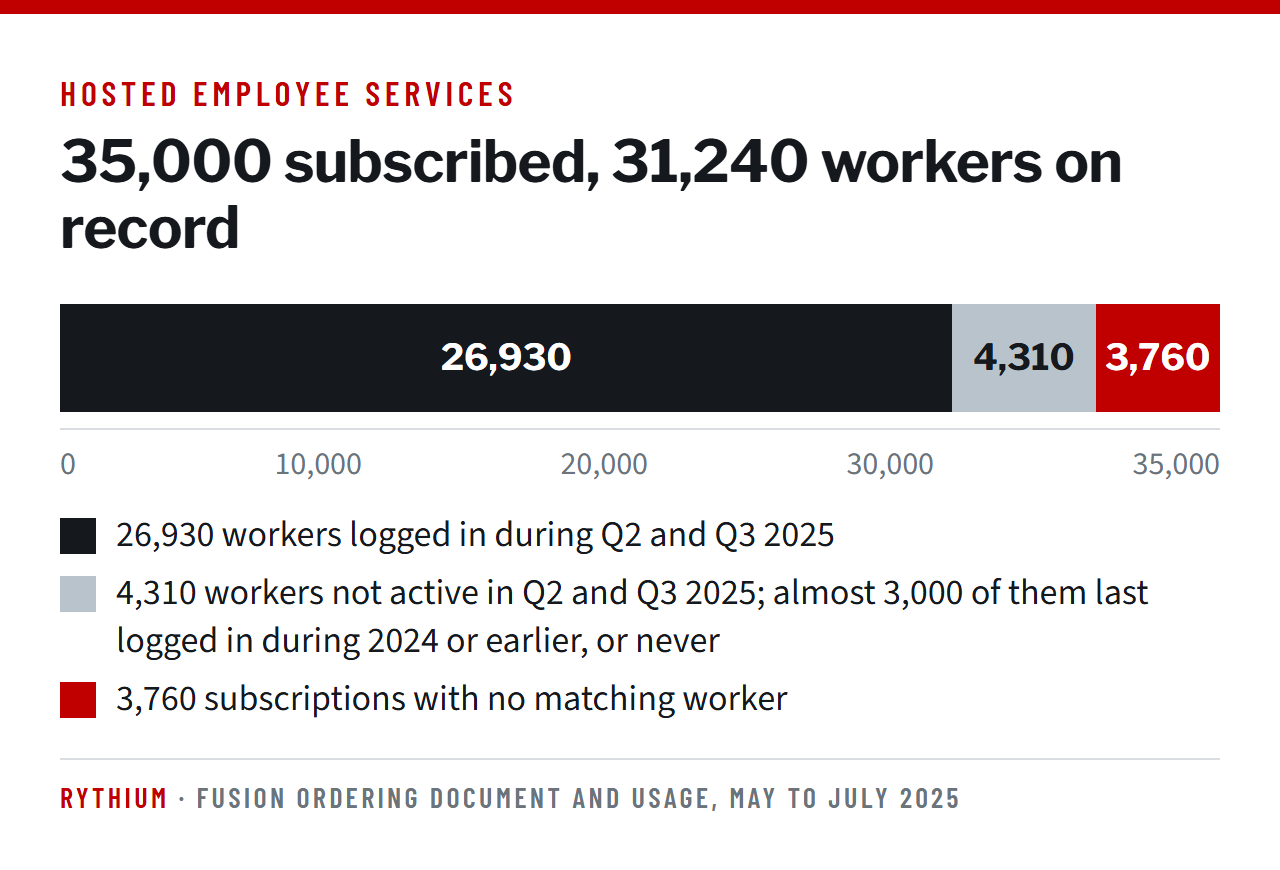
The workforce-based services told the same story. The client was subscribed for 35,000 employees across HCM Base, HR Help Desk, Recruiting and the Digital Assistant platform, but held only 31,240 worker records, including contingent workers. Of those, almost 3,000 had not logged in since 2024 or had never logged in at all.
The analysis also cut the other way. Fusion Financials was under-subscribed: up to 596 users against 500 subscriptions. And small groups of users were active in eleven services the client had never purchased, including Inventory, Task Management, Order Management and Supply Chain Execution. Left alone, both would have become Oracle’s opening position at renewal. We built them into the new bill of materials so the client went into the negotiation with a clean, defensible position.
2. Oracle had not offered the most economical services
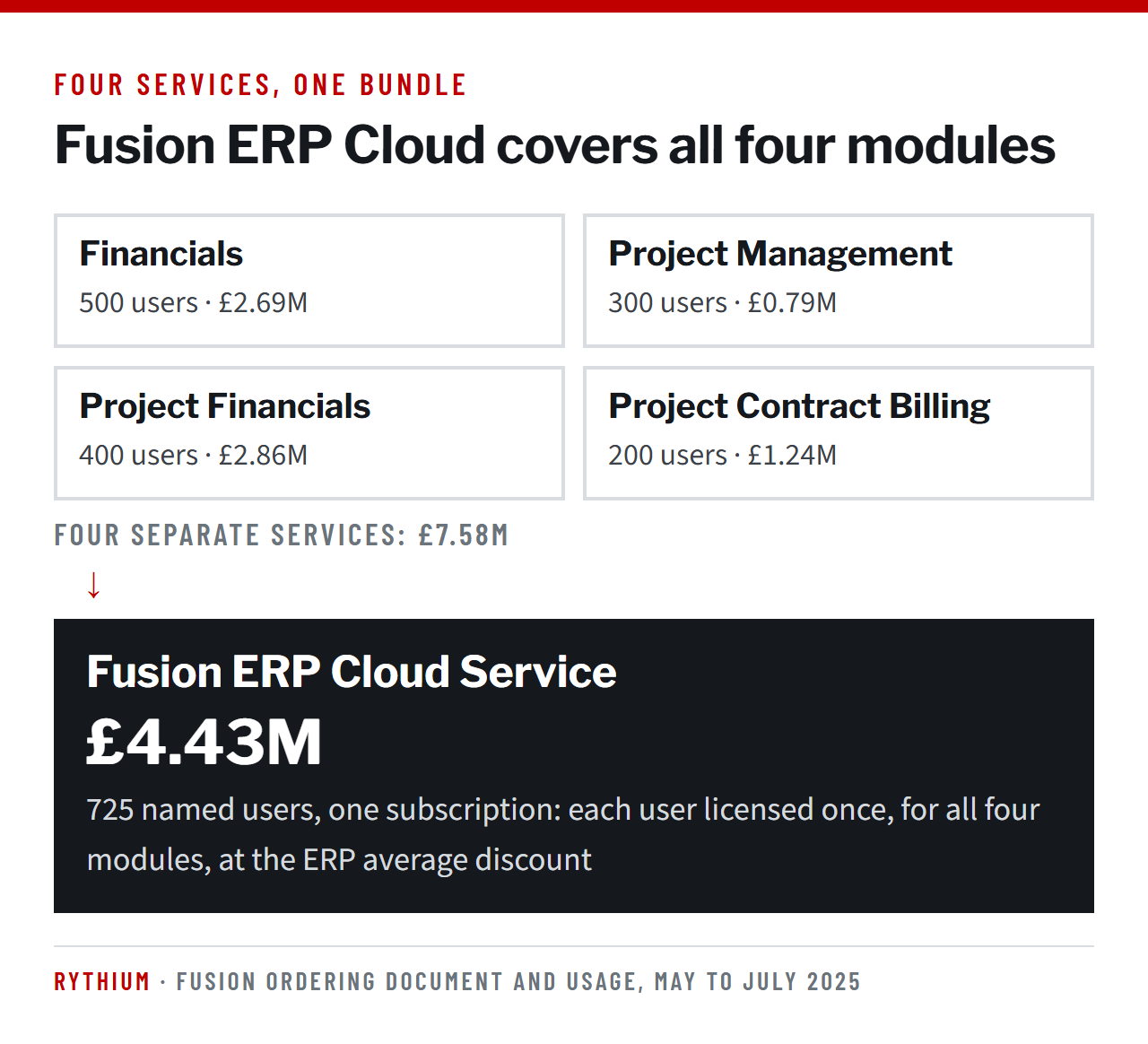
Four project and finance services (Financials, Project Management, Project Financials and Project Contract Billing) were licensed separately, at a combined £7.58M. Many users held two or three of them. Oracle offers a single bundled service, Fusion ERP Cloud, that covers all four. Matching users across the four modules showed that 725 named users on the bundle would cover everyone.
3. Discounts were well below global benchmarks, and inconsistent
Average discounts were about 55% on HCM services and 45% on ERP. Both sat below what we see in comparable global Fusion agreements. The line-by-line view was more striking: one newer HCM service carried an 87% discount while Purchasing sat at just 3%, two Recruiting lines differed by more than 70 points, and a few legacy lines were priced above Oracle’s current list.
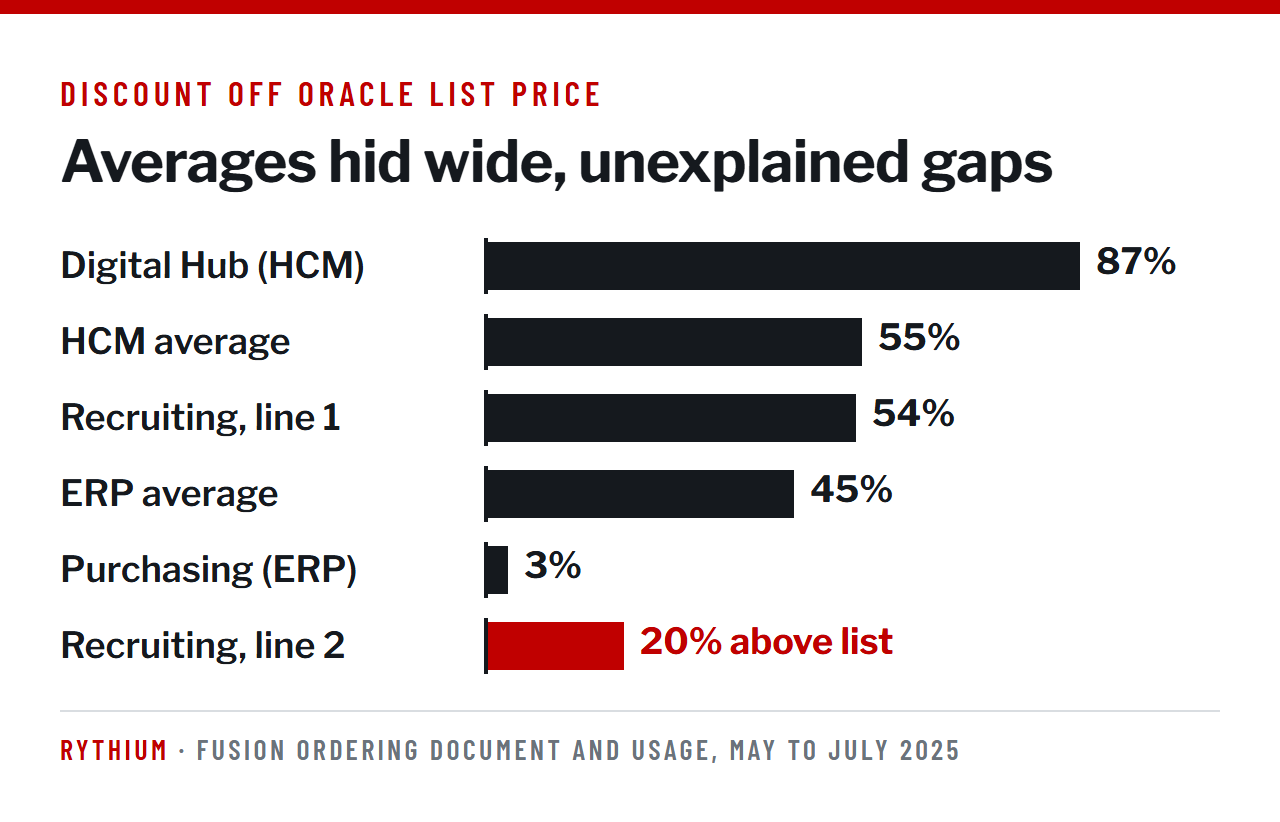
Recruiting deserved particular attention. It is licensed on total employees, yet its value lies in hiring future staff, so we recommended it be discounted more steeply than the average.
What we recommended
- Resize named-user services to peak consumption over the last three to four months, increasing Fusion Financials where it was short.
- Reset the Hosted Employee count to 33,500, covering the real workforce with headroom for growth, rather than 35,000.
- Consolidate the four finance and project services into a single Fusion ERP Cloud subscription.
- Negotiate additional discounts in line with global benchmarks, with a steeper rate on Recruiting and the anomalous lines corrected.
The result: from £24.1M to £17.4M
We gave the client four pricing options, each building on the last, so its negotiating team could decide how hard to push and in what order.
| Option | Basis | Ordering document value | Reduction |
|---|---|---|---|
| Current | Existing quantities and prices | £24.07M | – |
| A | Quantities resized to three months of consumption | £21.05M | 12.6% |
| B | Option A plus SKU consolidation at a 45% discount | £19.35M | 19.6% |
| C | Option B plus a further 10% discount | £17.42M | 27.6% |
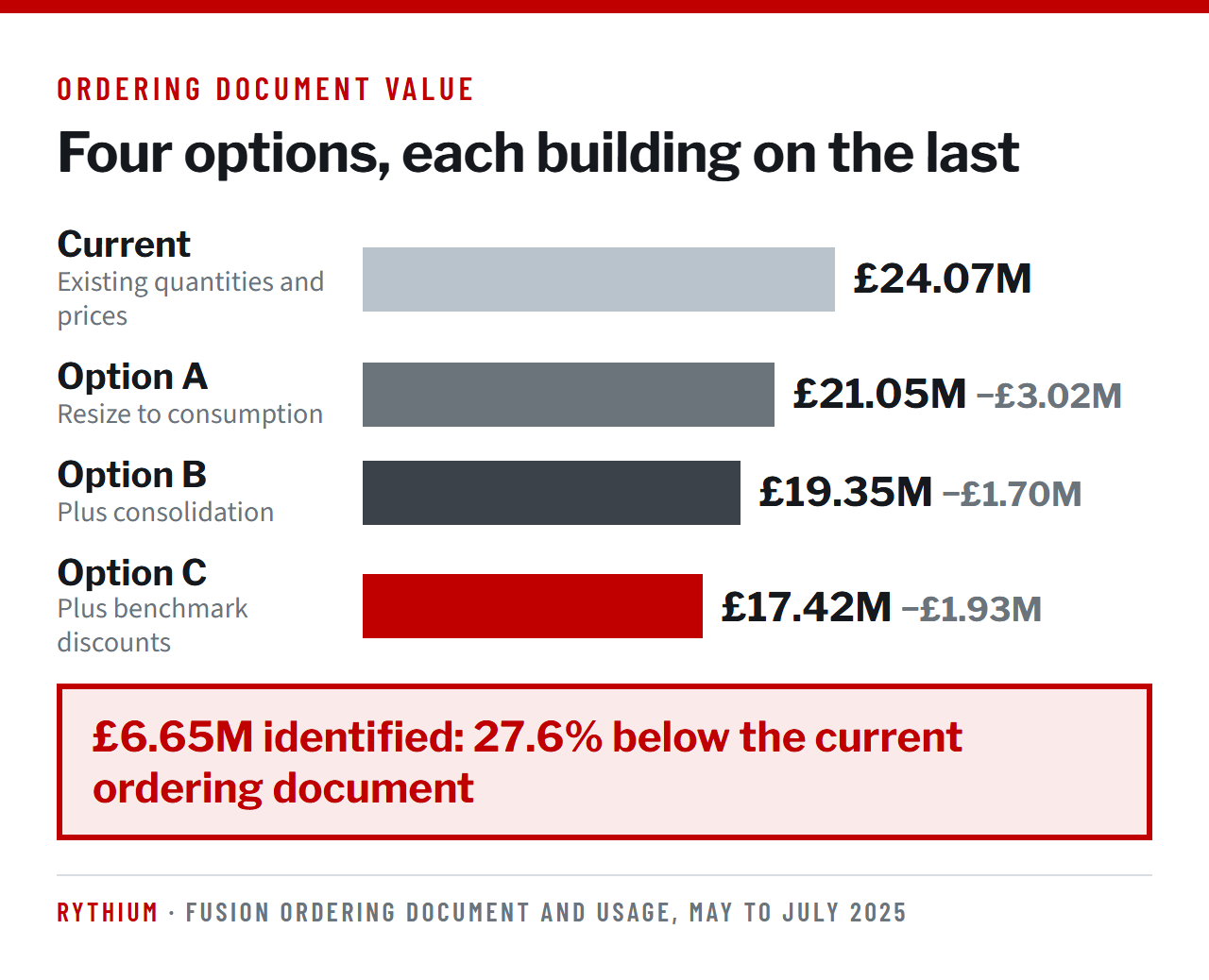
Even the most conservative option, resizing quantities alone, reduced the ordering document by about £3M. With consolidation and benchmarked discounts, the identified reduction reached £6.65M, or 27.6%. A stretch scenario with a 20% additional discount would take the figure to about £15.4M.
What other Oracle Fusion customers can take from this
- Measure before Oracle does. Authorized users, not active users, drive the bill. Peak-usage data turned an opinion into a number Oracle could not argue with.
- Look for the bundle. Oracle rarely volunteers a cheaper consolidated service once separate subscriptions are in place.
- Fix your own gaps first. Under-licensed services and unlicensed usage are Oracle’s strongest cards at renewal. Bringing them into your own proposal takes them off the table.
- Read the discounts line by line. An acceptable average can hide individual lines priced at, or above, list.
- Start early. This analysis took weeks, not days. It has to be finished before the renewal quote arrives, not after.
Is your Oracle Fusion renewal coming up?
Tell us your renewal date and send us your ordering document. A senior advisor will tell you, within 24 hours, where we expect to find savings.
Talk to an advisor or go back to Oracle SaaS Optimization.

Sheshagiri Anegondi
Managing Partner of Rythium Technologies. Seventeen years at Oracle, from 1998 to 2015, in leadership roles including Vice President Sales, after Compaq and Digital Equipment Corporation.
Author of “Licensing Oracle: The Reference Manual for Managing Oracle License Compliance & Procuring Oracle Software, Hardware, Cloud & Services” (2021, ISBN 10: 1639046887).
See more of our analysis in Google: add Rythium as a preferred source