
The short answer: Yes, an Oracle standby server usually needs licences, the same as production. That includes a Data Guard standby that nobody ever logs into. Oracle allows only two narrow free cases: one spare node in a failover cluster for up to ten days a year, and short tests of backup restores. Everything else that has Oracle installed or running must be licensed.
Standby servers are one of the most common gaps we find, because many teams believe a copy “that does nothing” is free. Since a standby usually mirrors a large production server, the gap is rarely small. This guide explains Oracle’s rules in plain terms, using Oracle’s own policy document, “Licensing Data Recovery Environments” (in effect as of 15 December 2024).
In short
- Standby and mirrored servers are licensed like production when Oracle is installed or running on them, including Data Guard standbys and servers set up only to test recovery.
- Licences must match production: The same metric and the same options. The one exception is Real Application Clusters, needed on the standby only if it is used there.
- The 10-day rule covers one spare node in a cluster that shares one disk array in one data centre, for up to ten separate days a year. Maintenance days count.
- Backup restore tests may run on an unlicensed server up to four times a year, for up to two days each.
- Active Data Guard, which lets people query the standby, is a paid option. Data Guard itself is included with Enterprise Edition.
Two designs, two very different rules
Oracle’s policy splits disaster recovery into two designs, and the licensing is completely different for each.
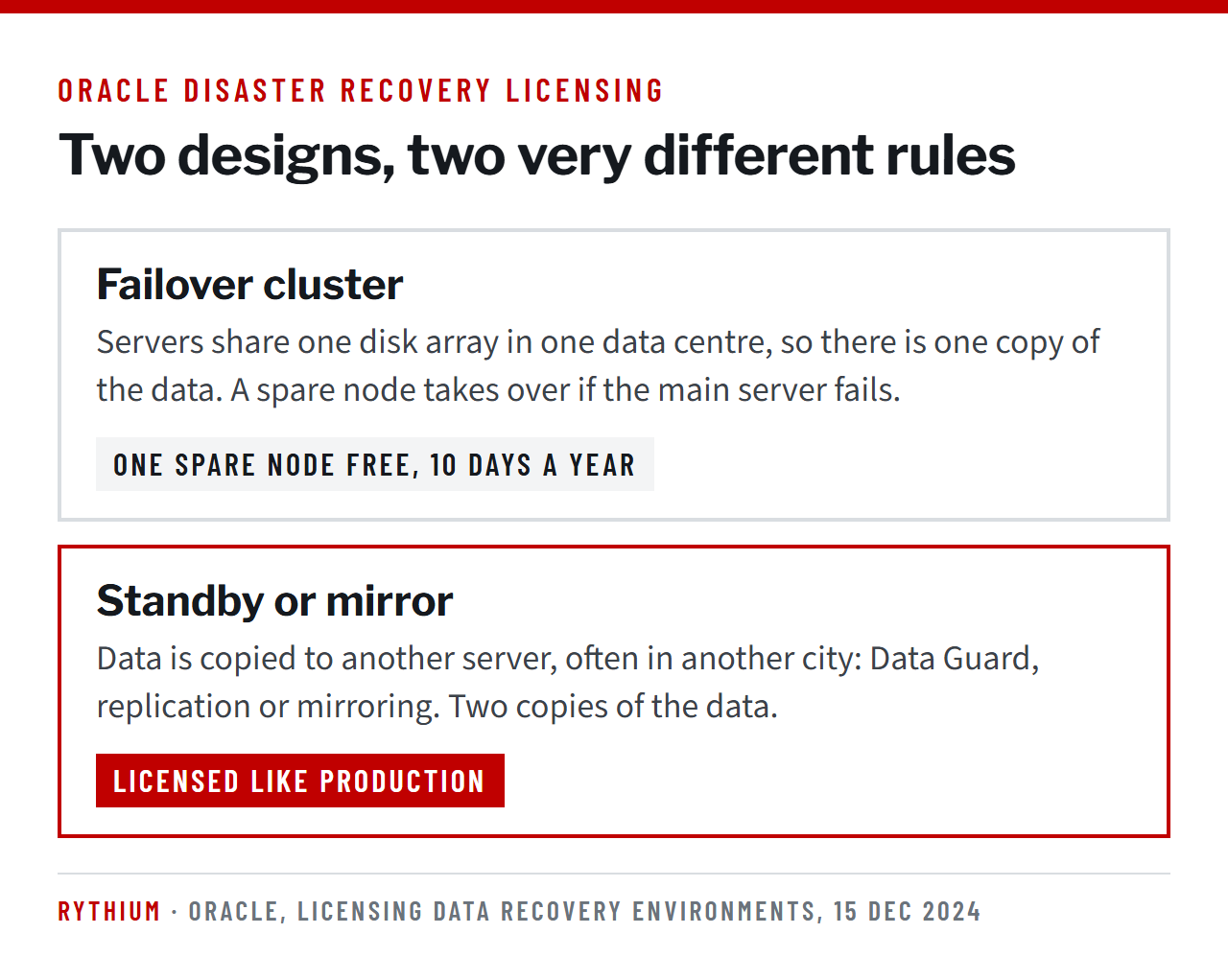
In a failover cluster, several servers share one storage array, so only one copy of the data exists. When the main server fails, a spare node takes over the same files.
In a standby or mirror, the data, and usually the Oracle software, is copied to separate storage on another server. Data Guard, storage replication and remote mirroring all work this way. Two copies of the data exist, often in two cities.
The 10-day rule, in Oracle’s words
Oracle’s policy gives a licence “the right to run the licensed program(s) on an unlicensed spare computer in a failover environment for up to a total of ten separate 24-hour periods in any given calendar year.” Each day the spare node runs counts as one period, however short. Oracle’s own example: down for two hours on Tuesday and three hours on Friday is two of your ten.
The conditions are strict:
- The servers must form a cluster and “share one logical disk array located in a single data center”.
- Only one failover node per cluster is free, even if several are set up as spares.
- “Downtime for maintenance purposes counts towards the ten separate 24-hour periods.”
- After a failover, you must switch back once the main server is fixed, or make the repaired server the new spare.
- After ten periods in a year, the spare node needs its own licences.
- Production and spare must use the same metric. If the spare is licensed per user, the user minimums are waived on that one node.
Because the rule needs shared storage in one data centre, it never covers a second site. A standby in another city falls under the next rule.
Standby, replication and mirroring: licensed like production
For any design that copies data to another server, the policy says “all Oracle programs that are installed and/or running must be licensed per standard policies”. It adds that this “includes installing Oracle programs on the DR server(s) to test the DR scenario.”
So all of these need licences:
- a Data Guard standby, even if no user ever connects to it;
- a server receiving storage replication with Oracle software installed;
- a recovery server where Oracle is installed only to rehearse the recovery plan.
The licences must match production in metric and options. If production uses Partitioning and the Diagnostics Pack, the standby needs them too. The policy makes one exception: Real Application Clusters “does not need to be licensed on the Data Recovery server unless used on the Data Recovery server.”
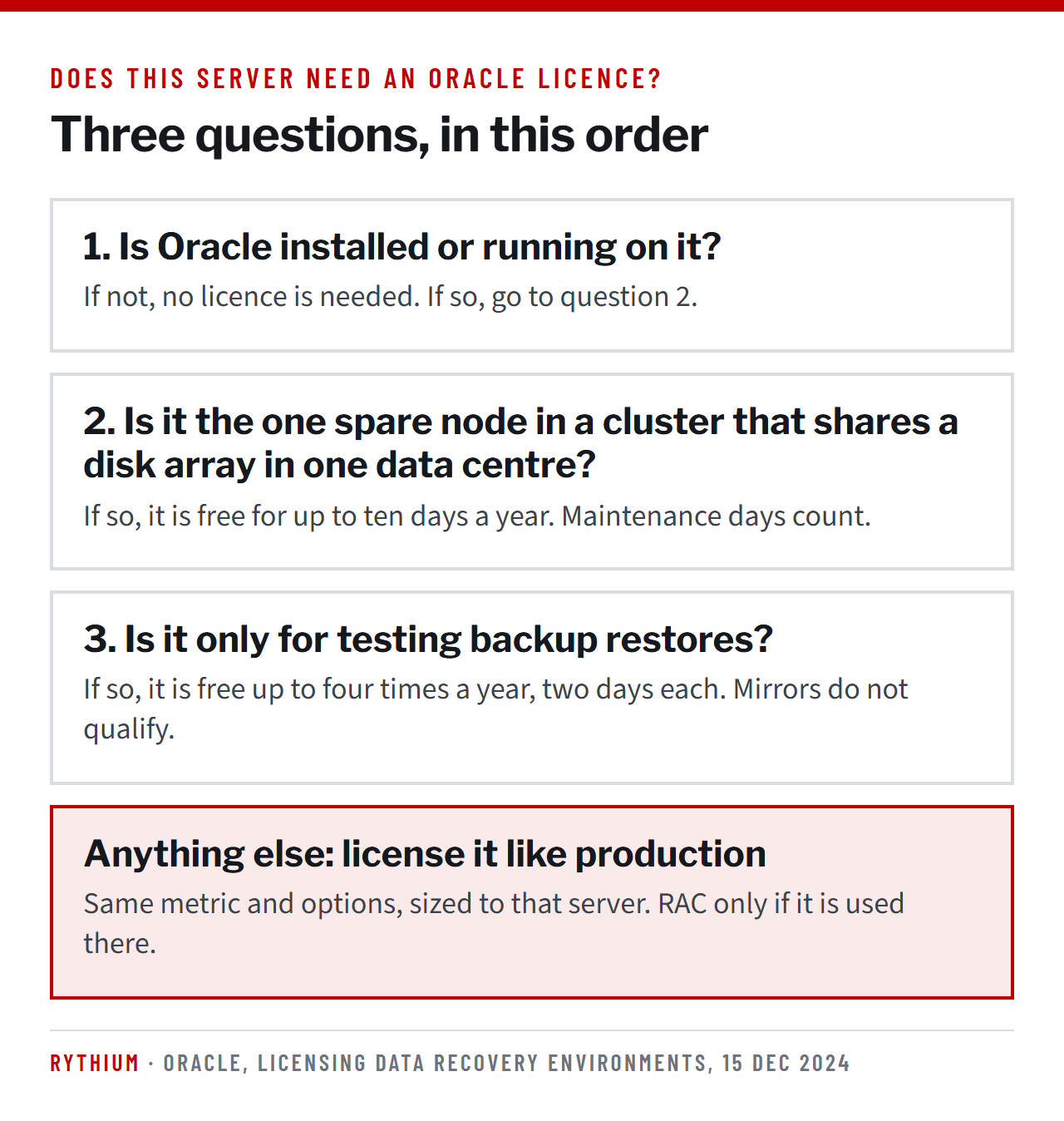
Does this server need a licence?
Run any Oracle server through these questions, in order.
What a standby costs
Take a production server with 16 processor licences of Enterprise Edition, Partitioning and the Diagnostics Pack. At list price that is $66,500 per processor, or $1,064,000. A matching Data Guard standby on the same size of server needs the same again: another $1,064,000, plus $234,080 a year in support.
The standby only needs licences for its own cores. A standby on a server with half the cores needs half the licences. That is why the size of the standby matters as much as whether it exists.
Active Data Guard: the option that switches itself on
Data Guard keeps a standby in step with production, and it is included with Enterprise Edition. Active Data Guard is a separate option, at $11,500 per processor, and it must be licensed on both the main server and the standby. Its best-known feature lets people run reports and queries on the standby while it keeps applying changes. Opening a physical standby read-only while redo apply is running uses it. The database records the use, and it is one of the first things an audit looks for.
Testing your backups for free
For testing physical copies of backups, a licence includes the right to run the program on an unlicensed server, including one in a cloud, up to four times in a calendar year, for no more than two days each time. The right covers restore tests only. It does not cover mirrors or any setup where the Oracle software is copied or kept in sync.
Disaster recovery in the cloud
A standby on AWS, Azure or Google Cloud is counted under Oracle’s cloud policy: two vCPUs count as one processor licence, and the core factor does not apply. Since a vCPU is usually half a core, a cloud standby sized like your production server can need twice the licences of the server it protects. The 10-day rule’s shared-storage, single-data-centre conditions also mean a cloud standby gets no free days. Size it for recovery, not for a perfect match. See licensing Oracle in the cloud.
How to protect the business without paying twice
- Use a failover cluster where your recovery target allows it. One free spare node for up to ten days a year costs nothing extra.
- Size the standby for recovery. Fewer cores, fewer licences. Agree the performance you really need during an outage.
- Keep options off the standby where you can, and switch off packs you have not licensed.
- Do not open the standby for reports unless Active Data Guard is licensed on both servers.
- Test restores within the allowance instead of keeping a permanent test copy.
- Consider Standard Edition 2 for smaller systems. It has no Data Guard, so recovery must be built another way, but the licences cost far less.
- Count recovery servers in every self-audit. They are the gap Oracle’s audit scripts find most reliably.
Our guide to Oracle licence compliance covers the other common gaps, and how Oracle licensing works explains the rules behind them.
Questions people ask about Oracle disaster recovery
Do I need a licence for an Oracle standby database?
Yes. A standby, including a Data Guard standby, must be licensed like production when Oracle is installed or running on it, with the same metric and options. Only one spare node in a single-site, shared-storage cluster gets the 10-day exception.
What is Oracle’s 10-day rule?
A licence includes the right to run the program on one unlicensed spare node in a failover cluster, sharing one disk array in one data centre, for up to ten separate 24-hour periods a year. Maintenance days count towards the ten.
Is Data Guard free with Enterprise Edition?
Data Guard is included with Enterprise Edition, but the standby server still needs licences. Active Data Guard, which lets people query the standby, is a paid option on both servers.
Do I need Real Application Clusters on the disaster recovery site?
Only if RAC is used on the recovery server. It is the one option Oracle’s policy exempts from the matching rule.
Can I test a backup on an unlicensed server?
Yes, up to four times a year, for no more than two days each time, to test physical copies of backups. The right does not cover mirrored or synchronised servers.
Does the 10-day rule apply in the cloud?
It needs servers that share one disk array in one data centre, so a standby in a public cloud does not qualify. Count it under Oracle’s cloud policy instead.
Recovery servers are where Oracle audits most reliably find money. Book an hour with our Advisor on Call to check your design, or talk to our audit defense team if Oracle has already asked.
Sources: Oracle, Licensing Data Recovery Environments (in effect as of 15 December 2024); Oracle Technology Global Price List, 15 September 2026; Licensing Oracle Software in the Cloud Computing Environment (in effect 4 September 2026).

Sheshagiri Anegondi
Managing Partner of Rythium Technologies. Seventeen years at Oracle, from 1998 to 2015, in leadership roles including Vice President Sales, after Compaq and Digital Equipment Corporation.
Author of “Licensing Oracle: The Reference Manual for Managing Oracle License Compliance & Procuring Oracle Software, Hardware, Cloud & Services” (Notion Press, 2021) (ISBN 10: 1639046887).