
Your AI budget is probably already in your Oracle renewal quote. It’s just going to the wrong place.
See how one enterprise could free $51 million over five years.
AI Projects Need Budgets
Every CIO has been told to “do AI”. Very few have been given new money for it.
The board wants fraud models, coding copilots, AI agents in customer service and forecasting that actually forecasts. The CFO wants a return before signing anything. And the IT budget is still busy paying for the systems you put in during the 2000s.
AI won’t be one big project. It will be dozens of small bets across finance, operations, IT, security and customer service, and each one needs money for models, compute, data engineering, integration and governance.
So here is the answer to getting budgets for AI projects:
Cutting down on legacy software like Oracle is the key to freeing up budgets for AI projects.
Oracle is legacy software. It runs mission-critical systems and will keep doing so for years, but most of its licenses were bought a decade or more ago. And every year you pay roughly 22% of their original value again as support, with an uplift on top. Add Oracle Java, now billed on your entire headcount, and you have one of the largest and least-questioned lines in the IT budget.
This article makes a simple case. Before you ask for a new AI budget, attack your Oracle renewals and your Java subscription. For a large enterprise, that can free up several million dollars a year. You won’t need to replace a single business application to do it.
Section 01
Cloud, open source, AI… New technologies have come in, but legacy Oracle still earns big
In the last fifteen years we’ve had public cloud, open-source databases, containers, SaaS and now generative AI. You’d expect the old on-premise software bill to have shrunk a long way by now. Oracle’s own results show it hasn’t.
Oracle continues to make huge money on their legacy software.
| ORACLE METRIC | VALUE | CHANGE | WHAT IT TELLS YOU |
|---|---|---|---|
| Software revenue, FY2026 (June 2025 to May 2026) | $24.5 billion | Down 1% | Customers are still paying for on-premise licenses and support at almost the same level as before |
| Software as a share of total revenue, FY2026 | 36% of $67.4 billion | Even with an AI-infrastructure boom, a third of Oracle’s revenue still comes from software customers already own | |
| License support revenue, FY2025 (June 2024 to May 2025) | $19.5 billion | 0% (FY2024: $19.6 billion) | Annual support on old purchases is a flat, dependable annuity for Oracle |
Oracle itself puts the slow decline in software revenue down to customers moving from on-premise to the cloud (Oracle FY2026 results). The movement is real but slow, and for most enterprises the on-premise estate, and its support bill, is still there.
Put simply, around $20 billion a year goes from Oracle customers to Oracle as support on licenses that were, in many cases, bought ten or twenty years ago (Oracle FY2025 Form 10-K). Some of that money is buying real value. A good part of it isn’t.
That’s the pool your AI budget should be drawn from.
Section 02
Why you should target Oracle for savings, and maybe not Microsoft or some other publisher
For twenty years, most enterprise software money has gone to three vendors: Microsoft, Oracle and SAP. Which one is biggest depends on the company. In database- and middleware-heavy estates, the Oracle bill is often larger than the Microsoft one.
But not every big bill is equally easy to cut.
| MICROSOFT | ORACLE | |
|---|---|---|
| How you pay today | Mostly subscriptions (Microsoft 365, Azure, CSP and EA renewals) | Perpetual licenses bought years ago, plus annual support at about 22% of the original license value |
| Does the bill follow usage? | Largely yes: subscriptions are re-counted at each renewal | Often no: support keeps running on licenses whether or not they’re still deployed |
| Typical waste | Excess seats, wrong editions | Shelfware, oversized processor counts, unused database options and packs, retired applications still under support |
| Big contract events you can use | EA renewals | ULA expiry and certification, support renewals, Java subscription renewals |
| Third-party support possible? | Limited | Yes, for stable estates (e.g. Rimini Street, Spinnaker, Rythium) |
| Size of saving without changing applications | Moderate | Often large |
Microsoft spend can and should be optimized, but most of it is already a subscription that gets trimmed at every renewal. Oracle spend is mostly a legacy annuity. It was set when the licenses were bought, it rises every year, and nobody looks at it closely.
That’s why Oracle should come first when you’re looking for AI money.
Section 03
Four places to attack the Oracle bill
There are four separate levers. Assess each one on its own, and count upfront savings separately from recurring ones.
| LEVER | TYPE OF SAVING | ILLUSTRATIVE RANGE |
|---|---|---|
| 1. ULA certification | Upfront, plus recurring support avoided | $2M to $20M upfront; $0.44M to $4.4M a year |
| 2. Support rationalization | Recurring | $0.25M to $15M a year |
| 3. Java subscription | Recurring | Often six or seven figures a year |
| 4. Other license optimization | Upfront and recurring | Depends on estate |
Lever 01
ULA certification, where the millions are decided
An Oracle Unlimited License Agreement (ULA) lets you deploy named products without a fixed quantity for a set term. At the end, you either certify, turning what you deployed into perpetual licenses, or renew, which usually means a new multi-million-dollar fee and higher support for good.
Oracle’s sales team will usually push for renewal. In many cases certification is the better commercial result, but only if you prepare 12 to 18 months ahead.
Before a ULA expires, every company should know:
- Its actual deployment footprint, measured independently of Oracle’s scripts
- The products and quantities it really needs for the next five years
- What it costs to certify now compared with renewing
- The five-year support bill under each option
| ULA OUTCOME | ILLUSTRATIVE VALUE |
|---|---|
| Upfront license spend avoided by certifying instead of renewing | $2 million to $20 million |
| Annual support avoided as a result (at 22%) | $440,000 to $4.4 million a year |
The recurring part is what makes it big. Avoid a $10 million renewal and you also avoid about $2.2 million in support every year after. Over five years, that one decision is worth about $21 million.
Treat ULA certification as a financial decision, not end-of-contract paperwork.
Ranges are illustrative. Actual outcomes depend on ULA terms, footprint, the renewal proposal and future requirements.
Lever 02
Support rationalization, $250,000 to $15 million every year
For most Oracle customers this is the biggest recurring opportunity. Support renewals get processed year after year with almost no scrutiny, and the bill rises each time. Many companies are paying support on licenses for retired applications, decommissioned servers and options nobody switched on.
There are three ways to cut it:
| APPROACH | WHAT YOU DO | BEST SUITED TO | WATCH OUT FOR |
|---|---|---|---|
| A. Optimize the deployment | Reduce licensed processors, remove unused options and packs, consolidate environments, retire obsolete deployments, then terminate the licenses no longer needed | Every Oracle estate | Oracle’s matching-service-level and repricing rules: dropping part of a support order can raise the price of what remains |
| B. Negotiate with Oracle | Go into the renewal knowing exactly what you’re contractually obliged to buy, what you need and what alternatives you have | Large renewals, multi-year commitments | Oracle bundling new cloud credits into a “discount” that doesn’t reduce what you spend on support |
| C. Move to third-party support | Move stable products to providers such as Rimini Street, typically at a large reduction | Stable estates not planning major upgrades | Loss of updates and patches, security and regulatory requirements, and the cost of coming back to Oracle later (including back-support fees) |
The principle is simple: your Oracle support bill isn’t a utility charge. It’s a commercial contract, and every line on it should justify itself.
For a company spending $20 million a year on Oracle support, a 25% reduction frees up $5 million every year. Unlike a one-off procurement win, that money comes back every year to fund AI.
Lever 03
Java, a tax on your headcount
In January 2023 Oracle stopped charging for Java SE by processor or named user and switched to the Java SE Universal Subscription, priced per employee. You pay for every employee in the organization, including contractors who support internal operations, whether or not they ever touch a Java application. List prices run from $15.00 down to $5.25 per employee per month.
In October 2026 Oracle cut Java prices for organizations with fewer than 3,000 employees. For enterprises, nothing changed.
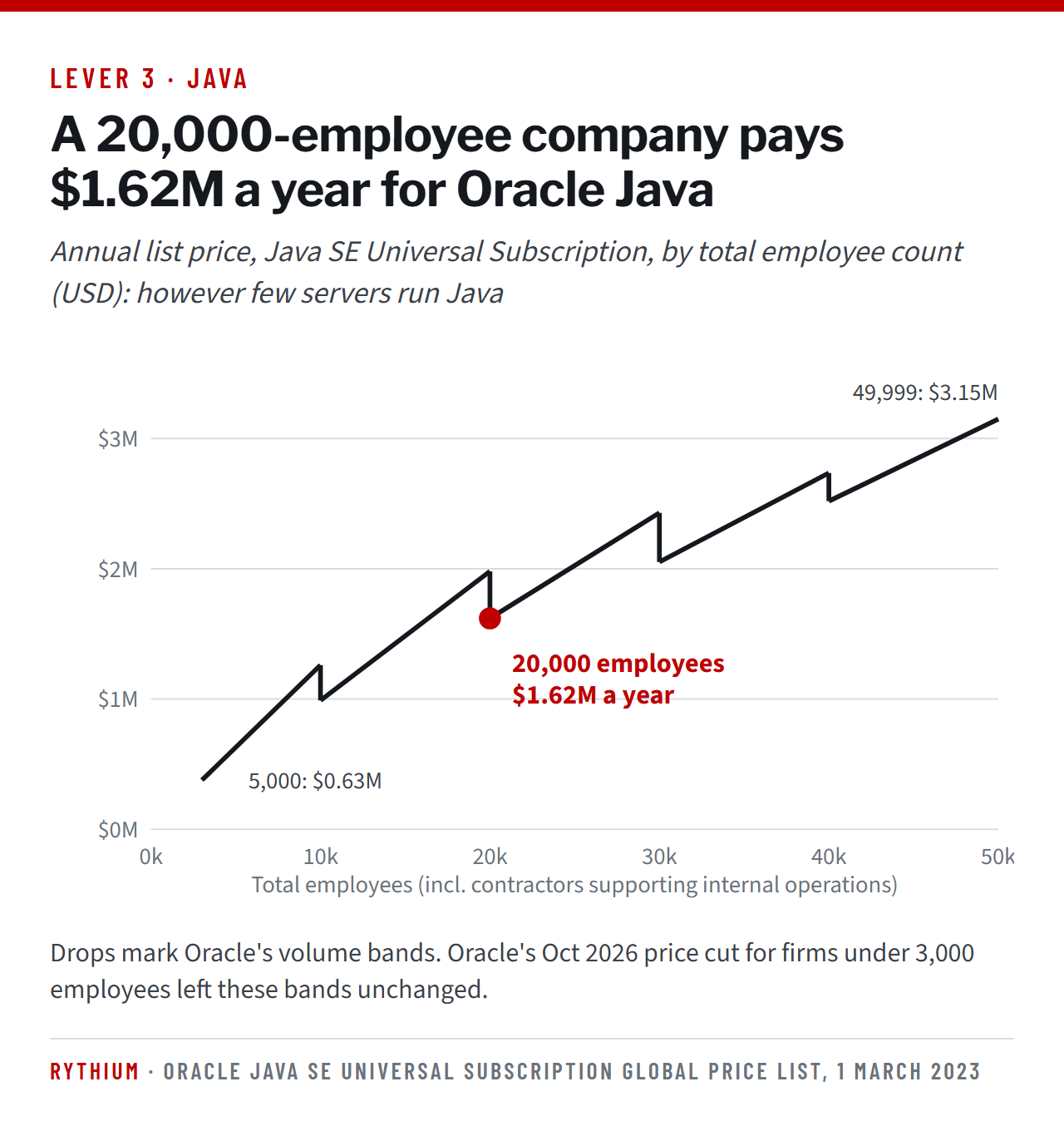
Source: Oracle Java SE Universal Subscription Global Price List (1 March 2023); annual = monthly list price × 12. Enterprise bands confirmed unchanged by Oracle on 8 October 2026.
The cost depends on payroll, not on how much Java you use. A 5,000-employee company running Oracle Java on 40 servers pays $630,000 a year at list, which works out to $15,750 per server.
That makes Java one of the quickest wins in the Oracle estate:
- Find out where Oracle Java actually runs. Many installs are old versions, bundled runtimes or desktops that can be removed.
- Move to OpenJDK builds (Eclipse Temurin, Amazon Corretto, Microsoft Build of OpenJDK and others) wherever no application depends specifically on Oracle’s build.
- Challenge the employee count Oracle quotes. Its definition is broad, but the count still has to be right.
- Keep a legacy processor or Named User Plus subscription where your existing order allows renewal on those terms.
- Watch the timing. Moving at renewal avoids paying for another year you don’t need.
Lever 04
Everything else in the Oracle estate
Beyond the ULA, support and Java, run a single optimization program across the rest of the estate. The goal is to pay for the Oracle technology you actually use, not for the licenses you happen to have accumulated.
| AREA | WHERE THE WASTE HIDES | WHAT TO DO |
|---|---|---|
| Database options and packs | RAC, Partitioning, Advanced Compression, Diagnostics and Tuning Packs enabled by default or used once | Confirm which are deployed, used and really needed, then remove or re-architect |
| Infrastructure and virtualization | VMware clusters, hard vs soft partitioning, DR replicas that pull whole hosts into scope | Redesign deployments within Oracle’s licensing rules (consolidation alone doesn’t reduce what you owe) |
| Dev, test and DR | Oversized or abandoned non-production environments | Rationalize, right-size and retire |
| Middleware | WebLogic and SOA Suite left over after migrations and acquisitions | Find overlaps and remove them |
| Entitlement reconciliation | Unused licenses, duplicate purchases, historical gaps | Reconcile what you bought against what you run, and stop buying what you already own |
Section 04
What this means for one enterprise’s AI budget
Take a large enterprise with a substantial Oracle database and middleware estate, a $20 million annual support bill, a ULA expiring in 18 months and 20,000 employees on an Oracle Java subscription. It runs a structured optimization program and finds four separate savings:
- ULA: certifies instead of renewing, avoiding a $10 million renewal fee and the $2.2 million a year of support that would have come with it
- Support: cuts 25% of the support bill through termination, negotiation and third-party support for stable products, saving $5 million a year
- Java: moves most workloads to OpenJDK and right-sizes what’s left, saving about $1 million of its $1.62 million subscription
- Other optimization: not counted here, so any savings are extra
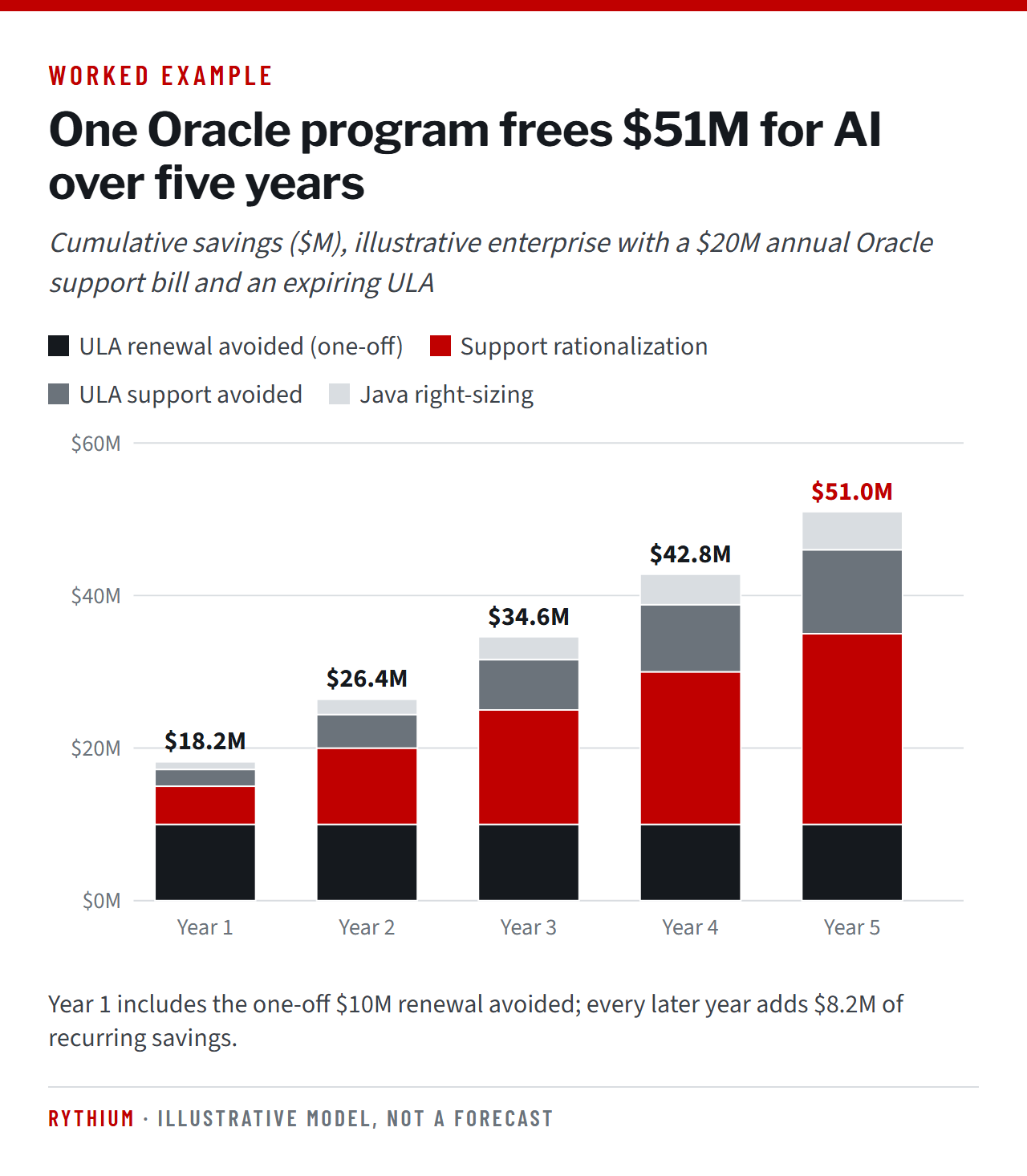
Source: Illustrative model, not a forecast. Assumes the four savings sources are separate and don’t overlap; ignores Oracle’s annual support uplift, which would make the savings larger.
That’s $10 million upfront and $8.2 million every year after. Add the recurring figures together only after checking that they don’t overlap.
It also changes the conversation with the CFO. Instead of asking for a new $10 million AI budget, the CIO can show a plan to move money that’s already being spent from a legacy category to a growth one. Few CFOs will turn that down.
Section 05
Spend it as a portfolio, not a moonshot
Don’t put the released money into one big AI program. AI pays off as a portfolio: many small bets across functions, with the winners scaled and the losers shut down quickly.
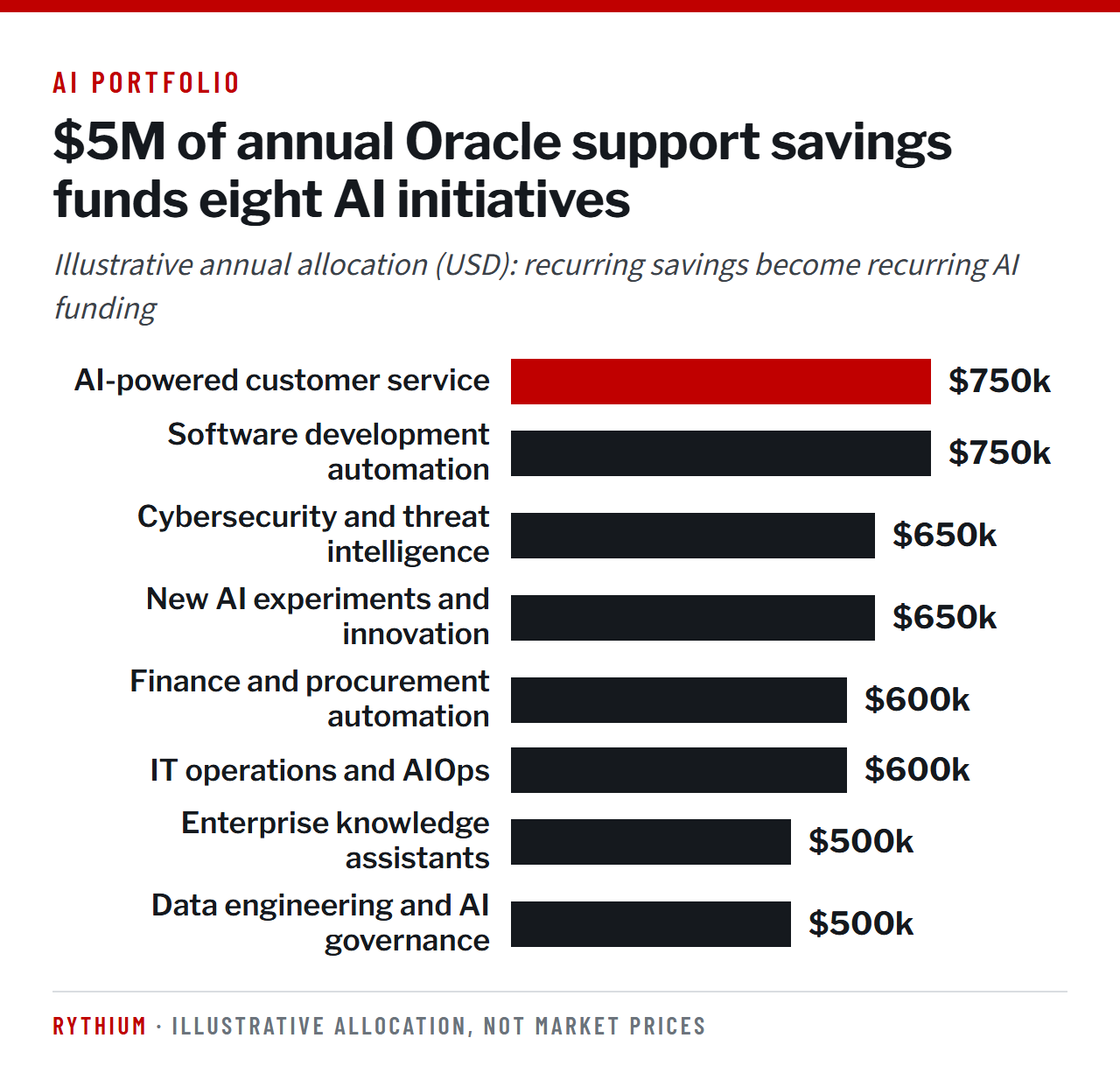
Source: Illustrative allocation, not market prices.
Some initiatives will raise productivity, some will cut operating costs and a few will open new revenue. Some experiments will fail, and that’s fine. A diversified portfolio lets you experiment without tying the business to one model, platform or vendor while the AI market is still changing every quarter.
The point is that recurring Oracle savings give you recurring AI funding: the same money comes back every year, so you can run a portfolio rather than a single pilot.
Section 06
Build an Oracle-to-AI funding program
Don’t treat Oracle optimization as a procurement side project. Tie it directly to the AI investment plan, so every dollar released has somewhere to go and an owner who’s accountable for it.
| STAGE | WHAT HAPPENS | OUTPUT | OWNER |
|---|---|---|---|
| 1. Baseline | Map all Oracle license, support and Java spend by product, business unit, application, environment and contract | A single Oracle spend baseline | CIO + procurement |
| 2. Find the savings | Assess the ULA, support, Java and other optimization separately | Opportunity list, upfront and recurring split | Licensing advisor |
| 3. Test the risk | Check each opportunity against contract rights, technical needs, compliance exposure, support policies and implementation cost | Validated, risk-adjusted savings | CIO + legal |
| 4. Ring-fence for AI | Agree with the CFO that a set share of realized savings goes to an AI reinvestment fund | AI fund with a committed annual amount | CFO + CIO |
| 5. Measure | Track Oracle spend reduced, compliance maintained, AI projects funded and value delivered | A quarterly scorecard | CIO + CFO |
Stage 3 matters most. Don’t count theoretical savings as realized savings. An Oracle optimization that triggers an audit finding or a repricing clause can wipe out a year’s gains.
Conclusion
Stop funding the past at full price
Enthusiasm won’t pay for AI. Someone has to find the money, and the CIOs who do will be the ones who stop treating legacy spend as untouchable.
Oracle is legacy software. That isn’t an insult. It’s an accurate description of how most enterprises pay for it: perpetual licenses bought long ago, support that rises every year, and a Java bill tied to headcount rather than usage. It’s also the most promising place to find AI money in the IT budget.
So, before your next Oracle renewal:
- Review your ULA and plan certification at least 12 months before expiry.
- Challenge every line of your support renewal. Terminate what you don’t use, renegotiate what you keep and consider third-party support where it fits.
- Audit your Java exposure, and decide whether you need an Oracle subscription at all.
- Optimize databases, options and middleware across production and non-production.
- Ring-fence the savings for AI, in writing, with the CFO.
You don’t need to replace a single mission-critical Oracle system, and you don’t need a bigger IT budget. You need to stop paying for what you no longer use.
Don’t ask your CFO for a new AI budget until you’ve looked at your Oracle renewal. Your next AI investment may already be in your Oracle and Java contracts.
About the author
Sheshagiri Anegondi (Sheshu) is Managing Partner of Rythium Technologies, an independent enterprise software licensing advisory firm. He has 20 years of experience in software licensing, including 16 years at Oracle Corporation, and is the author of Licensing Oracle. He advises enterprises on Oracle licensing strategy, audit defense, ULA certification and renewal, database and middleware optimization, and Java licensing.
Rythium helps enterprises understand, manage and optimize their Oracle licensing investments, so they can cut unnecessary spend while staying compliant.
Sources
- Oracle Q4 and FY2026 results press release, 10 June 2026
- Oracle Form 10-K for FY2025
- Oracle Java SE Universal Subscription Global Price List, 1 March 2023
- Oracle Java blog: new lower SMB pricing, 8 October 2026
All savings figures are illustrative ranges, not guaranteed outcomes.
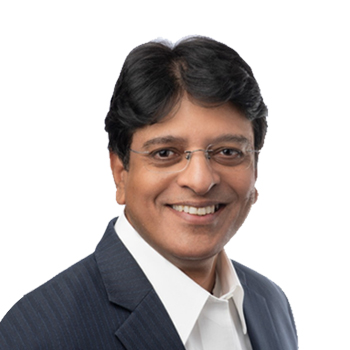
Sheshagiri Anegondi
Managing Partner of Rythium Technologies. Seventeen years at Oracle, from 1998 to 2015, in leadership roles including Vice President Sales, after Compaq and Digital Equipment Corporation.
Author of “Licensing Oracle: The Reference Manual for Managing Oracle License Compliance & Procuring Oracle Software, Hardware, Cloud & Services” (2021, ISBN 10: 1639046887).
See more of our analysis in Google: add Rythium as a preferred source