
A technical and commercial guide to the Oracle Fusion Setup and Configuration Registry (FSCR)
Oracle FSCR, short for the Oracle Fusion Setup and Configuration Registry and pronounced “FISS-ker”, is a public GitHub repository of AI skills, scripts and reference workflows that Oracle announced at Oracle AI World on 26 October 2026. AI agents use it to plan, run and validate Oracle Fusion Cloud setup, and a person approves each change before it is made.
This guide covers both sides of it: how FSCR is built and what it can do today, from a direct review of the repository, and what it changes in the price you pay implementation and maintenance partners.
“Customers can renegotiate and save up to 30% on Oracle Fusion implementation costs.”
 Sheshagiri Anegondi
Managing Partner, Rythium · Oracle Vice President, 1998 to 2015 · Author of Licensing Oracle
Key takeaways
Overview
- CIOs and procurement professionals should get an understanding of Oracle FSCR. The open-source library of knowledge will hasten implementations of Oracle Fusion and reduce SI costs.
- FSCR is real, public and growing fast. Announced at Oracle AI World on 26 October 2026, the repository currently holds 1,173 skill files across ERP, HCM, SCM and CX as of November 2026.
Licensing and support
- It is a knowledge layer for AI agents, not a product. FSCR turns requirements into setup plans, sequences dependencies, executes through REST/FBDI/HDL and setup import/export, validates, and keeps an audit trail. No change is made without human approval.
- Licensed under Oracle’s Universal Permissive License (UPL) 1.0, an open-source license.
- Oracle does not provide support for FSCR. It is not a formal product feature. Support is available from the FSCR Community on Oracle Cloud Customer Connect.
Savings for customers and negotiations with system integrators
- Configuration labor is the most exposed line in your services budget. A realistic base case trims total implementation services by around 15 to 20%, with configuration effort roughly halved. Savings are larger on setup-heavy, template-friendly scopes.
- The savings will not reach you by default. Customers will need to negotiate. Under time-and-materials or legacy fixed-price models, the implementer keeps the efficiency. Your leverage is greatest before the SOW is signed and again at every AMS renewal.
- Ask for the evidence FSCR already produces. The project workspace, approval records, validation reports and the per-skill token-usage log can be made contractual deliverables. They show how much work an agent did and give you portable handover.
1. Why this announcement matters more than it looks
Every Oracle Fusion program has a version of the same spreadsheet. It has hundreds of rows of setup tasks and owners. There are columns for the chart of accounts, business units, approval hierarchies, payroll elements, pricing strategies and role mappings.
For a decade, the gap between that spreadsheet and a working Fusion pod has been filled by consultants who know which Functional Setup Manager page to open, in what order, and what breaks if you get it wrong. That knowledge is what implementation partners sell, and it is billed by the day.
On 26 October 2026, at Oracle AI World in Las Vegas, Oracle published much of that knowledge on GitHub in a form AI agents can read and run.
The Oracle Fusion Setup and Configuration Registry (FSCR), pronounced “FISS-ker”, is a public repository of AI skills, scripts and reference workflows. Oracle’s Applications Development EVP Chris Leone described it as like having an expert Oracle product manager guiding teams through setup and configuration.
How much should you pay your consultants for implementation of Oracle Fusion?
Most commentary so far has asked whether consultants should worry. That is the wrong question for the people who pay for Fusion programs. The better question is this: if the setup knowledge is now free, maintained by Oracle, and runnable by an agent, what exactly are you paying your implementation and maintenance partners for, and does their pricing reflect it?
This article answers that in two halves. The first half is technical: what FSCR is, how it is built, and what it can and cannot do today, based on a direct review of the public repository. The second half is commercial: how FSCR changes implementation cost, and how customers should use it at the negotiating table.
1.1 A fast-moving timeline
Table 1. FSCR milestones to date
| Date | Event | Why it matters |
|---|---|---|
| 26 Oct 2026 | FSCR announced at Oracle AI World alongside AI Success Navigator, SuiteExpress and App Composer | Oracle positions agent-ready setup as the answer to slow time-to-value |
| Late Oct 2026 | Five SIs quoted in support: Accenture Edge, Apex IT, Deloitte, Grant Thornton, PwC | The large SIs are building delivery platforms on top of it, so expect it in their bids |
| Early Nov 2026 | First major update: 37 new skills, mostly SCM (Service Logistics, Intrastat, inventory, procurement) and CX (CPQ pricing and quoting), plus Payables and Fixed Assets rework | Coverage is broadening week by week |
| Early Nov 2026 | Validation framework and a cross-pillar security checkup added; the README drops the “scaffold repository” label | Oracle is no longer presenting it as a prototype |
| 6 Nov 2026 | Minimum requirement set to Release 26D with the 6 November 2026 weekly maintenance pack | Older pods need an update before FSCR can run against them |
| 13 Nov 2026 | Repository commit 4490cc9 reviewed for this article: 1,173 skill files | The baseline used for every count in this article |
2. What Oracle FSCR is, and what it is not
In Oracle’s words, FSCR is an open-source collection of reusable AI skills, scripts and reference workflows that help customers and partners automate the planning, setup, configuration and validation of Fusion Cloud Applications. Each skill describes what a setup task does, what it depends on, and how to run it safely. Workflows chain skills into sequenced work, and you can start from a plain question or a defined implementation goal.
The input is what every project already produces: requirement documents, process documents, policies and configuration workbooks. FSCR maps those to Fusion setup tasks, works out dependencies, proposes a plan and, once connected to an authorized environment, prepares data loads and setup imports, executes approved changes, and runs validation.
Table 2. FSCR at a glance: what it is and is not
| FSCR is… | FSCR is not… |
|---|---|
| A public Git repository of AI skills, scripts and reference workflows | A Fusion product feature. The README says it is not covered by Fusion Cloud product support |
| Model-agnostic: Oracle says it works with assistants from OpenAI and others. The README notes testing on a GPT-5.6-class model | An AI model or an Oracle-hosted agent. You bring your own assistant and pay for its usage |
| Released under the Universal Permissive License (UPL) 1.0 | A licensed, metered or chargeable Oracle cloud service. No pricing has been announced |
| A planner, executor and validator with human approval gates | Autonomous. No configuration change is submitted without explicit approval |
| Maintained by Oracle in step with Fusion releases | A replacement for solution design, data cleansing, change management or business ownership |
| Extensible: SIs and customers can add their own skills, accelerators and industry content | Complete. Coverage and depth vary by skill, and community posts already flag gaps in Financials |
The setup knowledge is no longer locked inside a partner’s methodology. That one fact drives most of the commercial argument later in this article.
3. Under the hood: How FSCR is built
This section is based on a direct review of the public repository at commit 4490cc9 (13 November 2026). Counts are of SKILL.md files, which include orchestration skills at offering and functional-area level as well as leaf-level setup tasks.
3.1 Eight layers, one entry point
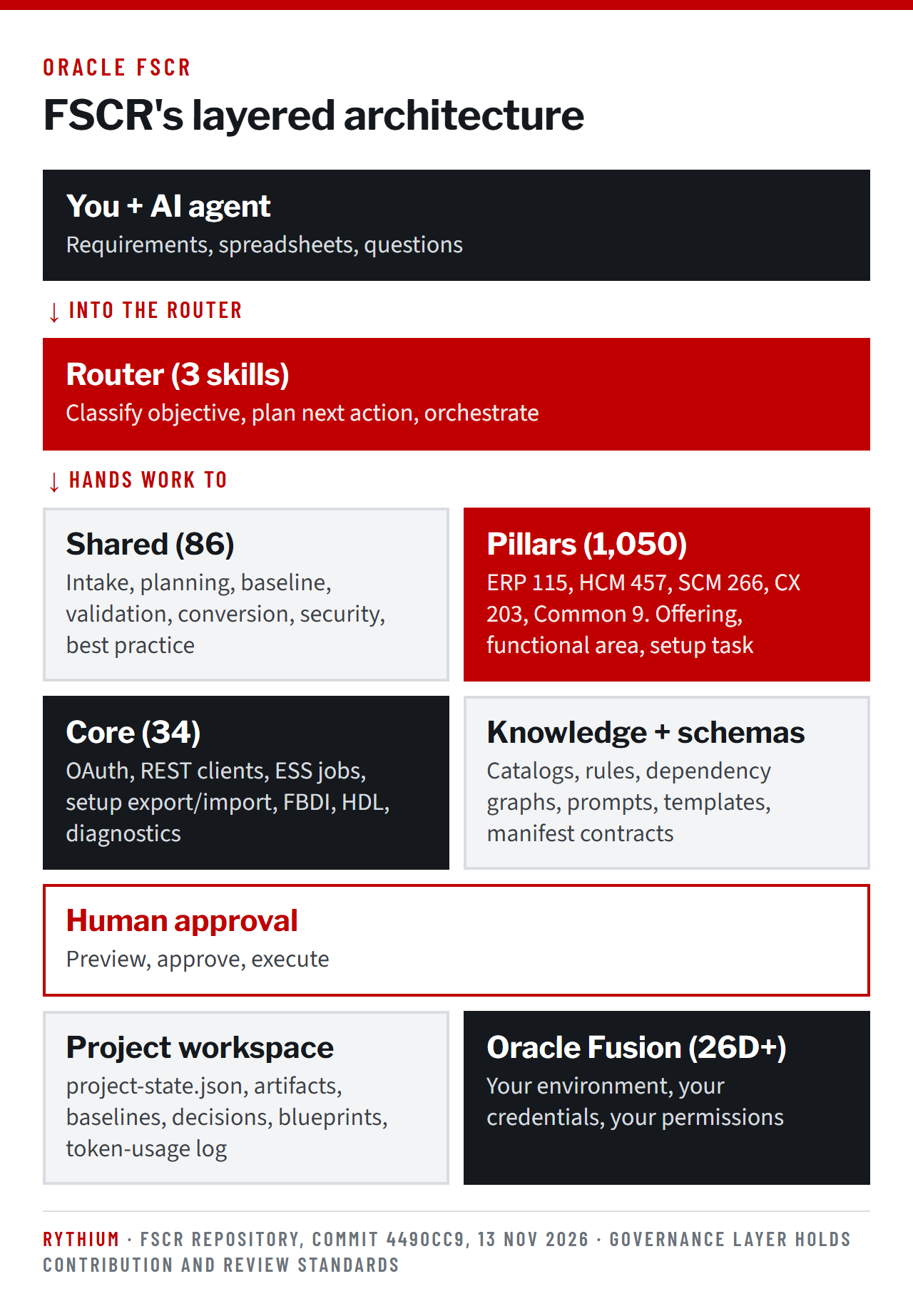
Table 3. Repository layers and what they do
| Layer | Skills | Role | What it means in practice |
|---|---|---|---|
| router | 3 | Classifies the implementation objective, decides the next action, orchestrates other skills | One canonical entry point, so every engagement starts with the same intake logic |
| core | 34 | OAuth (PKCE) authentication, REST clients, ESS job handling, setup export/import, FBDI, HDL, diagnostics | The plumbing that lets an agent act on a real Fusion pod |
| shared | 86 | Intake, scope, planning, baseline assessment, validation, best practice, conversion, integration, security, reporting, instance strategy | The implementation method that SIs have traditionally packaged and sold |
| pillars | 1,050 | Domain skills for ERP, HCM, SCM, CX and common security | Offering → functional area → setup task guidance and execution |
| knowledge | – | Catalogs, rules, reference models, dependency graphs, prompts, templates | The dependency graph is the real IP. It encodes what must exist before what |
| schemas | – | Machine-readable contracts for skill manifests and project artifacts | Makes output consistent and auditable across partners |
| governance | – | Contribution standards, review checklists, naming, release management | How Oracle and partners add skills without breaking the registry |
| project | – | Local workspace: state, outputs, exports, baselines, decisions, blueprints | The persistent project record and the basis for handover |
3.2 Coverage by pillar
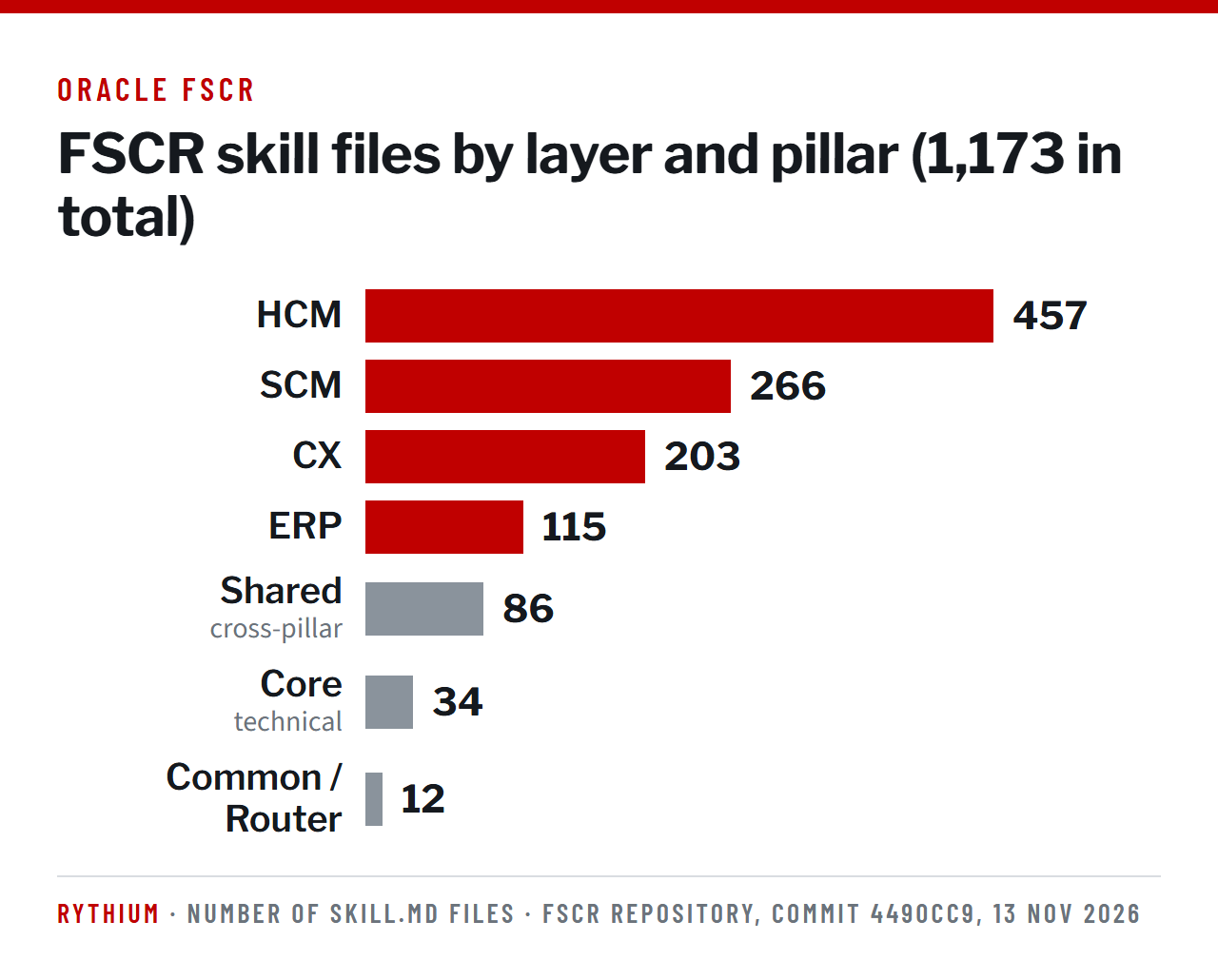
Three observations stand out. First, HCM leads with 457 skills, spanning Global HR, Payroll, Absence, Time, Benefits, Compensation, Talent, Recruiting, Learning and HCM security. Second, SCM (266) and CX (203) are growing fastest; the first update added Service Logistics, Intrastat and CPQ pricing.
Third, ERP has only 115 skills, across Financials, Accounting Hub, Projects, Grants and Public Sector. That is thin for the pillar where design decisions (ledger structure, accounting method, intercompany) carry the most risk. Customer Connect threads already discuss missing Financials setup tasks.
Table 4. Offerings visible in the repository, by pillar
| Pillar | Skills | Offerings and areas present |
|---|---|---|
| HCM | 457 | Global HR, Global Payroll, Absence, Time, Workforce Scheduling, Benefits, Compensation, Goals, Performance, Talent Review, Succession, Recruiting, Learning, HCM Communicate, HCM Security |
| SCM | 266 | Manufacturing and Supply Chain Materials Management, Order Management, Procurement, Product Management, Supply Chain Planning |
| CX | 203 | Sales, Sales and Marketing, Marketing, Service, Field Service, CPQ, Subscriptions, Customer Data Management, Loyalty, PRM |
| ERP | 115 | Financials (incl. General Ledger, Payables, Fixed Assets), Fusion Accounting Hub, Project Execution and Financial Management, Grants, Public Sector (Permits, Licences, Code Enforcement, Planning and Zoning), Risk and Security |
| Common | 9 | Security Console |
3.3 Anatomy of a skill
Every skill is a Markdown file with a structured YAML header, the manifest, followed by guidance. The manifest is what makes the registry machine-actionable. It declares inputs, outputs, dependencies, the core services the skill may call, how it updates project state, and how its run is logged.
Inside a skill file (abridged from the repository)
skill_id: "erp.public-sector-permits"
layer: "pillar" pillar: "ERP" type: "orchestration"
execution_mode: "assisted"
inputs: implementation_objective, project_context, erp_scope, ...requirements
outputs: scope, functional_area_skill_plan, work_products, token_usage_record
depends_on:
 - shared.project-intake.scope-definition
 - shared.implementation-planning.offering-task-map-builder
uses_core: project-state-manager, artifact-registry-manager, artifact-version-manager
persists_project_state: true
token_usage_tracking:
 enabled: true granularity: "per_skill_run"
 required_fields: skill_id, task, files_read, artifacts_written,
 estimated_input_tokens, estimated_output_tokens, ...
state_updates: scope, setup_task_sequence, design_decisions, configuration_blueprints
Two fields deserve attention from anyone negotiating a contract. depends_on makes sequencing explicit and checkable. A reviewer can see what each task needs to exist before it runs. token_usage_tracking is switched on in 1,140 of the 1,173 skills.
Every skill run writes a record of what it read, what it wrote, and an estimate of the tokens it consumed to a log in the project workspace. That log is, in effect, a timesheet for the agent.
3.4 Execution modes: how much the agent actually does
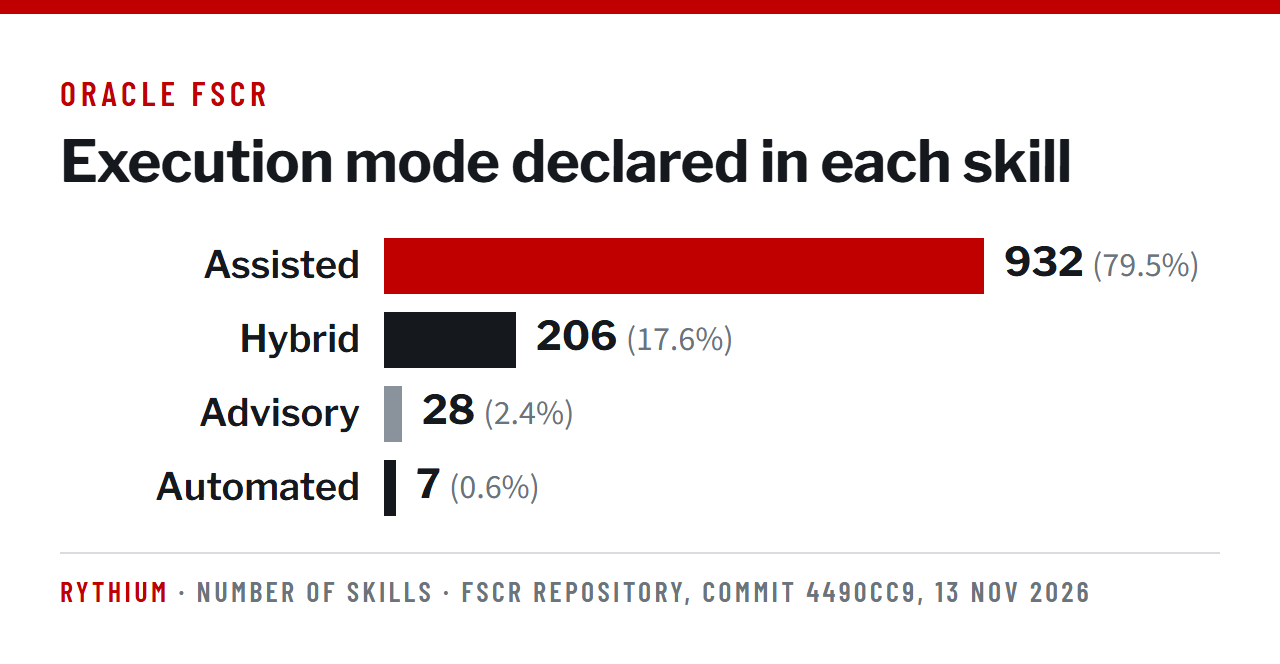
Table 5. The four execution modes
| Mode | Count | Meaning | Commercial reading |
|---|---|---|---|
| Assisted | 932 | Agent prepares the work (plan, payload, import file) for human review before anything is applied | The agent does the labor, a human does the judgment. This is where day-rate effort collapses |
| Hybrid | 206 | Mix of agent execution and human-performed steps (for example UI-only tasks) | Partial savings. Ask the partner which steps stay manual |
| Advisory | 28 | Guidance only, no execution | Knowledge that used to be in a consultant’s head is now free |
| Automated | 7 | Controlled execution of technical services (none in the pillar layer) | Plumbing such as authentication and jobs, not business configuration |
This distribution is the most honest signal of Oracle’s ambition. FSCR is not trying to remove the human from Fusion configuration. It is trying to remove the human from the keyboard while keeping the human in the approval chair. That model fits regulated enterprises well, and it is also exactly the model that should change how services are priced.
3.5 Safety rails: approvals, validation, security
- Approval gates. FSCR makes no configuration change until you approve it. The agent shows the exact change; if anything is modified, it must produce a new preview. Approval language appears in 737 skill files.
- Validation framework. The shared validation layer now covers pre-validation (environment readiness), setup-data and reference-data validation, configuration completeness against requirements, cross-pillar dependency checks, transactional validation (a test transaction with clean-up), and an implementation summary built from recorded evidence.
- Security checkup. A cross-pillar skill reviews sensitive access and toxic role combinations, and the security-console skills cover job roles, duties, data security policies, provisioning rules and bulk provisioning.
- Identity. Authentication uses OAuth with PKCE against a public client you register, with your own credentials and permissions. FSCR ships no environment and no credentials.
- Rollback. This is the weak spot. Baseline exports exist, but explicit rollback guidance appears in only 32 skill files. Greyhound Research also flags that Oracle’s announcements do not describe rollback of agent-applied configuration.
3.6 Prerequisites
Table 6. What you need before FSCR can touch a pod
| Requirement | Detail |
|---|---|
| Fusion release | Release 26D with the 6 November 2026 weekly maintenance pack, or later |
| Environment | An authorized test pod; FSCR does not include one. Start in a non-production environment |
| Authentication | A registered public OAuth client (PKCE) and a populated environment properties file |
| Runtime | Python 3.10+ (3.11 or 3.12 recommended) for repository scripts |
| AI assistant | A capable coding agent (Codex, Claude Code and VS Code-based agents are being used in the field); model reasoning quality affects results |
| People | A functional lead who can judge the plan, a security owner, and a business owner for each process |
4. How an FSCR-assisted implementation actually runs
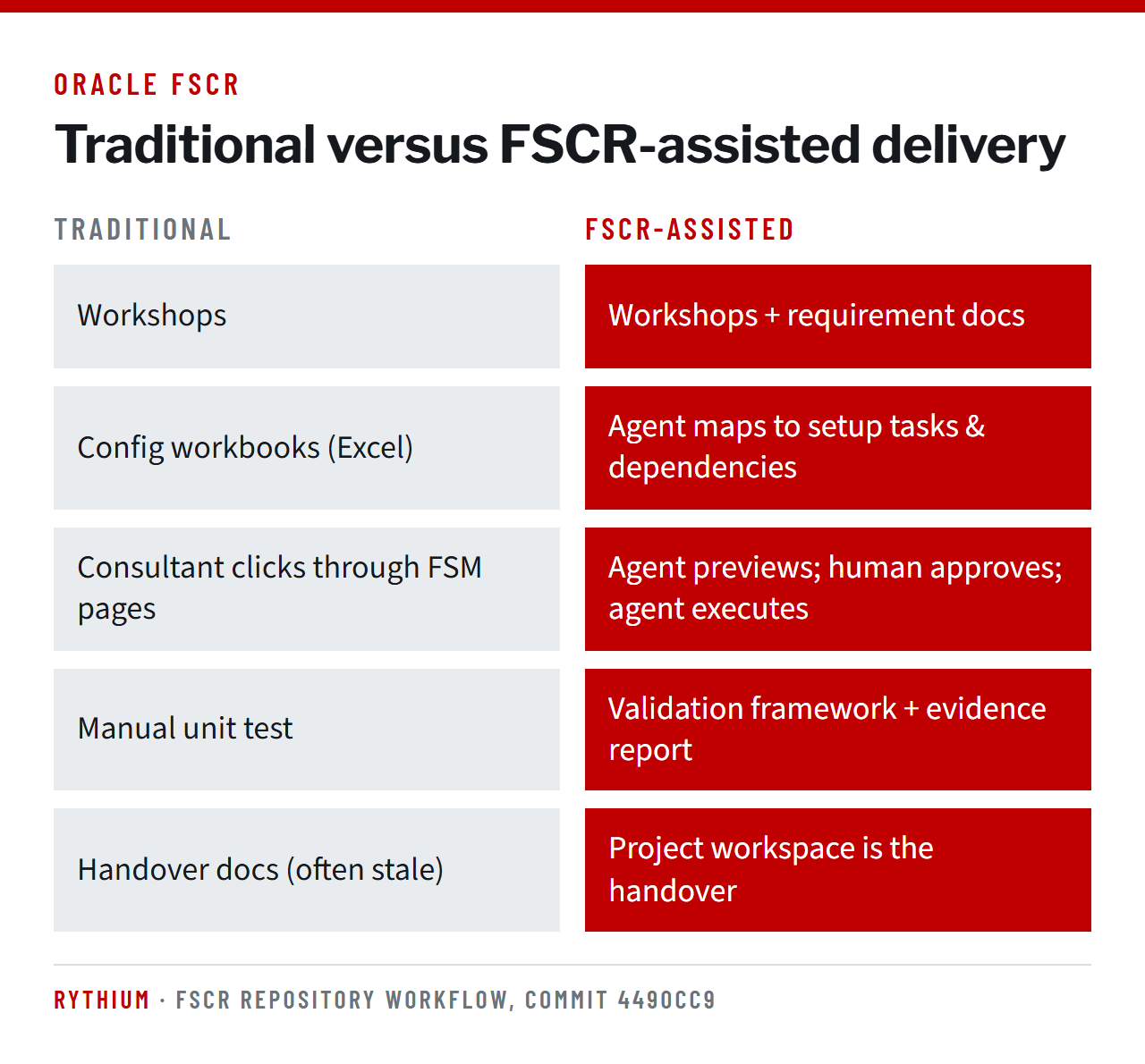
- Onboard. Clone the repository, open it in the AI assistant, and ask FSCR to introduce itself. Onboarding explains the layers and walks through OAuth setup.
- Intake and scope. The router classifies the objective by pillar, offering, functional area, scope, geography and delivery phase. Shared intake skills then capture the business requirements, implementation scope, enterprise structure, country localization and integration landscape.
- Map and plan. Requirements and workbooks are mapped to the setup task catalog. The dependency graph produces a sequenced setup task plan and runbook that a human reviews.
- Baseline. Existing configuration is exported and stored in the workspace, so you can compare it before and after and check it against Oracle’s recommended practice.
- Preview, approve, execute. For each task, the agent prepares the payload (REST call, FBDI or HDL file, setup import) and shows it. A named human approves; the agent executes and records the result.
- Validate. Configuration completeness, cross-pillar dependencies, security, and a transactional test with clean-up. An evidence-based summary report is generated.
- Persist and hand over. project-state.json, artifacts, decisions, blueprints and the token-usage log stay in the workspace, which can be resumed in a later session or by a different team.
Practitioners who have tried it describe the same pattern. When asked to create a primary ledger, the agent first checks that the chart of accounts, calendar and currency exist.
The agent can execute, but someone still has to design the chart of accounts and decide the calendar, currencies and enterprise structure. The consultant’s value moves from knowing which page to click to knowing what the setup should be and spotting when it is wrong.
5. What FSCR means for implementation partners
For systems integrators, FSCR is both a gift and a threat. The gift is a free, Oracle-maintained foundation that removes the need to rebuild the same setup logic on every project. Grant Thornton made this point in Oracle’s release. The threat is that the same foundation is available to every competitor, every offshore boutique, and every customer’s internal team.
Table 7. Implementor benefits and the uncomfortable flip side
| Benefit to the implementor | Flip side the customer should notice |
|---|---|
| Less time translating workbooks into setup steps and tracking dependencies | Configuration days in the estimate should fall. If they have not, ask why |
| Consistent, repeatable delivery across consultants and geographies | Less dependence on scarce senior functional consultants means a leaner, cheaper blend |
| Built-in validation and evidence reporting | Testing and documentation effort should shrink, not be billed as before |
| Persistent project workspace and decision log | Handover to the customer or an AMS provider becomes much easier, which reduces partner lock-in |
| A platform to add proprietary accelerators and industry skills (PwC, Deloitte, Apex IT) | The differentiator moves to design, industry IP and review quality, so evaluate bids on those |
| Ability to staff with fewer, more senior reviewers | Pyramid-based pricing (many juniors billed at blended rates) loses its justification |
5.1 The skill shift inside delivery teams
Implementation teams will probably shrink for setup-heavy work. Effort moves from repetitive configuration to process design, data quality, integration and review. The consultants who will remain valuable are those who can:
- Explain why Standard Accrual rather than Standard Cash, not just where the field sits.
- Read an agent’s plan and catch a bad dependency before it lands.
- Design the enterprise structure the agent will build.
- Validate results against the business requirement rather than the screen.
That is a smaller, more senior team. Commercially, it should mean fewer billable days at a somewhat higher average rate, and a lower total. If a bid shows the old pyramid at the old volume, the efficiency is being kept by the partner.
5.2 The business-model problem SIs will not say out loud
Most Fusion implementations are still priced on effort: time and materials, or fixed price derived from an effort estimate. Under T&M, every hour an agent saves is an hour of lost revenue. Under fixed price built on a pre-FSCR estimate, every saved hour becomes extra margin. Neither model passes savings to the customer on its own. The customer has to ask for them.
6. What FSCR means for end customers
Table 8. Customer benefits and how to capture each one
| Benefit | How to capture it |
|---|---|
| Faster time-to-value: less elapsed time between contract and go-live | Compress the plan in the SOW; tie milestones to tested processes |
| Lower services cost on setup, conversion and testing | Re-baseline effort estimates; use step-level or outcome pricing (Section 8) |
| Oracle-maintained best practice, updated with each release | Run a baseline comparison of your current configuration against the registry before scoping changes |
| Transparent, reviewable plans and decisions | Make the runbook, decision log and approval records contractual deliverables |
| Evidence-based validation and security checks | Require the validation report and security checkup output at each milestone |
| Portable project record and less partner lock-in | Own the workspace repository; make handover a no-cost obligation |
| Ability to do small changes in-house | Build an internal FSCR competency for minor configuration changes after go-live |
Caveats customers must keep in view
- Not product-supported. FSCR is reference material outside Fusion Cloud product support. If an agent misconfigures something, an Oracle SR will not cover the agent. Support is available from the FSCR Community on Oracle Cloud Customer Connect.
- Coverage gaps. Depth varies by skill. ERP coverage is thinner than HCM. Check that your scope is actually covered before assuming savings.
- Rollback is immature. Insist on baseline exports before every agent run and a tested way back.
- Best practice can flatten differentiation. If your design matches the registry everywhere, ask whether you have lost something that made your process better.
- Review becomes the control point. Configuration holds approvals, roles and limits. Approving agent-drafted configuration is in effect approving delegated authority.
7. How FSCR reduces the cost of Oracle Fusion implementation
Oracle has not published time-savings figures for FSCR, and its press release contains no percentages. The strongest public data point is Lexington Health’s reported 80% reduction in certain design and configuration efforts. Greyhound Research classes that as self-reported from a project still under way. Greyhound’s advice is the right starting point: treat the figures as grounds for a pilot, not as a basis for a budget.
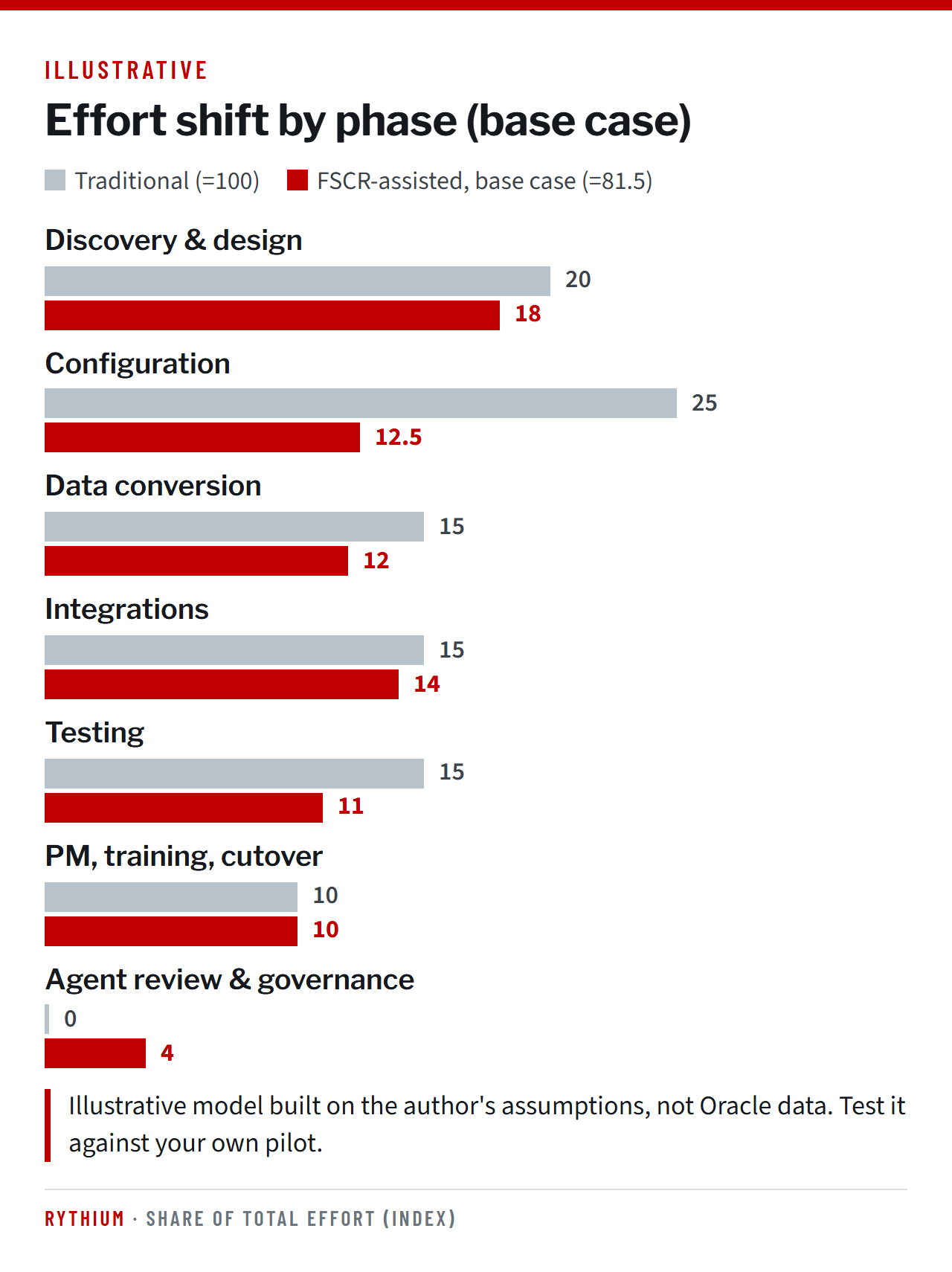
With that caution in mind, the model below estimates where effort moves. It uses a typical effort distribution for a mid-sized multi-pillar Fusion program and applies conservative reductions to each phase. It also adds a new cost line that most vendor material leaves out: agent review and governance.
Table 9. Illustrative effort model by phase (traditional = 100)
| Phase | Traditional | FSCR base case | Change | Why |
|---|---|---|---|---|
| Discovery and design | 20 | 18 | −10% | Best-practice guidance and structured intake speed workshops; design decisions stay human |
| Configuration | 25 | 12.5 | −50% | Agent maps, sequences and executes assisted tasks; humans review |
| Data conversion | 15 | 12 | −20% | FBDI/HDL preparation and validation skills; data cleansing does not shrink |
| Integrations | 15 | 14 | −7% | Limited coverage today; custom integration work largely unchanged |
| Testing | 15 | 11 | −27% | Automated validation and transactional tests; UAT and business sign-off remain |
| PM, training, cutover | 10 | 10 | 0% | Change management and cutover are unchanged |
| Agent review and governance (new) | 0 | 4 | new | Named reviewers, delegation co-signs, audit sampling, environment setup, LLM usage |
| Total | 100 | 81.5 | −18.5% |
7.1 Three scenarios
Table 10. Scenario assumptions
| Scenario | Total services saving | When it applies |
|---|---|---|
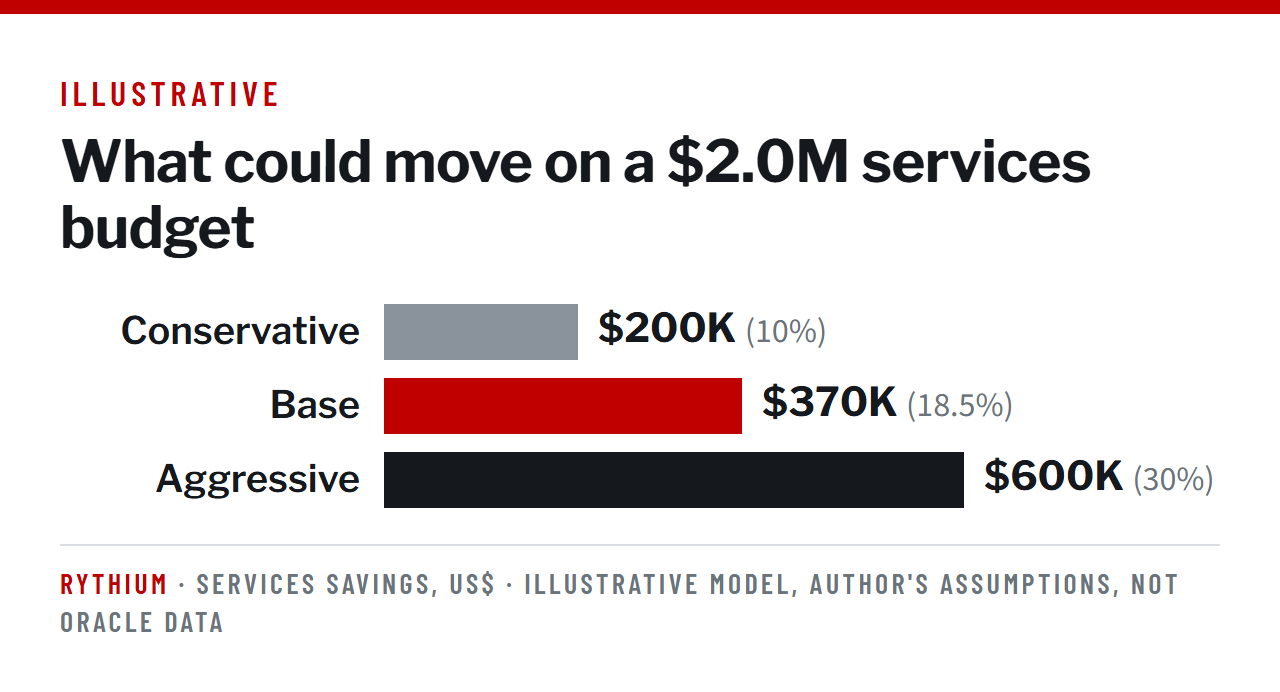
| Conservative | ~10% | ERP-heavy scope with thin skill coverage, heavy customization and integrations, partner new to FSCR |
| Base | ~18.5% | Multi-pillar scope, standard processes, partner with some FSCR experience, decent data quality |
| Aggressive | ~30% | HCM/SCM/CX-heavy, template-friendly scope, clean data, partner with a mature FSCR delivery platform, phased rollouts reusing artifacts |
7.2 A worked example
Take a US$2.0 million services budget for a Fusion ERP + HCM implementation, about 2,000 consultant days at a blended US$1,000 per day. In the base case:
Table 11. Worked example, US$2.0M services budget (illustrative)
| Line | Traditional (US$K) | FSCR base (US$K) | Delta (US$K) |
|---|---|---|---|
| Discovery and design | 400 | 360 | −40 |
| Configuration | 500 | 250 | −250 |
| Data conversion | 300 | 240 | −60 |
| Integrations | 300 | 280 | −20 |
| Testing | 300 | 220 | −80 |
| PM, training, cutover | 200 | 200 | 0 |
| Agent review and governance | 0 | 80 | +80 |
| Total | 2,000 | 1,630 | −370 |
A US$370K saving in the base case is significant, but notice where it comes from: almost 70% is configuration. That is exactly the work most likely to be estimated in bulk and priced in a fixed-price wrapper. If the bid does not show configuration effort explicitly, you cannot see whether the saving has been passed through.
7.3 What does not get cheaper, and what gets more expensive
- Design decisions: enterprise structure, chart of accounts, accounting rules, approval hierarchies and payroll design remain human work and are where most go-live risk sits.
- Data quality: agents load bad data faster and more consistently. Greyhound recommends a data workstream that gates configuration.
- Custom integrations and extensions: coverage is limited today, and Greyhound recommends that agent-written integration code go through normal change control.
- Review effort: senior reviewers cost more per day than the juniors they replace, and good review is now the scarcest skill on the project.
- AI usage costs: someone pays for the model’s tokens. The token-usage log makes this measurable, so agree in advance who bears it.
7.4 How strong the evidence is
Table 12. Evidence ladder, adapted from Greyhound Research (October 2026)
| Level | Evidence | How to use it |
|---|---|---|
| Documented | The registry is public and can be tested against your own configuration today | Run a baseline comparison now, before any agent touches a pod |
| Measured (third party) | Lexington Health: 80% reduction in certain design and configuration efforts, self-reported mid-project | A signal, not a benchmark. Ask for scope and definitions |
| Described | Five SIs back the approach; NetSuite customers report faster projects without measures | Ask each bidder for their own measured FSCR results |
| Claimed | SuiteExpress: implementation in “weeks or even days” (NetSuite, not Fusion) | Do not carry it across to Fusion estimates |
| Not yet evidenced | Full-program results; dates for most companion components | Plan a pilot before committing budget |
8. Negotiating with your implementation partner
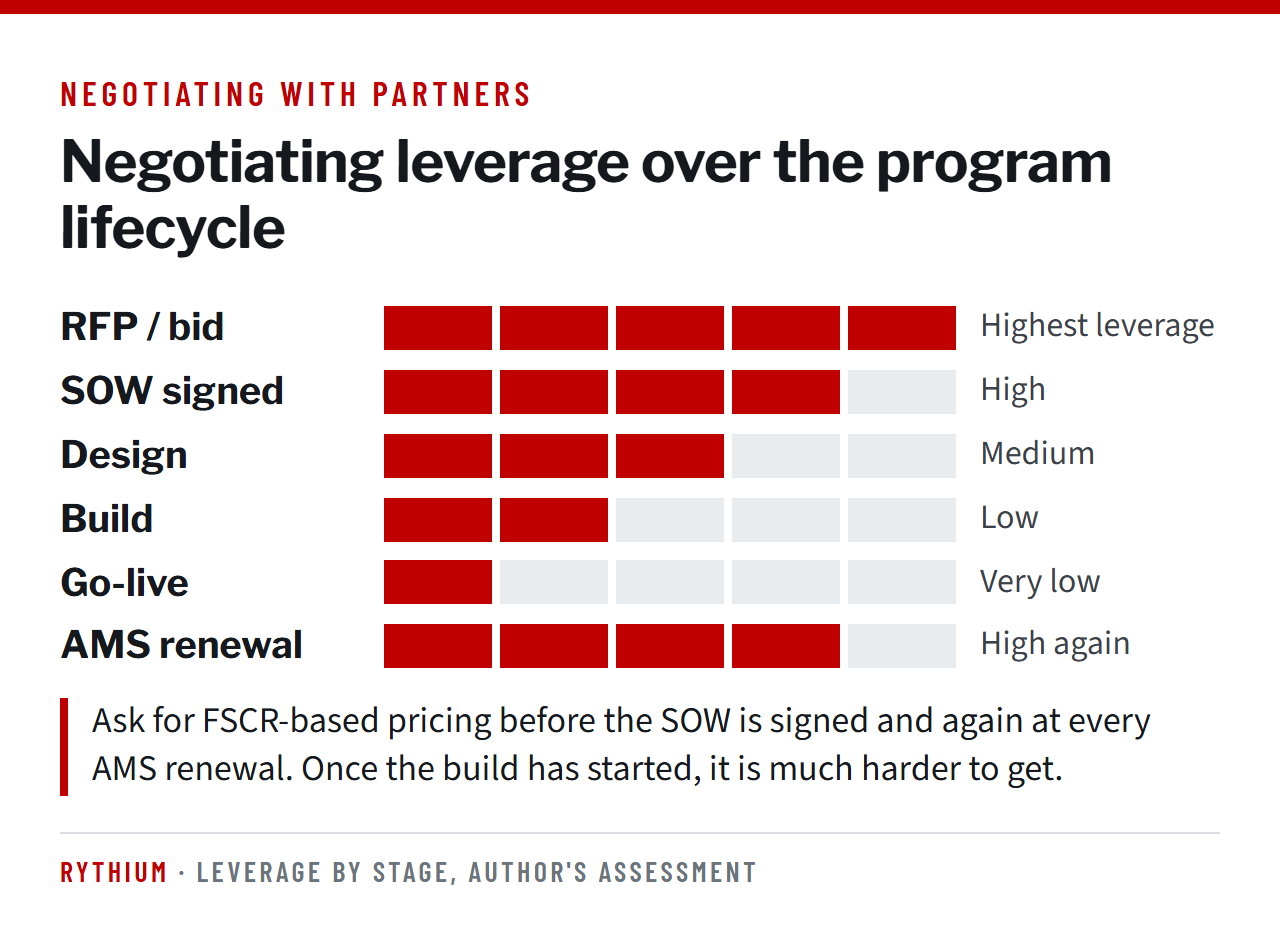
The core principle is simple: the contract decides who keeps the time the agents save. Without explicit terms, the default is the partner. Your leverage is also time-bound. It is highest before the SOW is signed, falls through the build, and only comes back at renewal points.
8.1 Put FSCR into the RFP
Make every bidder answer the same questions, in writing, before you shortlist:
- Will you use FSCR (or an FSCR-based platform) on this program? For which pillars and offerings?
- Which setup tasks will an agent perform, which will people perform, and how is each priced?
- Show your effort estimate with and without FSCR, by phase. What reduction have you applied, and why?
- What measured results do you have from previous FSCR projects (scope, effort, defects)?
- Which proprietary skills or accelerators will you add on top? Who owns them, and will we keep them after the project?
- Who are the named reviewers per area, and what are their certifications and experience?
- Under which identity will the agent act in our environment, and with what access?
- How will you baseline and roll back agent-applied configuration?
- Who pays for AI model usage, and will you share the token-usage logs?
- Will you hand over the complete FSCR project workspace at each milestone and at exit?
8.2 Pricing models compared
Table 13. Who keeps the FSCR efficiency under each pricing model
| Model | Who keeps the saving | Verdict |
|---|---|---|
| Time and materials | Partner loses revenue, so it has little incentive to use agents fully | Avoid for configuration-heavy phases |
| Fixed price on a pre-FSCR estimate | Partner keeps 100% as margin | Re-baseline the estimate before signing |
| Fixed price on an FSCR-adjusted estimate | Shared, if the adjustment is transparent | Acceptable with an open-book effort model |
| Step-level pricing (agent steps priced separately) | Customer, with visibility | Recommended for configuration and conversion |
| Outcome milestones (configured, tested, accepted process) | Shared, aligned with value | Recommended for payment triggers |
| Gain-share on agreed baseline | Shared by formula | Good for large multi-phase programs |
8.3 Ten clauses to add to your SOW
The first eight build on the nine statement-of-work clauses proposed by Greyhound Research. The last two are additions specific to FSCR’s design.
Table 14. SOW clauses for FSCR-assisted delivery
| # | Clause | What to ask for |
|---|---|---|
| 1 | Agent-use declaration | A task-by-task list of what agents perform and what people perform, updated at each phase |
| 2 | Step-level pricing | Agent-assisted steps priced separately and lower than human-performed steps |
| 3 | Outcome milestones | Payment tied to configured, tested and accepted business processes, not hours or configuration completion |
| 4 | Review and sign-off | Named expert reviewer per area. The delegation-of-authority owner co-signs changes to approvals, roles and limits. The drafter never approves its own output |
| 5 | Agent record and export | For every agent output: draft, reviewer, changes, decision and date, exportable by the customer at any time |
| 6 | Rollback baseline | A configuration baseline exported before each agent run, with a tested rollback path |
| 7 | Identity and access | Named project accounts with least-privilege access per task; no shared super-user for the agent |
| 8 | Staff certification | Named team members, including reviewers, with evidence of training on FSCR and the agents used |
| 9 | Workspace ownership and handover | The FSCR project workspace (state, artifacts, decisions, blueprints, baselines) is customer property, in a customer-owned repository, delivered at every milestone and at exit at no extra charge |
| 10 | Token-log transparency and efficiency share | Token-usage logs shared monthly. If agent-assisted share exceeds the bid assumption, an agreed portion of the saving is credited back. AI usage cost is capped or passed through at cost |
8.4 What not to do
- Don’t demand a flat percentage cut. It invites quality shortcuts. Ask for a transparent re-baseline and step-level pricing instead.
- Don’t squeeze review effort. Review is now the control point. Pay properly for senior reviewers and cap what each signs per cycle to prevent rubber-stamping.
- Don’t let the partner’s proprietary layer become the new lock-in. If they add skills on top of FSCR, agree license terms for continued use after exit.
- Don’t accept timelines that depend on components without written availability. Confirm status, region and edition in writing.
9. Negotiating with your Fusion Apps maintenance (AMS) partner
FSCR is not only an implementation story. After go-live, a large share of Fusion managed-services effort is configuration work: quarterly update impact analysis and regression testing, new business units or legal entities, approval-rule changes, role and security changes, new payroll elements, pricing updates and feature opt-ins. Much of this is exactly what FSCR’s assisted skills, baselines and validation framework are designed for.
Table 15. Typical AMS workload and FSCR exposure (illustrative)
| AMS activity | Typical share of effort | FSCR exposure | Negotiation ask |
|---|---|---|---|
| Quarterly update impact analysis and regression | 20 to 25% | High: baseline export, registry diff, automated validation | Fixed, reduced fee per quarterly update; evidence report as deliverable |
| Configuration change requests (BUs, approvals, elements, pricing) | 25 to 30% | High: assisted skills with approval gates | Lower unit price for configuration tickets; tiered by agent-assisted vs manual |
| Security and role administration | 10 to 15% | Medium-high: security console skills and toxic-combination checkup | Periodic security checkup included in base fee |
| Incident and break-fix | 20 to 25% | Low-medium: diagnostics skills help triage | Keep SLA-based pricing; ask for faster resolution targets |
| Reports, integrations, extensions | 10 to 15% | Low today | Unchanged; review at renewal as coverage grows |
| New feature opt-in and enhancement | 5 to 10% | Medium: planning and assisted setup | Price as mini-projects with step-level pricing |
9.1 Levers to pull at the next AMS renewal
- Re-rate configuration tickets. Separate configuration requests from incidents and price agent-assisted configuration at a lower unit rate.
- Fix the quarterly-update fee. Ask for a fixed, lower price per update cycle, with a registry diff and validation evidence report as the deliverable.
- Reduce the FTE floor. Dedicated-FTE contracts built around configuration volume should shrink. Move to ticket or outcome pricing for the configuration element.
- Demand the workspace. The AMS provider should maintain the FSCR project workspace in your repository so that you can switch providers without a costly knowledge transfer.
- Insource the simple work. Keep low-risk, high-frequency changes in-house with an FSCR-trained internal analyst. Use the AMS partner for review and complex changes.
- Run a competitive benchmark. FSCR lowers switching costs. Use that credibly at renewal, even if you intend to stay.
Illustrative AMS impact
On a US$600K annual AMS contract where configuration and quarterly-update work make up about half of effort, a 30 to 40% efficiency on that half implies US$90K to US$120K a year of potential reduction before governance costs. Over a three-year renewal term that is US$270K to US$360K: enough to justify a structured renegotiation. These figures are illustrative, so validate them with your own ticket data.
10. Risks and governance
Agents that draft setup move risk into review rather than removing it. Greyhound Research notes that Oracle’s announcements describe human approval at only two of six implementation stages (design and configuration). Identity, logging, authority bounds and rollback are not yet fully described. Until they are, customers need their own controls.
Table 16. Four risks, early warning signs and remedies (after Greyhound Research)
| Risk | Owner | Early warning | Remedy |
|---|---|---|---|
| Best practice flattens what differentiates you | Process owners | Design matches the registry everywhere | Short register of intended departures, checked at design review |
| Drift from the registry | Enterprise apps team | A registry change touches approvals or limits | Compare registry history with your configuration at each Fusion update |
| Review slides into rubber-stamping | Program director, internal audit | Approval time falls as volume rises; reviewers approve outside their area | Cap what each reviewer signs per cycle; audit sampling |
| Agents carry bad data further | Data lead | Test failures cluster around reference data | Data workstream that gates configuration |
10.1 Minimum control set
- No drafter approves its own output, whether the drafter is an agent or a person.
- Changes to approvals, roles and limits are co-signed by the delegation-of-authority owner.
- One program record links every setting to its design decision and approver.
- Internal audit samples the record at configuration and testing.
- Testing is checked against business requirements, not only against the configuration.
- Agent-written integration code goes through standard change control and security review.
- Configuration is baselined before every agent run, with a tested rollback.
11. A 90-day action plan for customers
Table 17. 90-day plan
| Window | Actions | Owner |
|---|---|---|
| Days 0 to 30 | Clone FSCR; run onboarding in a sandbox. Export your current configuration and compare it with registry best practice. Check skill coverage for your in-scope offerings. Get Oracle’s written status for companion components | Head of enterprise applications |
| Days 15 to 45 | Pilot one bounded area (for example an absence plan, a sales qualification template, or a procurement BU) with your partner. Measure effort, defects and review time against a traditional baseline | Program director + partner |
| Days 30 to 60 | Update RFP and SOW templates with the ten clauses. Prepare an open-book effort model. Define reviewer roles and delegation co-sign rules | CIO, procurement, legal |
| Days 45 to 75 | Open renegotiation with the AMS partner using ticket data: separate configuration from incidents, fix the quarterly-update fee, require workspace maintenance | Vendor management |
| Days 60 to 90 | Train one or two internal analysts on FSCR for low-risk changes. Set up the control set, audit sampling and baseline/rollback routine | Enterprise apps + internal audit |
12. Conclusion: The knowledge is free, the judgment is not
FSCR is the clearest signal yet that Oracle wants Fusion implementations to be faster, more consistent and less dependent on individual consultants’ memory. The technical design, with a router, a dependency graph, approval gates, validation, a persistent workspace and per-skill token logs, is thoughtful and built for governed enterprises. It is not finished. Coverage is uneven, rollback is immature, and the outcome evidence is still early.
The commercial consequence, however, is already here. Setup knowledge that partners used to sell by the day is now public, licensed permissively, and maintained by Oracle. What remains valuable is design, data, integration, review and accountability. Customers should pay well for those, and stop paying day rates for the rest.
That will not happen on its own. It happens in the RFP, in the SOW, and at the AMS renewal table, when customers ask the right questions and require the evidence FSCR already produces. The partners who welcome those questions are the ones worth hiring.
FSCR changes what you pay implementation and AMS partners. What you pay Oracle for the Fusion subscription itself is a separate negotiation: our Oracle SaaS optimization page sets out how Fusion subscriptions are measured and right-sized, and the Oracle Fusion renewal case study shows one renewal rebuilt around what was actually used.
If an implementation, an AMS renewal or a subscription renewal is on your plan, talk to us.
Questions about Oracle FSCR
What does FSCR stand for in Oracle?
FSCR stands for Fusion Setup and Configuration Registry, pronounced “FISS-ker”. It is Oracle’s public Git repository of AI skills, scripts and reference workflows for planning, setting up, configuring and validating Oracle Fusion Cloud Applications across ERP, HCM, SCM and CX. The repository’s own README names it the Oracle Fusion Setup and Configuration Skills Registry.
Where is Oracle FSCR on GitHub?
Oracle publishes it at github.com/oracle/Fusion-Setup-Configuration-Registry. You clone the repository, open it in your own AI assistant, and connect it to a Fusion environment you are authorized to use, with your own OAuth client, credentials and permissions. FSCR does not include a Fusion environment or credentials.
Is Oracle FSCR free, and does Oracle Support cover it?
FSCR is released under the Universal Permissive License (UPL) 1.0, and Oracle has announced no price for it; you pay for your own AI assistant’s usage.
Oracle describes it as separately released sample and reference material that is not a Fusion Cloud product feature and is not covered by Fusion Cloud product support, so a service request will not cover a change an agent got wrong. Support is available from the FSCR Community on Oracle Cloud Customer Connect.
Which Oracle Fusion release does FSCR need?
Release 26D with the 6 November 2026 weekly maintenance pack, or later. You also need an authorized test pod to start in, a registered public OAuth client that uses PKCE, Python 3.10 or later for the repository scripts (3.11 or 3.12 recommended), a capable AI coding assistant, and people who can judge the plan.
Does FSCR change Fusion configuration without approval?
No. For each task the agent prepares the payload, such as a REST call, an FBDI or HDL file or a setup import, and shows it. A named person approves, and only then does the agent run it and record the result. If the file changes after approval, the agent has to prepare a new preview and ask again.
How much can FSCR reduce Oracle Fusion implementation cost?
Oracle has published no savings figure. Lexington Health reported an 80 percent reduction in certain design and configuration efforts, self-reported from a project still under way. The illustrative model in section 7 puts the saving at about 10% to 30% of implementation services, 18.5% in the base case, with configuration effort roughly halved. Treat it as grounds for a pilot, not a budget.
Which AI assistants work with FSCR?
Oracle says AI assistants and coding agents from OpenAI and others can use it, and the README records testing with the GPT 5.6 Terra Medium model, adding that performance varies by model. Teams in the field are using Codex, Claude Code and VS Code-based agents. The quality of the model’s reasoning affects the results.
Sources
- Oracle press release, “Oracle introduces AI agent-ready Fusion Applications setup and configuration to speed implementations”, Oracle AI World, 26 October 2026
- Oracle press release, “Oracle unveils agentic AI platform to accelerate implementation of Oracle Fusion Cloud Applications” (AI Success Navigator, Lexington Health), 26 October 2026
- Oracle Fusion Insider blog, “Introducing FSCR: from spreadsheets to Fusion setup”
- Oracle CX blog, “Getting started with FSCR: exploring a CX Sales use case”
- Oracle FSCR GitHub repository, github.com/oracle/Fusion-Setup-Configuration-Registry, commit 4490cc9 (13 November 2026): README, AGENTS.md, skill manifests (counts computed by the author)
- Greyhound Research, “Oracle agentic implementation: when agents draft the setup, review becomes the control”, October 2026 (Exhibits 1 to 7, Tables 1 to 3)
- Practitioner posts on LinkedIn comparing FSCR versions and observing Claude Code configuring Fusion, November 2026
- Oracle Cloud Customer Connect, FSCR community discussions, November 2026
Note on figures: skill counts are taken directly from the public repository. Effort, scenario and AMS figures are illustrative models built on the author’s assumptions, not Oracle or analyst data, and should be validated through a pilot.

Sheshagiri Anegondi
Managing Partner of Rythium Technologies. Seventeen years at Oracle, from 1998 to 2015, in leadership roles including Vice President Sales, after Compaq and Digital Equipment Corporation.
Author of “Licensing Oracle: The Reference Manual for Managing Oracle License Compliance & Procuring Oracle Software, Hardware, Cloud & Services” (2021, ISBN 10: 1639046887).
See more of our analysis in Google: add Rythium as a preferred source