
The short answer: Oracle ULA renewal means signing a new Unlimited License Agreement term when the current one ends, with a new fee, for the same or a different set of products, legal entities and years. The alternative is certification, which keeps what you deployed as perpetual licenses. Plan either choice 12 to 18 months before the end date.
What is an Oracle ULA renewal?
A ULA gives you an unlimited deployment right for a specific set of Oracle programs, for a limited number of legal entities and for a limited period. When the term ends, you have two main options.
Renewal is a fresh agreement: you can renew for another period, for example one to five years or as a perpetual ULA, for a different or the same number of legal entities, and for fewer, the same or more Oracle programs than the original ULA.
Certification is the other route: you count what you deployed during the term, declare it to Oracle and keep it as perpetual licenses. Whichever you choose, you must tell Oracle whether you intend to renew or certify.
Renewal is never a requirement, because the ULA gives you the right to certify, and as our Managing Partner Sheshagiri Anegondi writes, “the ULA does not even talk about renewal.” Our Oracle ULA certification guide covers that route in full.
 Sheshagiri Anegondi
How to save millions on Oracle contract renewals. Do this 30 day test 12 months before renewal
A 30-day risk test to run 9 to 12 months before an Oracle renewal, for a ULA, SaaS, Java or OCI, so you go into the negotiation with leverage.
Video · 7:13Watch on YouTube
Should you renew or certify your Oracle ULA?
Renew only if you genuinely need substantial new Oracle deployment over the next three to five years. If your use of the ULA products has levelled off and the count is clean, certification usually costs less, because it brings no new license fee and the support fixed at the start of the ULA stays the same, whatever count you declare.
A renewal brings a new fee and a new annual support fee linked to the license cost. Oracle earns substantial revenue from ULAs, so expect its account team to present renewal as the safe option.
In our Oracle ULA certification case study, Oracle presented a three-year renewal at $7.1M eight months before the end date, positioned against the risk of an audit after certification. We measured the bank’s real use and found that growth in the covered products had flattened, so the bank certified instead. Its certified exit with right-sized support came to $2.85M, 60% below the renewal quote.
Renewing or certifying a ULA is the most expensive choice in Oracle licensing. Oracle will recommend one path, so someone on your side should be qualified to recommend the other.
When should you start planning an Oracle ULA renewal?
Start 12 to 18 months before the end date at the latest. Oracle’s deadline is its main lever, and the earlier you start, the longer the choice between renewing and certifying stays yours.
Remediation and a clean re-count only work while the unlimited window is open, and everything you deploy inside the term, within what the contract allows, counts toward the perpetual grant at no further cost.
If a renewal offer is already on the table, the price check needs time too, and our ULA Price Intel benchmark is built for ULAs that expire within the next three weeks to six months. Late starts are expensive.
A bank we describe in the cost of failing an Oracle ULA certification asked Oracle for the certification process one month before its term ended. Oracle proposed to grant up to 20% of the expected licenses on three products and nothing on two others, and the bank renewed for US $4.5 million over three years.
What does an Oracle ULA renewal cost?
There is no list price for an Oracle ULA, and Oracle prices the same deployment differently for different customers, so the fee depends on the products, legal entities and term you renew for.
The Oracle ULA price has three parts: the license fee for unlimited use of the named products, a year of support on that fee, and the support you already pay on earlier licenses. Oracle prices support at 22% of the net license fee a year.
The support base, the uplift, bundled products and the contract terms often matter more than the headline fee. Oracle may offer a discount on the renewal fee and, in the same offer, try to lock you into a longer term, so read it closely.
Oracle’s sales team prices a renewal with full visibility of the market, while most customers negotiate with only their own proposal, their previous contract and a deadline. Our Oracle ULA renewal price benchmark, ULA Price Intel, closes that gap in seven working days.
Sheshagiri’s view, from the 10 things customers get wrong about the Oracle ULA: a renewal is costlier than the previous ULA if you do not control the conversation with Oracle, and it need not be if you know what to disclose and how to set up the terms of the negotiation.
What is a forced Oracle ULA renewal?
A forced renewal happens when you have deployed outside the terms of the ULA and a renewal looks safer than the potential shortfall bill at certification. Products outside the named list are the usual cause, and use outside that list has led to audits during the term and to very large license fees.
Sheshagiri notes that almost 60% of ULA customers are either audited during the term or forced to buy additional products to avoid the audit. Oracle can also use the end date.
For the bank above, Oracle proposed a partial grant and asked for more licenses on two products outside the ULA across the whole virtualised estate, which left renewal looking like the only way out.
The defence is to fix gaps while the term is still running:
- a compliance review months before the end date
- remediation of anything outside the contract
- a second count of the changed estate
- an independent price check of any renewal offer before you answer it
What are the 12 steps in an Oracle ULA renewal?
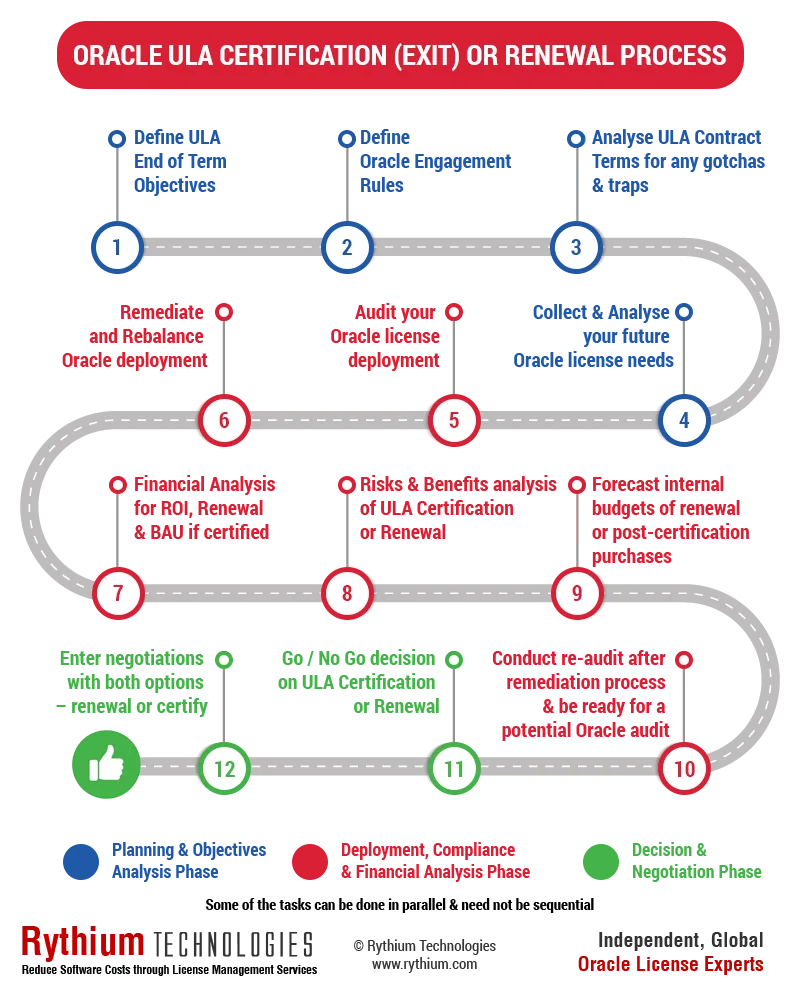
We run every ULA end of term through the same 12 steps, whether the result is a renewal or a certification. The steps fall into three phases: planning and objectives analysis; deployment, compliance and financial analysis; and decision and negotiation. Some steps can run in parallel, so you have clarity before the next one begins.
The first four steps carry the most weight, because they set up everything Oracle sees later. You decide what you want from the end of the term, settle who speaks to Oracle and what you hold back, read the contract for pitfalls and hidden costs before you act on deployments or start talks, and write down what you will need from Oracle next.
The diagram below shows all 12 steps in order, and our article on ULA certification value realization explains why the phases matter.
Define your end of term objectives
Decide what you want from the end of the ULA term, then plan to get it. The objectives to look at are:
- Compliance
- Certification or renewal
- Cost reduction
- Simpler license management
Define the rules of engagement with Oracle
Many customers underrate this, but it may be the most important decision in the process. Settle these points:
- Who is the internal sponsor for the ULA end of term?
- Who speaks to Oracle, and who does not?
- What information can you share, and what do you hold back during negotiation?
- When should you speak to Oracle, and who is your point of contact there?
Analyze the ULA contract
Review the terms and conditions for pitfalls and hidden costs. Do this before you act on deployments or start talks with Oracle. The key terms for certification or renewal are:
- Product list and certification process
- Environments included or excluded
- Legal entity, merger, acquisition and divestiture definitions
- Virtualization and cloud terms
- License metrics, product dependencies and license restrictions
- Support costs
Document your future Oracle requirements
Assess what you will need from Oracle and write it down. Well-documented license needs are your core asset when you negotiate. They also support new terms, such as adding or removing products, changing metrics or changing your support level.
How do you negotiate an Oracle ULA renewal?
Negotiate an Oracle ULA renewal from your own count, with certification ready as the alternative. The ULA gives you the right to certify and does not require a renewal, so a customer with a clean count can decline Oracle’s price.
An Oracle ULA negotiation starts 12 to 18 months before the end date. Work through it in this order:
- Fix any use outside the ULA terms. That gap is what makes a renewal look safer than certifying.
- Decide who speaks to Oracle. Settle what that person may share and what is held back.
- Write down what you will need. Look three to five years ahead, and ask for a price that rests on it.
- Compare the whole offer. Look at the license fee, support at 22% of the net fee, and the support you already pay.
A discount on one part can come with a higher charge on another, or a longer term. Our guide to the Oracle ULA price covers the pricing models.
How we manage a ULA through to renewal or certification
You can start at any time in the ULA term. We recommend a one-year program, which gives time to find opportunities and threats, optimize usage and get the most from the ULA before you decide. The work runs in this order:
- Deployment review: a baseline license review of the global deployment of the ULA products in your network.
- Contract analysis: standard and non-standard terms, your usage rights and license definitions, the risks in any non-standard language, and your entitlement for each Oracle license.
- Your effective ULA position: a global deployment report, a server-wise license analysis, and the financial exposure in license and support fees, including any non-compliance.
- Remediation: architectural changes and feature remediation for anything outside the contract.
- Getting the most from the term: deployments optimized within the ULA’s terms, for the time left, your current architecture and your projected license needs.
- The decision: a recommendation to renew or certify, and if you certify, the certification documents and a deployment check.
“Rythium worked with us to get our database, middleware and applications ULAs certified. They worked with us on the management and certification for a year. Their understanding of Oracle negotiation procedures and license optimization techniques saved us at least $3m in upfront ULA renewal fees.” Vendor relationship head, large manufacturing company
For leaving a ULA, see our Oracle ULA exit service. Our Managing Partner, Sheshagiri Anegondi, who worked at Oracle from November 1997 to May 2014 and wrote the book Licensing Oracle, leads this work.
Questions about Oracle ULA renewal
Do we have to renew our Oracle ULA?
No. The ULA gives you the right to certify what you deployed and keep it as perpetual licenses. You must tell Oracle whether you intend to renew or certify.
What happens at the end of an Oracle ULA?
You either renew the ULA for a new term or certify it. Certifying means declaring what you deployed during the term, which then becomes your perpetual license count.
Can an Oracle ULA be renewed with different products?
Yes. A renewal can cover fewer, the same or more products than the original ULA, for a different number of legal entities and a different term.
Is renewing an Oracle ULA cheaper than certifying?
It depends on how your use will change. If you expect it to grow a lot, a renewal can be the better choice. If it will stay stable, certification usually costs less. Read the renewal offer closely: a discount can come with a longer term.
How does Java affect an Oracle ULA renewal?
Check the ordering document first. If Java SE is an ordered program, it is part of the renewal or certification decision like any other product. If it is not, it sits outside the ULA and the Java SE Universal Subscription applies. Our Oracle ULA certification guide covers Java in detail.
Sheshagiri Anegondi
Managing Partner of Rythium Technologies. Nearly seventeen years at Oracle, from November 1997 to May 2014, in leadership roles including Vice President Sales, after Compaq and Digital Equipment Corporation.
Author of “Licensing Oracle: The Reference Manual for Managing Oracle License Compliance & Procuring Oracle Software, Hardware, Cloud & Services” (2021, ISBN 10: 1639046887).
See more of our analysis in Google: add Rythium as a preferred source