
Have you received a notice for an Oracle license audit, or run Oracle scripts? Our Oracle audit support runs from the first letter to the final settlement, and our audit experts can help you save 30% to 100% of your potentially claimed exposure. An Oracle license review is a confidential count of the Oracle software you run, set against what your contracts allow, so you know your compliance position before Oracle does.
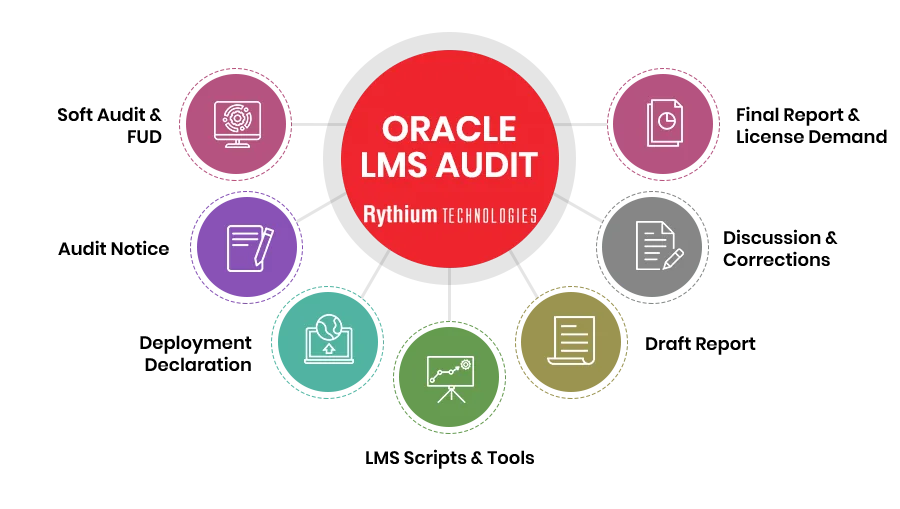
Oracle License Management Services is the established authority on Oracle licensing policy. Their job is to validate the compliance position of your Oracle deployments, identify license violations and correct them by purchase of licenses where necessary.
A formal notice for an audit or a correspondence discussing the measurement of your deployment.
A declaration of usage by the customer through the update of an MS Excel spreadsheet.
Deploy tools to gather installation and usage data.
Analysis of the gathered usage data.
Inform you regarding the deployment & usage of audited products in your network.
In case of non-compliance, collaborate with the sales team internally within Oracle to submit a commercial proposal that will correct the license gap through a negotiated purchase.
For the longer version, read our guide to the Oracle license audit process.
Contact us at any stage of the engagement with Oracle.
Oracle audits can be formal, informal, or even casual. But they are not random. Below are some descriptions of Oracle license audits and their stages.
A seemingly friendly askAn Oracle salesperson asks about your architecture or deployment, or offers to advise you on your Oracle footprint. Most customers look up to Oracle salespersons as go-to sources for Oracle technical information, forgetting that his/her only job is to get revenue from their set of accounts. The sales reps are compensated for delivering against stiff sales targets. This financial incentive makes the conversation of an Oracle sales rep highly suspect.
An email or letter from Oracle's LMS teamYou might receive a note from Oracle's license management team stating that they would help you understand Oracle licensing. The acceptance of such an offer could lead to a detailed discussion that opens you to a more formal audit notice.
A formal notice for auditWhen a friendly discussion to purchase more licenses fails, it is customary for Oracle to send a formal notice for an audit. This has a contractual binding.
Oracle license audits are not random. The customers are targeted to get in more revenue. Some reasons for a potential license audit are:
We are firm believers in license compliance. But, equally, we are firm believers that a license audit should be investigated in detail, and not accepted without a complete understanding of your contractual rights and obligations.
We have also realized that Oracle, like many other publishers, makes a large number of mistakes when they report audit findings to customers.
Deployment assessmentWe conduct an audit of your deployed Oracle estate. The data gathering is comprehensive and gives information on the installation and usage of Oracle products and specific features. In case there is a report from Oracle, we compare our audit findings with those provided by Oracle for accuracy.
Contracts analysisWe study your contracts: the OMAs, OLSAs, ODs, email or letter correspondence to understand customer rights and obligations. Our experts will analyze the audit reports and contracts to understand the exact compliance gap, if any. Our experts understand the potential loopholes or mistakes in Oracle conducted audits.
Defense strategyWe will recommend the correct approach and strategy to counter Oracle's claims that may be incorrect. We will recommend the lowest possible bill of materials that you might need to purchase from Oracle to correct the non-compliance gaps.
Our expertise can help you save 30% to 100% of your potentially claimed exposure.
Engage us during an impending or ongoing Oracle license review or audit. With us, you control the audit, and Oracle’s license auditors do not dictate the terms. We help you:
PlanDevelop a response plan.
ReplyDraft each response to Oracle.
Read the contractsUnderstand the contractual terms of your agreements.
CountRun a quick baseline audit to understand the compliance gap.
Push backChallenge any incorrect requests or conclusions from Oracle’s teams.
NegotiatePrepare for and support the final negotiations.
Look aheadWork out the right Oracle strategy for the future.
The presence of Sheshagiri from Rythium changes everything. We were staring at an exposure of $23m of ‘alleged’ license non-compliance. Rythium’s Oracle license audit defense showed us that we didn’t have to pay a penny, despite our having a very good internal SAM team.
If you use Oracle software, the chances are that you are non-compliant somewhere. A review tells you where, in private, and what to do about it.
A baseline compliance checkA confidential inventory of the Oracle products deployed in your network, set against your contracts to give you a baseline license position. Our discovery tool finds Oracle technology and applications products across the estate.
License optimizationAdvice on how to optimize the licenses you already have and stay compliant.
| Finding | Why it happens |
|---|---|
| Options and packs in use without a license | Often the Diagnostics and Tuning Packs, which are enabled by default in Enterprise Edition. |
| VMware clusters counted in full | Oracle’s partitioning policy counts the cluster, even where Oracle runs on a few hosts. |
| Standby and test servers | With the database installed and running, they need licenses like production. |
| Cloud instances counted the on-premises way | AWS, Azure and Google Cloud need twice the licenses for the same cores. |
| Oracle Java installations | Java is now priced per employee, for the whole organization. |
| Licenses you own and do not use | Still paying 22% of their net price in support every year. |
Rythium has the best tools for Oracle license deployment discovery. We got the most detailed information on Oracle database options, all editions of WebLogic, multiple middleware and integration products, as well as our vast EBS deployment, within a couple of weeks. I have never seen this capability in any of the license consultants we have worked with before.
Our baseline Oracle license review runs the first count as a mock Oracle audit. To count yourself first, follow our guide to running an Oracle license self-audit.
A year before a ULA endsSo you can decide between certifying and renewing on your own numbers.
Before a major renewal or purchaseSo you negotiate from your position rather than Oracle’s.
Before a hardware, virtualization or cloud changeMore cores per socket, a new VMware cluster or a move to AWS can change the count overnight.
After a merger or acquisitionWhen two estates and two sets of contracts meet.
As soon as Oracle asks for deployment dataWhatever the request is called, that is the start of an audit.
The baseline review follows the same procedures as a real Oracle audit, so you get the same reports and compliance analysis, but first. You see where you use more than you own and where you own more than you use. Then you can fix and rebalance the deployment to remove risk and cut cost, and take a true baseline into your next renewal.
Before a renewalNegotiate from your own numbers.
Before a ULA certificationKnow what you will declare before Oracle checks it.
Before an expected auditFix what you can while the findings are still private.
A mock audit is only useful if it looks where Oracle’s scripts and collection tools look. These are the places our published guides show they go first.
Feature usageEvery Oracle database keeps a record of each feature used, in a view called DBA_FEATURE_USAGE_STATISTICS, and it is the first thing Oracle’s audit scripts read.
Recovery serversRecovery servers are the gap Oracle’s audit scripts find most reliably, so count them in every self-audit.
WebLogic domainsOracle’s collection tools read the WebLogic domain configuration, which records any Enterprise Edition feature a domain has used.
VMware clustersOracle’s partitioning policy asks for every core of every host an Oracle virtual machine could move to.
The other common gaps, and the rules behind them: our Oracle license compliance guide.
We provide one-time assessments, and annual or twice-yearly assessment services.
Holding an Oracle ULA? Read the 12 steps to ULA certification or renewal.
Oracle offers its own license reviews, often presented as help. They are run by Global Licensing and Advisory Services (GLAS), the same team that runs audits, and their findings go to Oracle’s sales team. An independent review keeps the findings yours: you decide what to fix, what to remove and what, if anything, to buy, before anyone at Oracle sees the data.
| Oracle GLAS review | Independent review | |
|---|---|---|
| Run by | The team that runs Oracle’s audits | People who spent years on Oracle’s side of the table, now on yours |
| Findings go to | Oracle’s sales team | You alone |
ExpertiseOur Managing Partner spent 17 years at Oracle, and we have advised on more than 260 engagements.
IndependenceWe take no fees, commissions or partnerships from Oracle or any other vendor.
ConfidentialityWe do not publish the names of our license audit customers.
Every industryOur clients come from every industry. What they share is Oracle software.
While Oracle has a very large number of products, their license management teams focus on a few product sets.
We provide a detailed discovery for Java and give customers a deployment dashboard of Java versions and JDKs from multiple publishers. This helps our customers decide on Java optimization and future decisions. Java Defense & Cost Reduction
A review often surfaces a bigger decision. These are the ones we support most.
Rythium worked with us to get our database, middleware and applications ULAs certified. They worked with us on the management and certification for a year. Their understanding of Oracle negotiation procedures and license optimization techniques saved us at least $3m in upfront ULA renewal fees.
The first 7 days and the next 30 days set the tone for the entire audit, so get them right.
Usually no. Your Oracle Master Agreement gives Oracle audit rights.
But you can heavily control how the audit unfolds: timing, scope, data format, who participates, what gets shared.
Most audit cost comes from giving Oracle more than the contract requires. We narrow the scope to what is contractually mandated and nothing more.
Common triggers include
Audits are rarely random. They are commercial events tied to compliance review.
All three feed the same outcome, which is pressure to buy. We respond carefully to each.
Only after we have reviewed what they collect, validated the output against your contracts, and prepared a response strategy. The scripts gather more data than most customers realize: feature usage, option triggers, multiplexing signals. Running them without preparation exposes you to findings that may not actually reflect contractual non-compliance.
In our experience, initial Oracle audit claims are inflated by 30% to 90%. In quite a few cases we have been able to reduce by 100%, i.e. not needing to pay Oracle any additional license fees.
The reductions come from challenging Oracle’s interpretation of your contract, disputing virtualization scope, correcting option-usage data, and pushing back on non-contractual policy documents. We negotiate the final outcome, not the initial claim.
Typical Oracle audits run 4 to 9 months from formal notice to commercial settlement. Some stretch to 12-18 months. The length is usually a function of how aggressively Oracle pushes and how prepared the customer is.
Yes. We routinely handle direct communication with Oracle LMS and Oracle’s audit team on behalf of our clients. Your name remains on the contract, but the day-to-day correspondence (data exchanges, meetings, follow-ups, negotiations) runs through our team. This removes pressure from your internal team and improves consistency.
Often yes. But this can be a very expensive proposition if done without having the best advice.
Oracle frequently prefers a forward-looking commercial outcome (OCI credits, new licenses, SaaS subscriptions) over a backward-looking penalty. Whether this is good for the customer depends entirely on whether the new spend reflects real future usage.
We model the alternatives before agreeing to any settlement structure.
Yes. Java audits follow a different playbook from Database audits: employee counts, deployment scope, contractor definitions, OpenJDK vs Oracle JDK identification. We have run dozens of Java audits and reviews, and clients have ranged from paying nothing to paying significantly less than Oracle’s opening number, with clean future positions.
Audit defence fees are a small fraction of the savings.
Across our engagements, the ROI ratio is typically 10x to 150x, meaning a client who pays us for audit defense saves 10 to 150 times that amount versus Oracle’s opening claim.
We size the opportunity before you commit so the business case is transparent.
We don’t disappear. We document the final position, update your effective license position, and flag the contractual changes Oracle introduced during settlement. We then recommend the controls (monitoring, governance, contract clauses) that prevent the same exposure from rebuilding silently in future.
A confidential count of the Oracle software you run, set against what your contracts allow. It gives you a baseline license position and advice on optimizing the licenses you have, before Oracle sees any of it.
A year before a ULA ends, before a major renewal or purchase, before a hardware, virtualization or cloud change, after a merger or acquisition, and as soon as Oracle asks for deployment data.
Options and packs in use without a license, often the Diagnostics and Tuning Packs; VMware clusters counted in full; standby and test servers that need licenses like production; cloud instances counted the on-premises way; Oracle Java installations; and licenses you pay support on but do not use.
It is run by Global Licensing and Advisory Services, the same team that runs Oracle’s audits, and its findings go to Oracle’s sales team. An independent review keeps the findings yours.
Treat it as the start of an audit, whatever the request is called. Bring in an adviser before you reply: we develop the response plan with you and draft each response to Oracle.
No. We do not publish the names of our license audit customers.
Oracle’s licensing team works for Oracle, and its findings go to Oracle’s sales team. An independent Oracle license expert works only for you. We take no fees, commissions or partnerships from Oracle or any other vendor, and our Managing Partner spent 17 years at Oracle.
Runs the audit with you: agrees the scope in writing, measures your deployments before Oracle’s scripts, checks every finding against your contracts, drafts each reply to Oracle and supports the final negotiation.
No. Rythium is independent and does not resell licenses or support, or earn income from Oracle or any support provider.
A mock Oracle license audit that we run for you. It uses the same kind of discovery and analysis as Oracle’s auditors and gives the same result, an effective license position, while the findings are still yours to act on.
The Oracle software you have installed and use, set against what your contracts entitle you to. It shows where you use more than you own and where you own more than you use, with the financial exposure in license and support fees.
It follows the same procedures and produces the same reports and compliance analysis, but you see them first, and you decide what to fix, remove or rebalance before Oracle sees anything.
Before a renewal, before a ULA certification, or when you expect an audit.
The database’s record of every feature used, in the view DBA_FEATURE_USAGE_STATISTICS. Recovery servers are the gap the scripts find most reliably.
Agentless network scans for the servers and architecture, scripts and agentless scans for VMware, scripts that find Oracle on each machine, and scripts that record each Oracle product installed with every feature enabled and used.
A global deployment report, evidence of feature usage, your effective license position, and a remediation and cost reduction strategy.
Yes. We provide one-time assessments and annual or twice-yearly assessment services.
Tell us what prompted the question. Everything you share stays confidential, and nothing goes to Oracle.
Cookies on rythium.com
We use essential cookies to make this site work, and additional cookies to measure visits and our ads. You can reject the additional ones or choose which to keep. Privacy Policy