
The short answer: You can reduce Oracle license costs, but not by accepting the first quote or by haggling without a benchmark. The savings come from three places: knowing what you are really using, knowing the prices others in your market pay, and acting on contracts and support before Oracle does. In our work we have saved customers 30% to 100% of their potential exposure in audit or ULA situations, and 20% to 60% on annual support.
Most clients tell us one of two things. Either “we have no choice, so we pay the price Oracle demands”, or “we negotiated well and got Oracle to cut its first quote”. Both can be true, and neither has to be.
- “We have no choice.” Reducing Oracle costs is a challenge, not an impossibility. There are ways to build bargaining power.
- “We negotiated well.” Without benchmark prices for your market and nearby regions, a good price is a shot in the dark. Oracle sales staff will cut the first quote. They will not give you the lowest price.
What makes Oracle costs hard to reduce
- Oracle’s contracts
- Oracle’s software installation methods
- Oracle’s intricate license policies
- Oracle’s software stickiness
- Oracle’s sales aggression
- Oracle’s knowledge of the customer
Oracle has built a playbook around these issues to win large license and support fees. See Oracle licensing costs for how fees are built up.
How we reduce Oracle license costs
We have helped clients reduce Oracle costs for most of the last decade. The process is complex and needs a full engagement that covers:
- Analyzing existing software contracts and auditing the deployments
- Current and future licensing needs, and business transformation projects
- Licensing Oracle in the cloud, if a migration is planned
- Potential mergers and acquisitions
For the five pressures behind Oracle costs this year, read our guide to Oracle license optimization; for a wider view across vendors, read 5 ways to reduce enterprise software licensing costs.
When customers come to us
- Oracle salespeople demand large license fees and threaten an audit.
- Oracle has sent a formal audit notice, or has finished running LMS scripts.
- Your Oracle ULA term is ending and you want to certify or renew.
- Oracle wants you to pay for Java.
- You plan a cloud migration and want to know how to use Oracle licenses.
- You pay very high support fees to Oracle.
How much can you save?
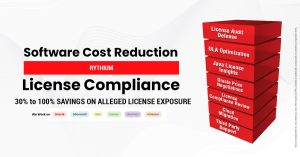
We have saved customers between 30% and 100% of potential license exposure during audit or ULA situations. On support, we have helped clients cut annual spend by 20% to 60%. Read a case study in CIOTechOutlook or see more on our case studies page.

Sheshagiri Anegondi
Managing Partner of Rythium Technologies. Seventeen years at Oracle, from 1998 to 2015, in leadership roles including Vice President Sales, after Compaq and Digital Equipment Corporation.
Author of “Licensing Oracle: The Reference Manual for Managing Oracle License Compliance & Procuring Oracle Software, Hardware, Cloud & Services” (Notion Press, 2021) (ISBN 10: 1639046887).
See more of our analysis in Google: add Rythium as a preferred source