
Java License Changes are forcing customers to relook at their Java strategy and costs
Impact of Java License Changes
From January 2019, Oracle changed the licensing policy around Java. And, again in January 2023, Oracle change the licensing metric for Java. From a predominantly ‘free’ Java for most use cases, Oracle Java has been migrated to a largely commercial licensing model. This has given rise to potential license non-compliance risks and brought in a new revenue stream for Oracle.
Java’s licensing maze increases costs exponentially
For enterprises worldwide, navigating the ever-shifting landscape of Java licensing has become a growing headache. The pressure on customers to pay huge license fees for Java is immense adding to the challenges of an already stretched IT budget. Oracle’s recent overhaul of the Java license metric has drastically inflated the cost of Java usage, with estimates suggesting a 10-fold to 14-fold increase.
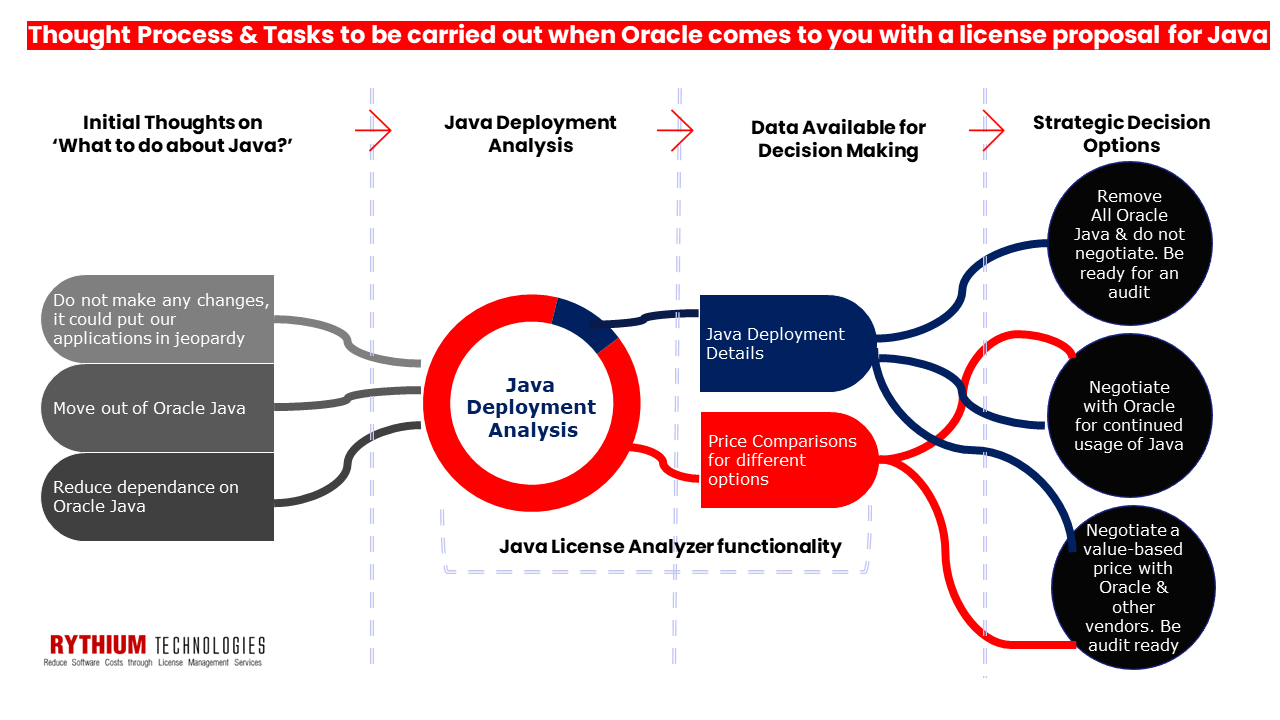
Our Java License Assessment Service & Analyzer is designed to provide customers a deep dive into current usage patterns to avoid compliance penalties.
This squeeze forces organizations to rethink their Java footprint, starting with a clear picture of their existing deployments.
Scope of Work in our Java License Assessment Service
The scope of our Java License Assessment Service includes:
- Java deployment discovery
- Data Normalization & Identifying to Oracle Java Agreements
- Contracts & Entitlement Analysis (Oracle and third party)
- Normalization with third party entitlements
- Normalization with other Oracle entitlements
- Reporting
- Negotiations and Hand Holding
Java Deployment Discovery & Raw Data Reporting
- Raw data discovery
- Support troubleshooting for the discovery
- Report Raw Deployment – with the Hostname, Path, Publisher, Version, Product information as scanned
Data Normalization & Contracts Analysis
- Process Raw Data – incl virtual env mappings
- Classify deployments into Oracle, Non-Oracle, OpenJDK and various Oracle Java agreements
- Normalization with Oracle and third-party entitlements
- Provide processed Deployment Report with Product information as scanned and thereafter Classification of Deployment
Reporting
- Determine license requirements on as is basis post completion of discovery
- Remediation and Rebalancing Recommendations
- Oracle deal structuring advisory
Negotiations & Hand-Holding
- Reviewing and drafting communication from/to Oracle
- Strategic and tactical plays for negotiations
- Reviews of commercial offers and agreement terms
- Participation in negotiations.
What is the current status in Oracle Java license audits?
We have started seeing formal audits of end-user companies for their usage of Java since June 2022, there have also been been an increase in
- Discussions on wrong usage of Java and persuasion to purchase licenses
- Formal discussions for purchase of Java subscriptions
- Audits of third-party ISVs for their sales & sub-license of Java
We expect Java license audits to move into prime-time in 2024 and 2025.
What is expected in the future?
Oracle has always created new revenue streams from older products and licensing models. The same could hold true for Java. Oracle will try to make Java one of their largest revenue generators in FY 2023-24 and beyond.
What should you do today?
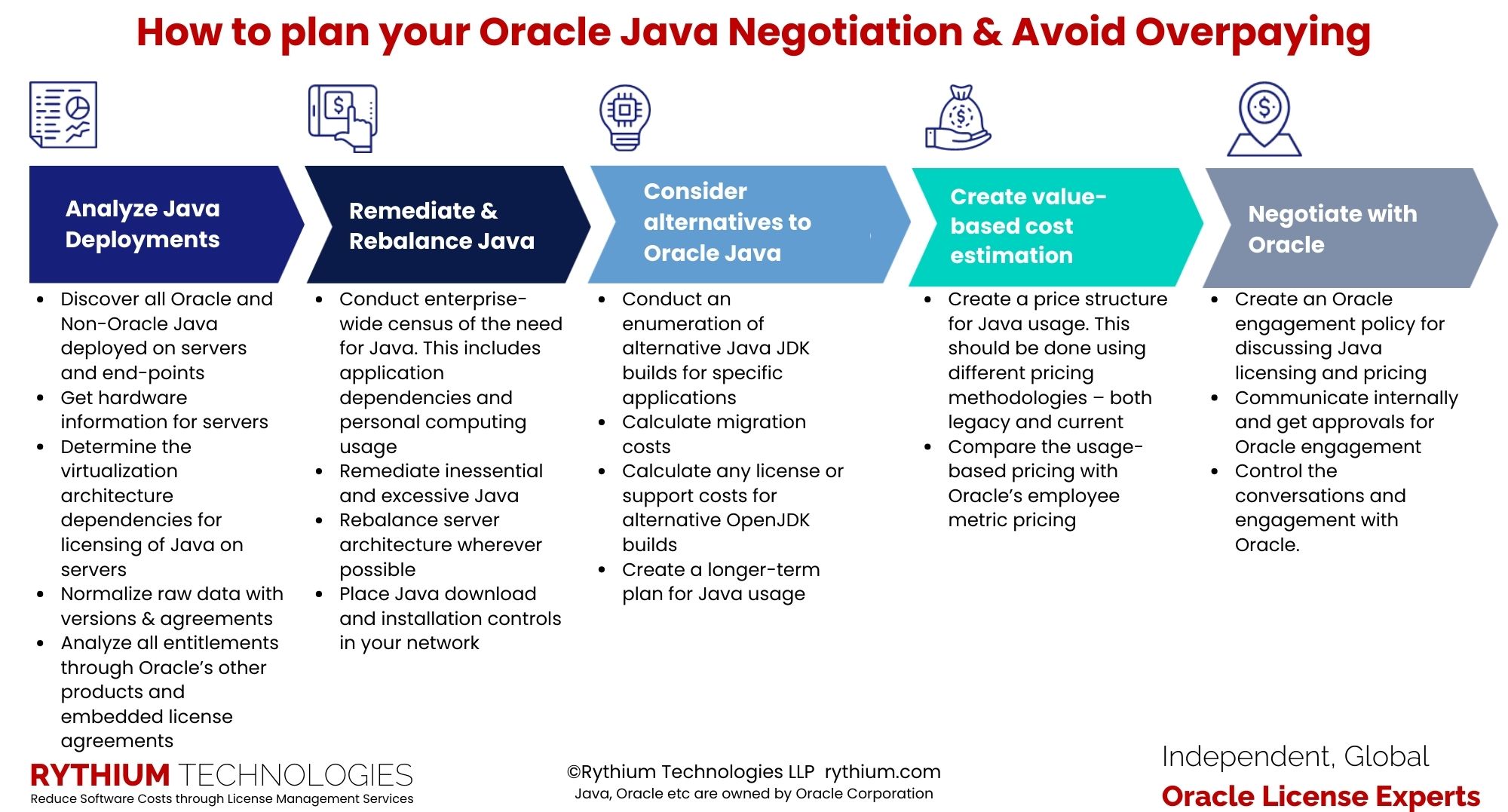
Get visibility. Understanding your deployment, license rights, and alternatives.
Conduct an internal Java License review and work through the compliance issues. The review will help you explore the need to
- Procure Oracle Java licenses
- Migrate to alternative Java platforms
- Work with your third-party development teams for obtaining coverage for Java usage.
How can we help?
We have developed discovery and license normalization techniques to provide you with an enterprise-wide Java (from Oracle, Open source, IBM, RedHat, etc) deployment inventory as well as a Java ELP. Using our services, you will be able understand your exposure, if any, to Java license fees.
We will assess the deployments, estimate potential savings, analyse risks & license non-compliance exposures and recommend optimizations.
Frequently Asked Questions
Oracle changed Java licensing twice, in 2019 and again in January 2023. The 2023 change moved Java SE to a per-employee subscription. For most enterprises, this has multiplied Java costs 10 to 14 times overnight, even when actual Java usage hasn’t changed. It has turned Java from a near-free utility into one of the largest Oracle line items.
You pay a per-employee per-month fee multiplied by your total employee count, not your Java user count. Oracle’s definition of “employee” is broad: it includes full-time, part-time, temporary employees and most contractors. So a 10,000-person company with Java on a single server is licensed for 10,000 people, not for one.
Under the per-employee subscription, yes. That is exactly Oracle’s position. The licensable count is your total organizational headcount, not your Java-user count. This is why the per-employee metric is so financially severe. The remedy is not arguing the count down. It is reducing or eliminating commercial Oracle Java in your environment.
Java deployment discovery across servers and endpoints, classification into Oracle commercial, Oracle non-commercial, OpenJDK and third-party distributions, normalization against your existing Oracle and third-party entitlements, license requirement determination, remediation and rebalancing recommendations, and direct support during any negotiation or audit with Oracle.
Start to finish, not just a report.
For most applications, yes. Eclipse Temurin, Amazon Corretto, Azul Zulu and Liberica are production-grade OpenJDK distributions used by major enterprises globally. Compatibility issues do exist with very old or vendor-locked applications, which is why discovery and classification come before migration.
Oracle may use download records from oracle.com, support interactions, and commercial outreach to identify likely usage. Increasingly, Oracle also sends formal letters and email “Java reviews” asking companies to confirm usage. Once you are on Oracle’s radar, the conversation is hard to defer indefinitely.
Carefully. Do not confirm headcounts, deployment scope or compliance status without first running an internal baseline. Acknowledge the letter, request clarification on what Oracle is asking, and engage independent advisory before any data goes back. We have helped many clients respond in ways that ended the conversation without payment.
Some older Oracle Java versions remain free under specific terms. But the rules are narrow, time-limited and easy to violate. Staying on the old version is rarely a durable compliance strategy. We help clients determine which versions are genuinely free under their actual usage.
• Majority of our clients pay nothing to Oracle after the review, because they were fully licensed, or commercial usage was negligible.
• Others reduce Oracle’s asking price by 60% to 90% through a combination of remediation, OpenJDK migration and negotiation. The starting point is always a baseline of actual deployments and contracts.
Almost never. Java is licensed separately from Database, Middleware and Application ULAs. Customers often assume a ULA gives them blanket Java coverage; Oracle’s contracts almost never agree.
Related Pages