
Independent Oracle license management advisory firm.
- Have you received a notice for an Oracle License Audit?
- Has an Oracle salesperson hinted at you being non-compliant on license deployment?
- Have you run Oracle scripts?
- Are you currently in the final stage of a license settlement with Oracle?
- Do you believe that there could be a discrepancy in Oracle’s findings and need help from an expert?
Our expertise can help you save 30% – 100% of your potentially claimed exposure.
Oracle’s LMS Audit Process
Have you received a notice for an Oracle License Audit? Has an Oracle salesperson hinted at you being non-compliant on license deployment? Have you run Oracle scripts? Are you currently in the final stage of a license settlement with Oracle? Do you believe that there could be a discrepancy in Oracle’s finding and need help from an expert? Contact us at any stage of the engagement with Oracle.
Run-up to an Oracle License Audit
Oracle audits can be formal, informal, or even casual. But they are not random. Below are some descriptions of Oracle license audits & their stages.
- A seemingly friendly ask by Oracle salesperson on your architecture or deployment or to advise you on your Oracle footprint.
Most customers look up to Oracle salespersons as go-to sources for Oracle technical information forgetting that his/her only job is to get revenue from their set of accounts. The sales reps are compensated for delivering against stiff sales targets. This financial incentive makes the conversation of an Oracle sales rep highly suspect. - An email or letter from Oracle’s LMS team to educate you on Oracle licensing.
You might receive a note from Oracle’s license management team stating that they would help you understand Oracle licensing. The acceptance of such an offer could lead to a detailed discussion that opens you to a more formal audit notice. - A formal notice for audit.
When a friendly discussion to purchase more licenses fail, it is customary for Oracle to send a formal notice for an audit. This has a contractual binding.
Key Features of an Oracle LMS Engagement
Oracle License Management Services is the established authority on Oracle licensing policy. Their job is to validate the compliance position of your Oracle deployments, identify license violations and correct them by purchase of licenses where necessary.
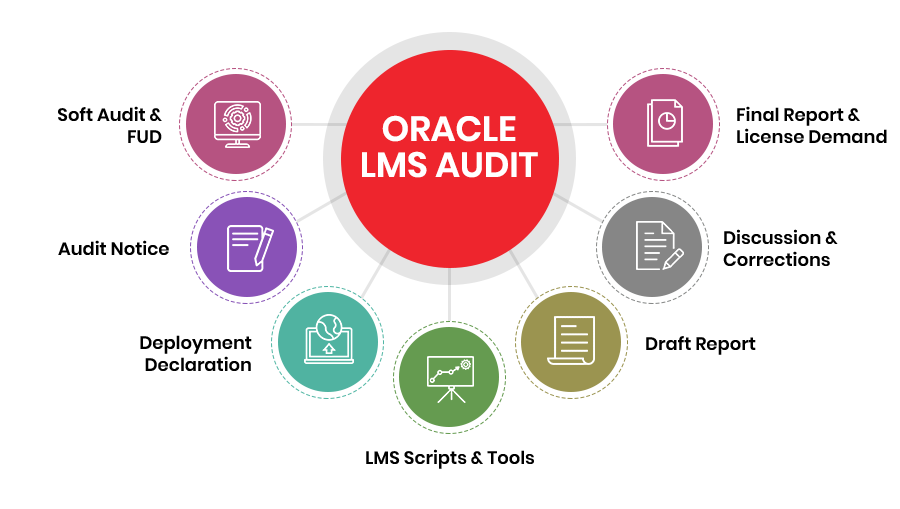
A formal Oracle LMS Audit goes through the following stages:
- A formal notice for an audit or a correspondence discussing the measurement of your deployment.
- A declaration of usage by the customer through the update of an MS Excel spreadsheet.
- Deploy tools to gather installation and usage data.
- Analysis of the gathered usage data.
- Inform you regarding the deployment & usage of audited products in your network.
- In case of non-compliance, collaborate with the sales team internally within Oracle to submit a commercial proposal that will correct the license gap through a negotiated purchase.
Which customers does Oracle audit?
As discussed earlier, Oracle license audits are not random. The customers are targeted to get in more revenue. Some reasons for a potential license audit are:
- The customer has not spent any money on fresh Oracle licenses for 2 – 3 years.
- There was a change in sales territory allocation within Oracle and the customer is assigned to a new sales rep.
- The customer is growing and the IT team is investing in non-Oracle technologies & applications.
- The customer has been audited by another publisher.
- There has been a merger or acquisition in the recent past.
- The customer is using E-Business Suite.
- The customer has purchased new hardware in the datacenter.
- The customer is using VMware, Nutanix, or other virtualization technologies or appliances.
- The customer decides to certify, rather than renew, a ULA.
- The customer has put in a question in a support request about a product that is not purchased.
How can we help you?
We are firm believers in license compliance.
But, equally, we are firm believers that a license audit should be investigated in detail.
And, not accepted without a complete understanding of your contractual rights & obligations.
We have also realized that Oracle, like many other publishers, makes a large number of mistakes when they report audit findings to customers.
We take the following approach to Oracle audit defense:
- Deployment Assessment
- We conduct an audit of your deployed Oracle estate. The data gathering is comprehensive and gives information on the installation and usage of Oracle products and specific features.
- In case there is a report from Oracle, we compare our audit findings with those provided by Oracle for accuracy
- Contracts Analysis
- We study your contracts – the OMAs, OLSAs, ODs, email or letter correspondence to understand customer rights and obligations.
- Our experts will analyze the audit reports & contracts to understand the exact compliance gap if any. Our experts understand the potential loopholes or mistakes in Oracle conducted audits.
- Defense Strategy
- We will recommend the correct approach and strategy to counter Oracle’s claims that may be incorrect.
- We will recommend the lowest possible bill of materials that you might need to purchase from Oracle to correct the non-compliance gaps.
Top Oracle Audit product sets
While Oracle has a very large number of products, their license management teams focus on a few product sets.
Tech – Database
- Oracle Database
- Database Options & Management Packs
Tech – Middleware
- WebLogic Server/Suite
- BPEL, SOA, IDM
- Forms & Reports, iAS, iDS
Application Products:
- E-Business Suite
- Siebel CRM
Other Products:
- Java
- Industry-Specific products – Healthcare, Communications, Hospitality
Note on Java: Whilst we have not seen too many end-user audits on Java to date, we have seen sales reps spread fear on this product and use it as a leverage to sell other products. (May 2020).
We, at Rythium, provide a detailed discovery for Java and provide customers with a deployment dashboard of Java versions and JDKs from multiple publishers. This helps our customers decide on Java optimization & future decisions.
You might want to read more about our CEO Sheshagiri Anegondi (Sheshu). He is amongst the foremost Oracle License Experts globally.
Frequently Asked Questions
• Do not reply immediately.
• Do not run Oracle’s scripts.
• Do not share any data immediately.
• Acknowledge receipt formally and request a clarification meeting.
• In parallel, engage an independent advisor to baseline your position before any data leaves your environment.
The first 7days and the next 30 days set the tone for the entire audit, so get them right.
Usually no. Your Oracle Master Agreement gives Oracle audit rights.
But you can heavily control how the audit unfolds: timing, scope, data format, who participates, what gets shared.
Most audit cost comes from giving Oracle more than the contract requires. We narrow the scope to what is contractually mandated and nothing more.
Common triggers include
• a ULA approaching expiry,
• a sales target Oracle isn’t hitting,
• a change in your hardware or virtualization,
• an M&A event, declining renewals, or simply
• being on the audit rotation for your industry.
Audits are rarely random. They are commercial events tied to compliance review.
• A soft audit is a friendly email from a salesperson asking about your environment.
• A license review is an LMS-led measurement exercise, often without a formal audit letter.
• A formal audit is a written notice citing the audit clause in your contract.
All three feed the same outcome, which is pressure to buy. We respond carefully to each.
Only after we have reviewed what they collect, validated the output against your contracts, and prepared a response strategy. The scripts gather more data than most customers realize: feature usage, option triggers, multiplexing signals. Running them without preparation exposes you to findings that may not actually reflect contractual non-compliance.
In our experience, initial Oracle audit claims are inflated by 30% to 90%. In quite a few cases we have been able to reduce by 100%, i.e.. not needing to pay Oracle any additional license fees.
The reductions come from challenging Oracle’s interpretation of your contract, disputing virtualization scope, correcting option-usage data, and pushing back on non-contractual policy documents. We negotiate the final outcome, not the initial claim.
Typical Oracle audits run 4 to 9 months from formal notice to commercial settlement. Some stretch to 12-18 months. The length is usually a function of how aggressively Oracle pushes and how prepared the customer is.
Yes. We routinely handle direct communication with Oracle LMS and Oracle’s audit team on behalf of our clients. Your name remains on the contract, but the day-to-day correspondence (data exchanges, meetings, follow-ups, negotiations) runs through our team. This removes pressure from your internal team and improves consistency.
Often yes. But this can be a very expensive proposition if done without having the best advice.
Oracle frequently prefers a forward-looking commercial outcome (OCI credits, new licenses, SaaS subscriptions) over a backward-looking penalty. Whether this is good for the customer depends entirely on whether the new spend reflects real future usage.
We model the alternatives before agreeing to any settlement structure.
Yes. Java audits follow a different playbook from Database audits: employee counts, deployment scope, contractor definitions, OpenJDK vs Oracle JDK identification. We have run dozens of Java audits and reviews, and clients have ranged from paying nothing to paying significantly less than Oracle’s opening number, with clean future positions.
Audit defence fees are a small fraction of the savings.
Across our engagements, the ROI ratio is typically 10x to 150x, meaning a client who pays us for audit defense saves 10 to 150 times that amount versus Oracle’s opening claim.
We size the opportunity before you commit so the business case is transparent.
We don’t disappear. We document the final position, update your effective license position, and flag the contractual changes Oracle introduced during settlement. We then recommend the controls (monitoring, governance, contract clauses) that prevent the same exposure from rebuilding silently in future.
Related Pages